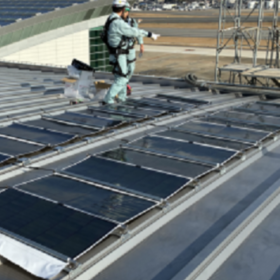
Japanese airport terminal hosting chalcopyrite solar modules
In two separate projects Japan-based Kyuden Mirai Energy and Nissan Motor are demonstrating the use of flexible, glass-free chalcopyrite PV panels provided by PXP Corporation.
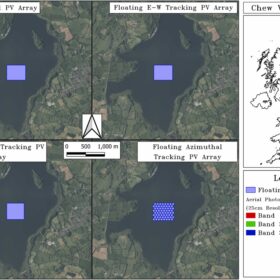
UK study finds azimuthal trackers boost floating PV performance
A University of Exeter team has tested single-axis tracking systems for floating solar across 12 UK sites, finding azimuthal tracking delivers the largest energy gains and lowest levelized cost of energy (LCOE).
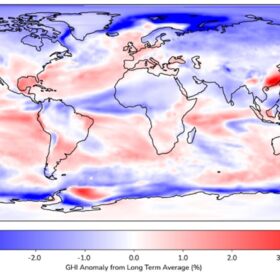
Early Solar forecast: First half 2026 solar outlook
In a new weekly update for pv magazine, Solcast, a DNV company, reports that early 2026 will bring mixed solar conditions globally, with strong prospects in eastern Australia and eastern China, but cloudier-than-normal outlooks for much of Europe, Asia, and parts of the US early in the year.
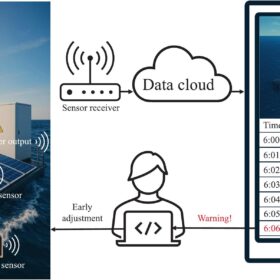
New digital twin for floating PV application uses artificial intelligence
Scientists have developed a floating PV digital twin system, trained on data from 155 physical experiments, using a two-tier artificial neural network (ANN) with a high-fidelity model and a reduced-order model. Predictive performance reached R2 values of 0.9996 for PV surface temperature and 0.9189 for power output.

Flexible front cover tested for glass-free CIGS devices
Researchers in Japan have developed an effective encapsulation with a PET front cover for copper indium gallium diselenide mini-modules. The lab devices withstood damp heat tests, retaining approximately 97 % of initial efficiency after 3,600 h.
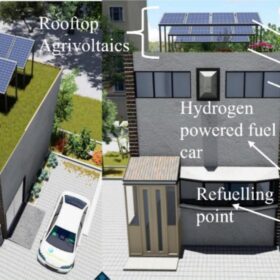
Growing agri-PV tomatoes while producing hydrogen for smart windows
Scientists have simulated a residential building based on a real double-story house in the United Kingdom, combining rooftop agrivoltaics with onsite hydrogen production. Electricity generated by the solar system is used to produce hydrogen, which is then supplied to a hydrogen vehicle and insulated gasochromic smart windows.
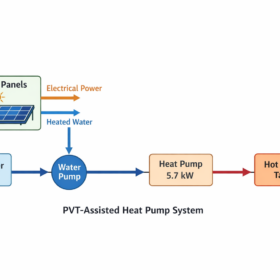
How to improve indirect-expansion PVT-assisted heat pump performance
Scientists in Thailand have simulated an indirect-expansion photovoltaic-thermal-assisted heat pump and measured its performance under various cold water temperatures and tank sizes.

Solar and storage program forecast to save all Massachusetts ratepayers $313 million per year
Solar plus storage can also offer winter reliability improvements and limit gas consumption, finds a report from Synapse Energy Economics and the Solar Energy Industries Association.
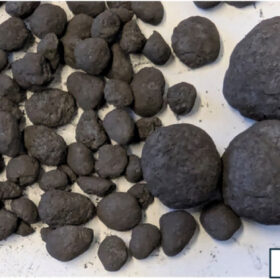
Research shows vacuum melting is key to efficient silicon kerf recycling
Researchers in Norway investigated the melting behavior of silicon kerf agglomerates under different atmospheres and temperatures to improve recycling for solar-grade silicon. They found that vacuum melting enhances deoxidation and produces a homogeneous, oxide-free melt, while agglomerate size has little effect on melting behavior.
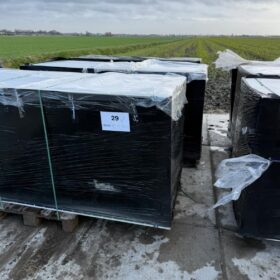
Solar glare forces panel removal at Amsterdam Airport
Glare from a nearby solar park forced temporary runway closures at Amsterdam Airport Schiphol, prompting Dutch authorities to order the removal of about 78,000 PV modules and apply anti-reflective film to others. The solar park operator, however, decided to replace all the panels. The largest portion of the removed, near-new modules have since been acquired by BM Energy and are expected to be redeployed in projects where glare is not a concern.
