
New German government coalition wants to deploy another 143.5 GW of solar this decade
The new plan would require the deployment of around 15 GW of new PV capacity each year to 2030. The agreement also includes the gradual phasing out of all coal power plants by the end of the decade.
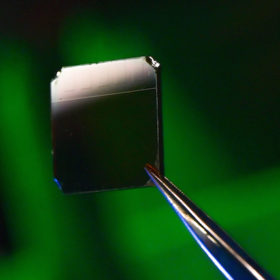
Ultra-thin 2D perovskite solar cell with 18.3% efficiency
The solar cell was built with a layer of organic cations between the iodide on top, and lead on the bottom enhanced interactions between the layers. Its creators designed the device after they discovered that, when the sunlight hits a 2D perovskite, it contracts the space between atomic layers in the material.
South Korea’s largest floating PV plant now online
The 41 MW facility was built by Korean developer Scotra with solar modules provided by South Korea-based manufacturer Hanwha Q-Cells. It was deployed on a water reservoir at the Hapcheon dam, in the South Gyeongsang province.
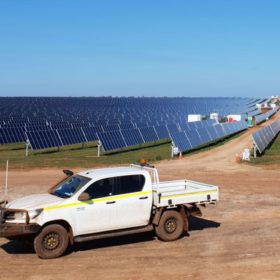
Renewables to drive down prices as fossil-fuel generators exit Australian electricity market
Ongoing growth in both renewable generation capacity, including rooftop solar, large-scale wind and solar, and dispatchable power in the form of big batteries is expected to drive down household power bills across the National Electricity Market in the coming years despite the impending closure of several of Australia’s ageing fossil-fuel fired power stations.
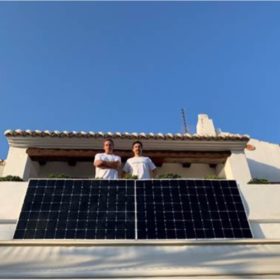
UPDATE: Spanish start-up offers flexible kit for balcony solar power generation
The kit consists of one or two modules, a microinverter, and a five-meter cable. Thanks to its plug-in technology, it can be connected to any electrical outlet and immediately begin generating electricity.

Developers building solar park along French highway
The five-hectare project is part of the Vinci Group’s plan to develop unused areas close to the motorways operated by its unit Vinci Autoroute.
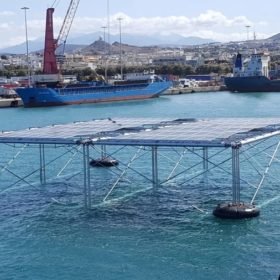
Pilot floating platform for offshore hybrid wind-solar-wave projects
Developed by German company Sinn Power, the floating platform currently hosts solar modules totaling 80 kW and may also embed small wind turbines and wave energy converters.
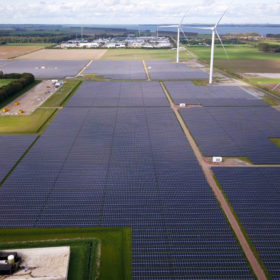
RWE sells Belectric to Czech utility CEZ
The German Federal Cartel Office is currently reviewing the transaction. RWE confirmed the plan.
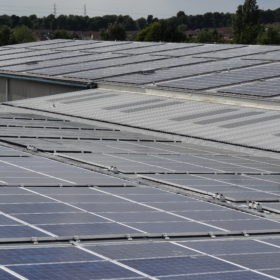
Swedish utilities are competing to buy distributed solar power
Swedish power utilities and electricity traders are increasing their efforts to buy surplus solar power from residential prosumers under fair competition conditions, according to analysts from local consultancy Becquerel Sweden. In a conversation with pv magazine, they analyzed the reasons for this new corporate mentality and observed a possible trend for the global solar market.
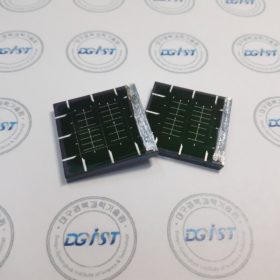
Korean research institute claims 12.2% efficiency world record for flexible CTZS solar cell
Korean manufacturer SolarFlex Ltd will now seek to bring the solar cell to commercial production.
