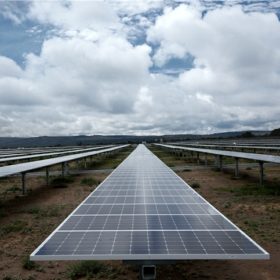
Big solar+storage project linked to hydrogen production in Spain
Spanish utility Iberdrola plans to link a 100 MW/20 MWh solar-plus-storage plant to hydrogen production in Puertollano, in southern Spain. The project will require an investment of up to €150 million euros and will be one of the largest installations of its kind in Europe.
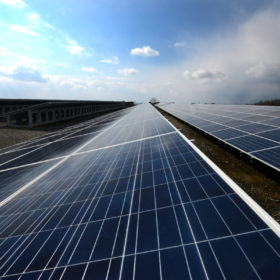
EnBW starts working on 187 MW unsubsidized PV plant in Germany
The utility will build the project this year on 164 hectares of land just outside of Berlin. It will be the largest solar park to be constructed outside of Germany’s incentive scheme for solar and renewables.

Solar growing faster than expected in Sweden
The Swedish Energy Agency this week said solar power supplies will increase from 400 GWh in 2018 to 1.7 TWh in 2022. Total energy supply in the country is expected to decline from 551 TWh to 526 TWh in the 2019-22 period, due to the shutdown of several nuclear power plants.

New fractal solar panels combine efficiency and aesthetics
Researchers from the United States have proposed a new electrode design for fractal solar panels that combines the typical aesthetic advantages of the technology with the efficiency of busbar design. The proposed pattern is based on the fractal tree structure known as H tree, or T-branching, which is a geometric shape consisting of a repeating pattern that resembles the letter H. The hybrid H-tree/busbar pattern showed power losses that are close to those of standard busbars.
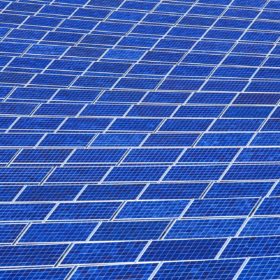
Republika Srpska launches tender for 60 MW PV project
The Ministry of Energy of Republika Srpska is seeking proposals for its first large-scale PV project. The solar park is planned to be located in Bileća, in Bosnia’s southernmost part.

Slovakian government hands out €700,000 for residential solar in just 36 minutes
The national Green Houses Program grants incentives for the installation of solar water heaters, PV systems with a generation capacity of up to 10 kW, heat pumps and small wind turbines.
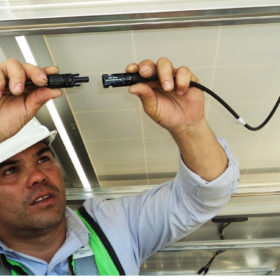
BNEF lowers 2020 global PV outlook due to coronavirus concerns
Many solar factories in China are starting to resume production, suggesting that concerns about supplies of PV components could soon begin to ease. Nevertheless, the temporary standstill will have an impact on the global solar market, as the implementation of some projects will probably be postponed until next year.
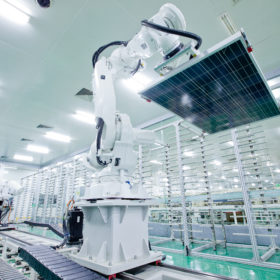
Jinko profits surge in 2019
The Chinese manufacturer shipped 14.3 GW of PV modules last year, up 2.9 GW from 2018. In its 2020 outlook, it reiterated its initial shipment guidance and confirmed its plans to ramp up capacity.

Poland added 300 MW of solar in first two months of 2020
The country’s cumulative installed PV capacity reached 1.6 GW at the end of February, according to the national grid operator.

Solar windows made of chromophores
An Italian startup has developed a luminescent solar concentrator technology that can be integrated with active architectural elements and windows. The technology is based on nanoparticles known as chromophores, which decouple the absorption and light-emission processes, thanks to appropriate engineering. The company claims it has achieved a conversion efficiency of up to 3.2%, with a degree of transparency in the visible spectrum of around 80%.
