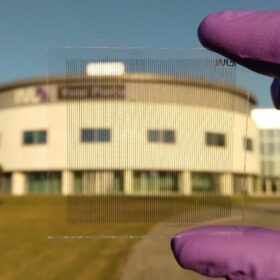
Improving solar windows via microfabrication techniques
Researchers in Europe are investigating semi-transparent solar windows, applying microfabrication technniques to both CIGS and perovskite devices, to overcome the view-impeding properties of earlier solar window concepts.
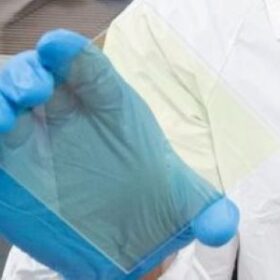
UbiQD developing novel encapsulant technology for solar modules
The U.S.-based quantum dot (QD) materials company is developing polymer encapsulation materials that reportedly have the potential to provide a relative power boost of 16% when integrated into crystalline silicon PV devices.

SolReina’s patented solar window wins best protected invention award in Spain
The windows, composed of glass-glass BIPV panels with thermal and acoustic insulation, are designed for use on building exteriors. They can generate between 150 and 225 W/m2. While currently manufactured and marketed in Spain, they may soon be available in Germany.

ClearVue releases results from first long-term study of clear solar glass
Perth-based ClearVue is making significant strides as its transparent solar windows demonstrate tangible outcomes following a two-year study and published paper.
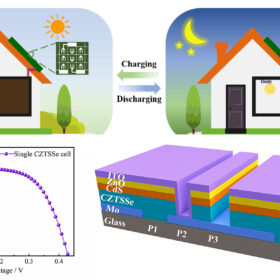
New solar window prototype based on kesterite photovoltaic cells
A research team in China combined solar power generation from kesterite thin-film generation with a nickel-cobalt bimetal oxide (NiCoO2) electrochromic window. The proposed prototype not only realizes the function integration of self-power and intelligent solar radiation adjustment, but also extends its function to energy storage.
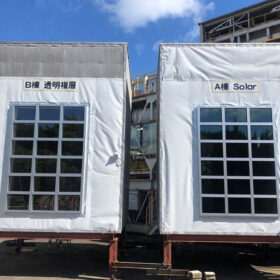
Japanese consortium demonstrates transparent PV windows in indoor environment
Nippon Sheet Glass (NSG), Japan’s largest glassmaker, plans to show photovoltaic windows developed by its US unit, Ubiquitous Energy, at a train station in Japan. The windows feature a transparent photovoltaic coating with an invisible element of power generation, capable of absorbing non-visible wavelengths.

Solar windows cut emissions, energy use by 40% in glass skyscrapers
The US National Renewable Energy Laboratory (NREL) has modeled the benefits of PV in highly glazed skyscrapers.

Transparent organic PV materials for solar window applications
US scientists have built photovoltaic materials with two top layers made of phthalocyanine and heptamethine. They tested the new tech across four different climate areas in the United States.
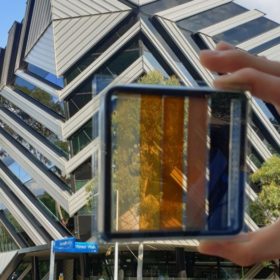
Semi-transparent perovskite solar cell for window applications
Buildings, particularly those with glass facades, are getting closer to self-powering, according to Australian scientists who recently developed a 15.5%-efficient, semi-transparent solar cell that allows more than 20% of visible light to pass through.
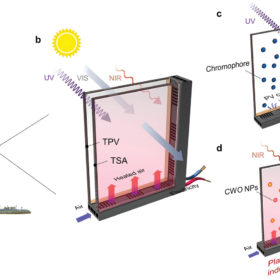
Solar window generates electricity, thermal energy
A research team in Hong Kong has built a solar window that can generate power on the external side via a luminescent solar concentrator and thermal energy on the internal side via transparent solar absorbers.
