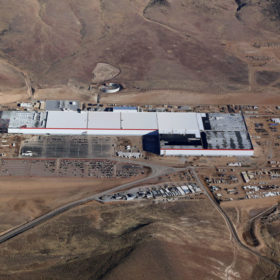
Tesla begins construction of GW factory in China
The US electric car maker wants to start production of its Model 3 in the Chinese factory. Next year, according to high-profile CEO Elon Musk, mass production of electric cars will start there.

US: Top Senate Democrat calls for permanent renewable energy, storage, EV tax credits
U.S. Senator Chuck Schumer is calling for permanent tax credits for clean electricity, storage and EVs as part of a set of demands for the form of any new infrastructure package. What does this mean for solar?
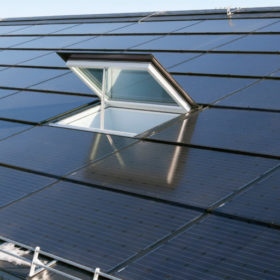
Switzerland’s third largest canton launches $3 million incentive scheme for solar-plus-storage
The scheme will provide incentives for solar-plus-storage projects for self-consumption, as well as for projects for virtual power storage.
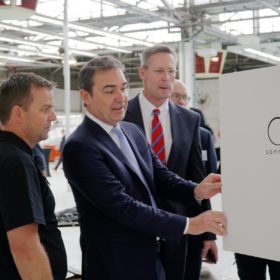
Sonnen begins battery production in Australia
The German energy storage provider has begun assembling batteries at the former Holden site at Elizabeth in Adelaide’s north. The company has already hired 50 full-time employees.

Spain’s Endesa to deploy 4 MW / 1.7 MWh battery in Melilla
The battery will be made by assembling 78 second life battery packs from Nissan’s electric Leaf vehicles. The project is expected to help resolve imbalances in the electrical system of the autonomous city and improve quality of supply.

Boom in electromobility unlikely to cause lithium shortage
The French Environment & Energy Management Agency (Ademe) has published a report in which analyzes the dynamics of lithium supply and demand in different scenarios of global electrification by 2050. The agency experts are convinced that only with a 75% penetration of electric vehicles there is the real risk of a marked decrease in the safety margin of lithium supply.
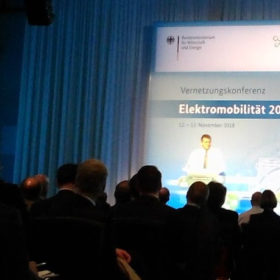
German government devotes €1bn to battery cell production
The Federal Ministry of Economics has published further details of possible battery cell production on a gigawatt scale. At the Networking Conference Electromobility 2018 in Berlin this week, Minister Peter Altmaier stressed the urgency of the project, for Germany and Europe to be independent of Asia and the US in storage technology.
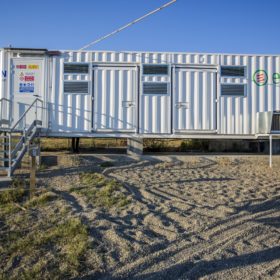
Edison connects large-scale storage system at PV plant in southern Italy
The Italian power provider has implemented its first pilot storage projects linked to solar. The system can provide grid services such as primary and secondary frequency regulation and tertiary and voltage regulation.
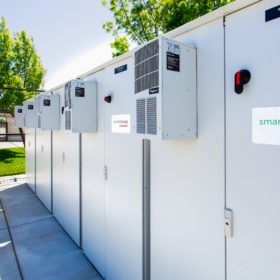
NantEnergy acquires Sharp’s US energy systems & services
Zinc battery specialist NantEnergy has acquired the U.S. energy systems and services business from Japanese electronics giant Sharp. The acquisition, according to NantEnergy, will provide the company with an important foothold in the U.S. market and allow it to provide “energy as a service” business models, using its Zinc-air battery, in multiple markets.
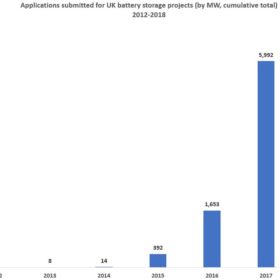
UK storage on the fly with 6.9 GW cumulative pipeline
At an event in London, a new tool was presented which lets the user track the UK storage landscape. The market is gaining traction amidst disfavourable policies for solar PV and other renewables from Westminster. The UK’s storage portfolio seems to be growing rapidly.
