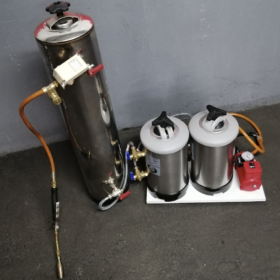
UPDATED – New tech to produce hydrogen from tap water
A Spanish scientist has developed a system that reportedly produces hydrogen on-site without expensive electrolysis. The prototype utilizes a water tank that is initially filled with water, ferrosilicon, and sodium hydroxide.

Tesla big battery begins providing inertia grid services at scale in world first in Australia
South Australia’s 150 MW / 193.5 Hornsdale Power Reserve, more commonly known as the Tesla Big Battery, will now provide inertia services to Australia’s National Electricity Market after securing approval from the Australian Energy Market Operator. Neoen says it is the first big battery in the world to deliver the service at such a scale.

Universal Solar to open 600 MW solar module factory in Panama
The US module provider said the panels produced at the facility will be 100 percent compliant with the U.S. Commerce Department’s Withhold and Release Order on Hoshine silicon.
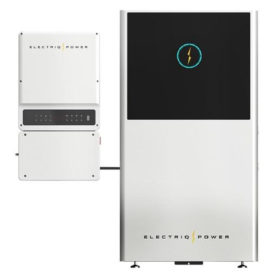
Electriq Power residential batteries beat the heat with backup power, smart time of use
A home battery paired with rooftop solar can provide backup power during rolling blackouts, shift power usage schedules to avoid peak demand charges, among other benefits.

Polish utility PGE wants to couple 200 MW/820 MWh of battery storage with existing pumped-hydro facility
The project is located 10 km from the Baltic Sea, where PGE is planning to build offshore wind farms with a total capacity of 3.5 GW.
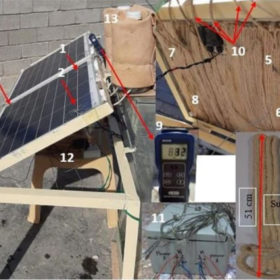
Cooling down solar modules with cotton wicks immersed in water
The novel technique consists of attaching cotton wicks immersed in the water (CWIWs) to the backside photovoltaic module. The water is supplied to cotton wicks from top to bottom by gravity which the scientists said helps the effective absorption of cotton and reduces water consumption.

Vehicle-integrated photovoltaics for low-speed electric vehicles
Canadian startup Capsolar claims its flexible solar modules can be adapted to any type of low-speed electric vehicle with no extra modification and custom work. The panels have an efficiency of 21.3%.

Peel-off patterning technique to create stable semitransparent solar cells for window applications
The cells are intended to be built inside panes of window glass, turning passive buildings into active energy producers. A key hurdle was creating the micron-scale electrical connections between individual cells that comprise a solar module.
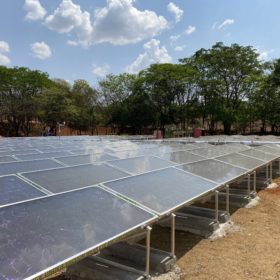
Solar thermal panel for large scale applications
The panel has an absorption area of 1.96 m2 and a weight of 27 kg per square meter. According to the manufacturer – Swiss startup TVP Solar – it may be a real booster for thermal output, by combining it with photovoltaics and heat pumps to provide enhanced output per square meter, in particular for low-temperature applications such as district heating.

New kind of black silicon shows improved light-trapping properties
Scientists in Russia have developed a new wide-band optical absorber called ‘black silicide’ which they claim is more adjusted to match AM-1.5 solar spectrum with theoretically higher photogenerated current density. It could be used for tandem operation in photovoltaic devices.
