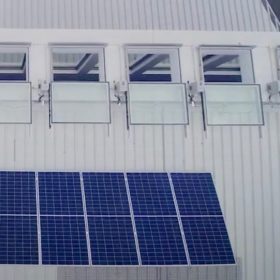
Solar chimney saves energy and lives
Researchers at Australia’s RMIT University have designed a solar chimney that could offer powerful safety and environmental benefits.
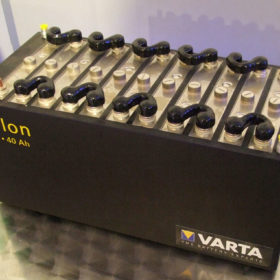
Lithium-ion storage is here to stay
A German-Israeli research group has gathered for three days to discuss which storage technologies may outperform lithium-ion batteries in the future. They concluded that there is no such a thing as a “post Li‐ion” era in sight. They recommended a “side‐by‐side” approach for multiple technologies in different applications, as well as the hybridization of technologies. The group highlighted the strong potential of redox flow storage, which in their view may outperform Li‐ion, although only for stationary applications.

Drones can drive down operational PV costs
In a recent interview with pv magazine, Supreeth Srinivasa Rao – associate director of the industrial practice at Frost & Sullivan – explained how drones can minimize the need to send employees to project sites, as they can be deployed for monitoring, operations, and maintenance purposes.

Form Energy claims aqueous air battery provides 150 hours of storage
The holy grail of energy storage has always been low-cost and long-duration. Form Energy intends on deploying a 1 MW/150 MWh system with a Minnesota utility before 2023, an unprecedented energy storage duration if successful.
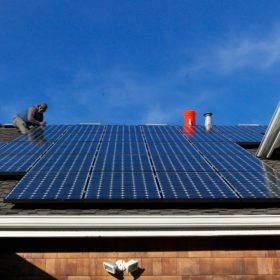
Power-to-heat-to-power storage for rooftop PV
Scientists in Spain have assessed the viability of ‘power-to-heat-to-power storage’ in a residential solar installation in Madrid. The technology could reduce electricity bills by more than 70% and would have a 12 to 15-year payback period, according to the researchers.

Solar driving efficient electrochemical water treatment
Researchers from the United States have investigated how solar could help electrochemical methods for water treatment become more competitive. The scientists analyzed how electrochemical technologies such as electrocoagulation, capacitive deionization, electrodialysis, and electrodeionization may be combined with solar power generation.
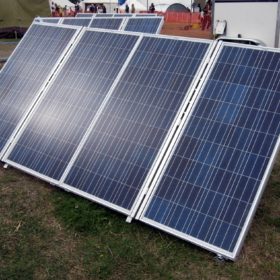
A new technique for cooling solar panels
Scientists in Egypt have investigated the effectiveness of using water and a mixture of aluminum oxide and calcium chloride hexahydrate to cool PV modules. Optimal performance was observed with a solution of 75% water, according to the research findings.
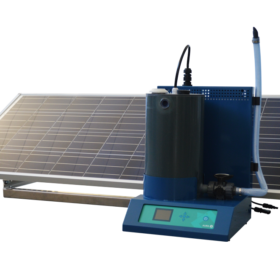
A disinfectant system powered by solar
French PV company Solea has developed a system which can produce 8-16 liters of solar-powered disinfectant solution per day.
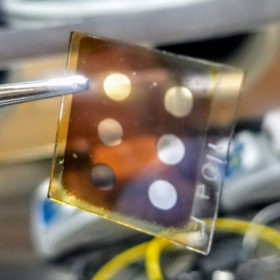
A flexible perovskite solar cell with 11.8% efficiency
U.S. researchers have created an inorganic mixed halide perovskite solar cell which they claim shows no thermal degradation even at 200 degrees Celsius for three days. The device can be used in tandem junction cells and is designed for use in real-life environments with high solar irradiation.

Storing solar and wind energy with compressed air
Researchers have studied the potential of using compressed air to store renewable energy in offshore saline aquifers. The technology could hold 77-96 TWh for up to two months in British waters, although the costs have proven hard to pin down.
