
The best redox flow battery tech
Batteries based on vanadium or zinc bromide represent the cutting edge of redox flow storage tech, an international research team has claimed. They have identified challenges and opportunities for about a dozen redox flow storage technologies, while providing estimates of their current and projected levelized costs of storage.
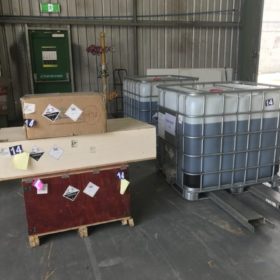
Australian Vanadium pushes ahead with plans for residential flow battery
Australian Vanadium is pushing ahead with plans to develop a vanadium redox flow battery for the Australian residential market, via its VSUN Energy subsidiary.

Enhancing electron transfer kinetics crucial for viability of redox flow batteries
Scientists in the United States claim that further research is needed to gain a deeper understanding of kinetic stabilization strategies to increase cell voltage in redox flow batteries and bring them closer to commercial viability.
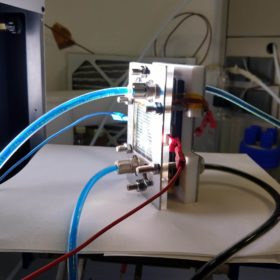
Vanadium redox flow battery integrating CIGS modules
Spanish and Finnish scientists have developed a solar vanadium redox flow battery paired with commercially available CIGS solar panels. The open-circuit voltage values were high enough to achieve unbiased photocharge, they said.
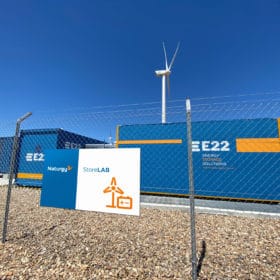
Vanadium redox flow battery goes online in Spain
Spanish storage specialist E22 said its new system can be integrated within a modular block from 250 kW to 330 kW. It purportedly has a product life above 12,000 cycles at full power.

Vanadium redox flow battery for utility-scale applications, microgrids
A unit of Largo Resources is launching a new vanadium redox flow battery for utility-scale storage projects, microgrids, renewable energy integration, grid smoothing, and backup power. The battery will feature a modular architecture, based on 1 MW “building blocks” and 2 MWh blocks of storage capacity.
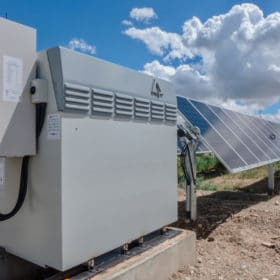
Australian PV plant tests 2 MW/8 MWh vanadium flow battery
Australia’s first utility-scale vanadium flow battery will be built in South Australia. It will demonstrate the tech’s potential to provide energy and frequency control ancillary services for the national grid.

Interest grows in going with the vanadium flow
The choice of battery storage technologies in support of solar energy supply is broadening to suit a variety of emerging applications. VSUN has just made its first power play for vanadium-redox-flow batteries in the off-grid residential market.

Solar micro-grid with 1 MW/4 MWh of vanadium redox flow storage in South Africa
Spanish renewable energy company Abengoa will deploy a 3.5 MW solar micro-grid at a vanadium mining site operated by Bushveld Minerals in South Africa. The storage system will be provided by Austria-based storage specialist Enerox Holdings Limited.
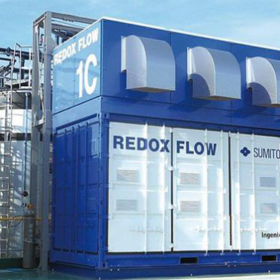
TNG sets up vanadium redox flow battery business
TNG Ltd. has set up a new subsidiary, TNG Energy, to advance its green ambitions by making vanadium redox flow batteries for off-grid solutions.
