Novel approach to assess performance loss rate of vertical bifacial PV systems
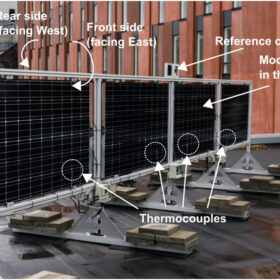
Scientists in Finland have developed a new method of assessing the long-term performance of vertical bifacial PV systems in Nordic conditions. The experimental setup consisted of a east-west oriented vertical array equipped with power, temperature, and plane-of-array irradiance sensors, wind speed and global horizontal irradiance sensors, and a weather station.
Vertical agrivoltaics to reduce PV curtailment, increase water efficiency
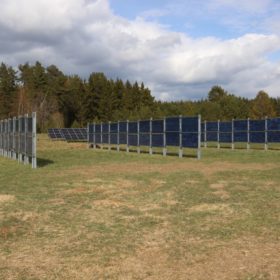
An international research group has analyzed a vertical bifacial agrivoltaics system in a drought-stricken part of Chile. They say that the solar array can improve water efficiency for crop irrigation, while the vertical system configuration optimizes PV power generation throughout the day, minimizing curtailment.
New model to assess effects of shading on crops in agrivoltaic projects
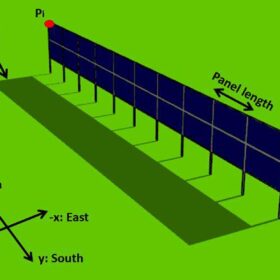
New research shows the importance of calculating the effects of shading created by PV panels on the photosynthetically active radiation (PAR) at the ground level, which is crucial to assessing crop yield in agrivoltaic projects. The proposed modeling considers different agrivoltaic project typologies across several sites in Europe.
Scientists analyze seasonal performance of rooftop, vertical PV in the Arctic
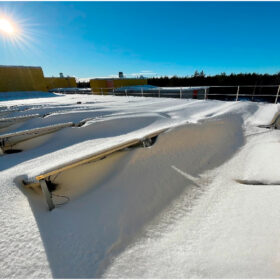
New research from Finland shows that the best season for rooftop PV generation in the Arctic is spring, and that the best tilt angle for rooftop systems is 28 degrees. It also showed that vertical PV installations perform better in winter.
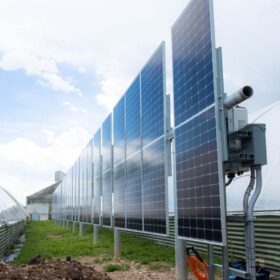
Vertical bifacial solar seeking greenhouse albedo, deployment space
A Colorado farmer has installed vertical bifacial solar, leveraging greenhouse albedo to increase output. The installation demonstrates promising generation during winter months, while maximizing limited land space.
New method to avoid overvoltage in vertical PV linked to low-voltage grids
A research group in Finland has created a new workflow to prevent voltage rises in bifacial vertical PV systems located at high latitudes. According to their findings, vertical bifacial PV may have a 46% higher power yield compared to monofacial conventional counterparts in the Nordics, while also having an improved temporal match between PV generation and consumption.
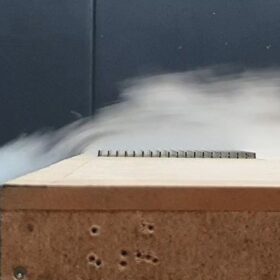
CFD tests show wind resistance in vertical rooftop PV systems
Norwegian startup Over Easy has validated the wind resistance of its vertical PV system for rooftops by using computational fluid dynamics (CFD) simulations. Wind tunnel tests conducted by I.F.I. Institut für Industrieaerodynamik GmbH confirm that the system can function without ballast or fastening to the rooftop.
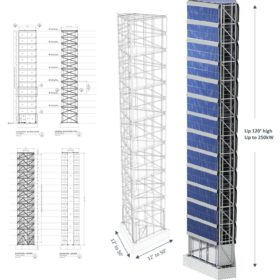
Solar tower of power shows benefits of vertical installations
Three Sixty Solar, a commercial and utility-scale solar developer, published a report this week that provides background on its vertically mounted solar system’s initial 16 months in operation.

Solar may cover the world’s electricity demand with 0.3% of its land area
An international research group claims that raw materials and land availability do not present a real barrier for a global energy system with solar at its center. They said that forecasts for PV growth should not have their axis on utility-scale power plants and instead consider vertical PV, agrivoltaics, and floating PV as the source of future big market volumes.
Vertical PV for clean energy and crop production
Researchers and project developers throughout the world are increasingly looking at agrivoltaic installations with vertically oriented solar panels.
