CFD tests show wind resistance in vertical rooftop PV systems

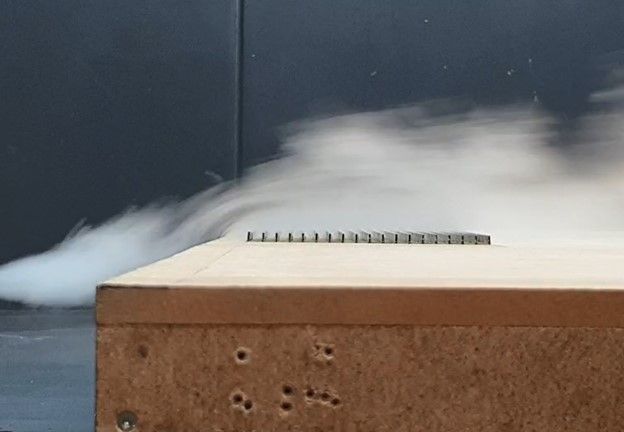
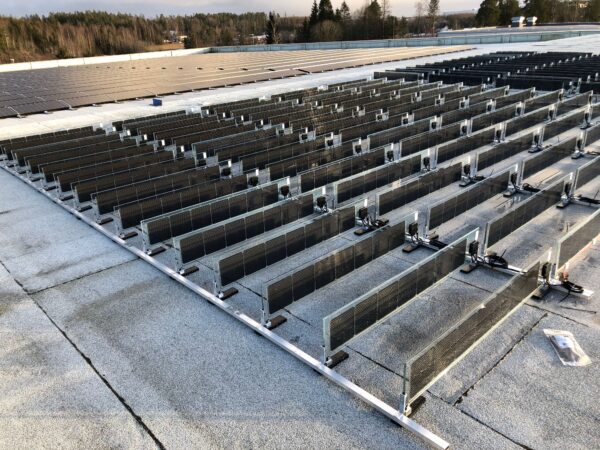
Norwegian startup Over Easy has reported the initial results of a series of computational fluid dynamics (CFD) simulations and wind tunnel tests on its vertical bifacial rooftop PV system, which uses specially designed solar modules.
Germany’s I.F.I. Institut für Industrieaerodynamik GmbH supported the company in measuring the wind resistance of the system.
“Wind tunnel tests on a 1:50 model equipped with 360 pressure taps were performed in a large boundary layer wind tunnel laboratory at I.F.I. Aachen,” CEO Trygve Mongstad told pv magazine. “Tests were done for different building heights and at different angles of attack on the building.”
Previous tests conducted by Fraunhofer ISE certified that the vertical system has no lift, even at wind speeds up to 47 meters per second, according to Mongstad.
“All measurements and analysis are in accordance with the German Standards DIN EN 1991-1-4:2010-12, DIN EN 1991-1-4/NA:2010-12 and the wind tunnel testing guideline of the German/Austrian/Swiss Wind Engineering Association, WtG, as well as EN 1991-1-4:2005,” he said. “Furthermore, they comply with international codes such as ASCE 7-22 and ASCE 49-21.”
The simulations showed that the system can function without ballast or fastening to the rooftop, according to his statement.
The company currently uses PERC cells with a bifaciality of 77% to 81% or HJT cells with a bifaciality of 90% in its demonstrators. The PV system, which includes a mounting system and solar panels, comes in a single pre-assembled package, making them easily mountable. Each unit measures 1,600 mm x 1,510 mm x 350 mm, weighs 24.5 kg, and features an IP68 enclosure rating and 3.2 mm double-tempered glass.
Over Easy plans to collaborate with production partners in China and Spain to begin manufacturing the solar modules. Currently, it uses solar cells from undisclosed Asian manufacturers.
This content is protected by copyright and may not be reused. If you want to cooperate with us and would like to reuse some of our content, please contact: [email protected].

Please login to comment

[…] Read More […]
[…] قامت شركة أوفر إيزي النرويجية الناشئة بالتحقق من مقاومة الرياح لنظامها الكهروضوئي الرأسي لأسطح المنازل باستخدام محاكاة ديناميكيات السوائل الحسابية (CFD). تؤكد عمليات المحاكاة ، التي أجراها IFI Institut für Industrieaerodynamik GmbH ، أن النظام لا يعاني من الرفع ، حتى عند سرعات الرياح التي تصل إلى 47 مترًا في الثانية …اقرأ المزيد […]
[…] Norwegian startup Over Easy has validated the wind resistance of its vertical PV system for rooftops by using computational fluid dynamics (CFD) simulations. The simulations, conducted by I.F.I. Institut für Industrieaerodynamik GmbH, confirm that the system does not experience lift, even at wind speeds of up to 47 meters per second…Read More […]
[…] The news was made public in an article in PV Magazine Global today. […]
[…] PV system provider Over Easy has deployed two vertical solar arrays on green rooftops in […]