Solar panel theoretical efficiency limit increases by 33%

Perovskites, perovskites, perovskites – one might think the product runs the planet with the number of headlines, but as of yet it still sits outside of the commercial market for solar power. There is, however, some serious advancement. OxfordPV in the UK and the Australians at Greatcell are both moving forward, with research pouring in from many labs globally.
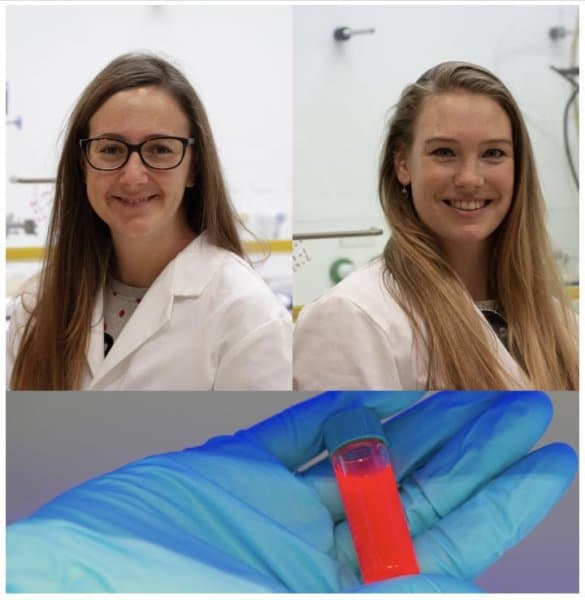
One of the major benefits talked up about perovskites is the attractive price, due to easier production. However it has often been suggested that perovskite products could become more efficient via a property called “carrier multiplication.” Now evidence of that higher theoretical efficiency, per Dr. Chris de Weerd (left) and Dr. Leyre Gomez (right), has been “obtained using three independent experimental approaches, and is conclusive.”
The basic meaning of this research is that the Shockley–Queisser limit of ~33% for a single layer of silicon based solar cells, is now the Gomez-Weerd limit of ~44% for a single layer of perovskite solar cells. From an application standpoint – what this means is that the exact same hardware that was generating 300 or 400 watts is a solar module, using the same module material, same racking, same transportation, mostly same engineering, and same human labor – not the same inverters or balance of system though – can now potentially put out 33% more electricity with similar costs.
De Weerd, who successfully defended her PhD thesis based on this and other research last week, says:
Until now, carrier multiplication had not been reported for perovskites. That we have now found it is of great fundamental impact on this upcoming material. For example, this shows that perovskites can be used to construct very efficient photodetectors, and in the future perhaps solar cells.
The fundamental aspect of “carrier multiplication” is this: generally the excess energy of photons on a solar panel are released via heat because materials only give up a single “valence electron” at a time. However, in material like perovskites – the excess energy can excite an additional valence electron, and this second electron can generate electricity from the same photon. More electricity from the same sunlight.
Of course, we’ve gotten nowhere near silicon-based solar cells efficiency limits of 33% with modern products, and – more importantly – real close to 0% of the world’s current solar power installed is perovskite based. However, the research moves forward.
This content is protected by copyright and may not be reused. If you want to cooperate with us and would like to reuse some of our content, please contact: [email protected].

Please login to comment

Solar cell efficiency degrades at higher temperatures, especially above 80 degrees F. No mention in this article in regards to how heat affects the perovskites that can be used to raise the theoretical limit from 33.7% to 44%.

Definitely an interesting theory! I would love to read more updates on this study.

Great news for photovoltaics if the long-known concept of carrier multiplication (or impact ionization) finally finds their way into the real world. It’s an effect that is known since quite a while, see e.g.:
July 1994· Physical Review Letters 72(24):3851-3854
DOI: · 10.1103/PhysRevLett.72.3851
or
August 1993 · Journal of Applied Physics 74(2):1451 – 1452
DOI: · 10.1063/1.354886
or
June 1996 · Solar Energy Materials and Solar Cells 41:419-425
DOI: · 10.1016/0927-0248(95)00125-5
The effect has also been observed experimentally, but thus far not to the extent that it allowed to be actually used for contributing significantly to the energy output of a solar cell. It would be great if perovskites are showing this effect to a notable degree that allow further increasing solar cell efficiency.
Congratulations to Dr. Gomez and Dr. De Weerd for their research.
But I am sure they are feeling a bit embarrassed for reading that here is the talk of the term “Gomez-Weerd” limit, because the physical effect and the efficiency limits were reported and calculated in detail in the 25 years old papers, listed above. The article above seems to say that they measured the effect of carrier multiplication in perovskites -which is great- and which also has been measured in other materials by others.
If someone has the desire to attach a name to this limit (other than impact ionization or carrier multiplication solar cell limit) one may talk of the Werner-Kolodinski-Queisser limit, referring to the authors of the 1994 paper above.
Anyhow, probably very interesting perovskite work that I am interested in reading.

I’m open to suggestions in changing the name! 🙂
It seems science goes back and forth with who gets credit – sometimes it is those who hypothesize and sometimes it is those who build the machines (Dr Smoot and Kobe Background Radiation Detector is one I know of).

What’s the theoretical limit for a tandem cell with a perovskite cell at the Gomez-Weerd limit on top of a silicon cell at the Shockley–Queisser limit for the light unused by the perovskites? I realize this is an absurd hypothesis, since the band gaps of real cells overlap, but let’s dream.
It is not an absurd hypothesis, actually. In an ideal scenario (leaving out of the discussion current matching constraints in 2-terminal tandem solar cells [or assuming 4-terminal operation] and ignoring optical losses from parasitic absorption etc.) the tandem stack that you propose will generate in the top cell the efficiency of the top-cell, plus the efficiency of the bottom cell FOR THE LIGHT THAT IS TRANSMITTED THROUGH THE TOP CELL. [The all caps are no shouting here, just emphasis… 😉 ]
It’s an interesting implicit question that you raise: What is the (change of the ideal) bandgap combination for a tandem cell, if the top cell works with efficient carrier multiplication. Should be interesting to calculate, …and then to answer your question what is the ideal efficiency of the tandem stack.

Great job!

Nice one
[…] https://www.pv-magazine.com/2018/10/17/solar-panel-theoretical-efficiency-limit-increases-by-33/ […]