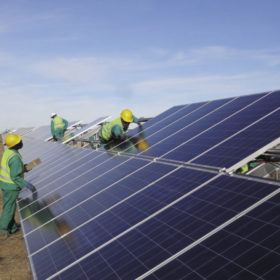
South Africa postpones commercial close timelines for projects selected in fifth REIPPPP round
The fifth round of South Africa’s REIPPPP scheme was launched in March 2021. The authorities allocated 2.6 GW of renewable energy capacity across 25 projects ranging in size from 75 MW to 140 MW.
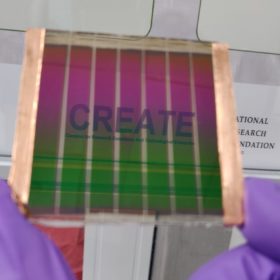
Large-area semitransparent perovskite PV module with 9.5% efficiency
Singaporean researchers have developed a semitransparent perovskite solar panels for applications such as building-integrated PV, vehicle-integrated solar, and smart glasses. They built it with a highly transparent and conducting transparent conductive oxide layer via tin-doped indium-oxide sputter deposition.
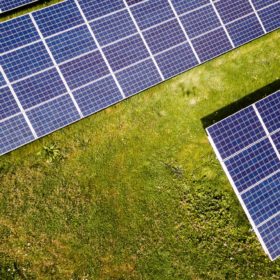
Chinese state-owned body enters Wiki-Solar’s ‘gigawatt club’
The 1.36 GW of solar capacity installed by Shanghai Electric across just three projects in 2021 and the first quarter of 2022 helped it enter an annual ranking of the global solar industry’s biggest engineering, procurement, and construction contractors.

Indian salt producer tenders 1 GW of solar
State-owned Hindustan Salts Ltd. has invited bids to build and operate 1 GW of solar capacity on 5,000 acres of disused land in the Indian state of Gujarat. The developer will pay Hindustan Salts a fixed annual rental fee for the land. Bidding closes on May 25.

Storing renewables with high-rise elevators
Lift Energy Storage Technology is a proposed long-term storage solution that relies on elevators to bring solid masses to the tops of buildings in charging mode. It then lowers the same mass to produce electricity in discharge mode.
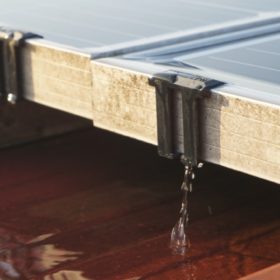
New water-draining device for rooftop PV systems
Portuguese startup Solarud has developed a way to eliminate soiling around the frames of PV panels with low inclination slopes. The device drains water that would otherwise stay stagnant on the surface of modules.
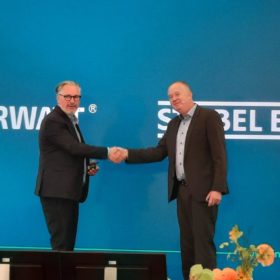
Solarwatt enters heat pump business with new energy management system
Solarwatt and Stiebel Eltron have agreed to cooperate on the development of heat pumps.
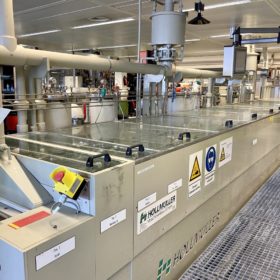
Fortescue provides backing for Dutch PV module maker
Fortescue Future Industries continues to advance its green energy ambitions, announcing it will provide new funding for Dutch solar PV module maker HyET Solar, in a move designed to accelerate a planned expansion of the company’s manufacturing plant in the Netherlands.
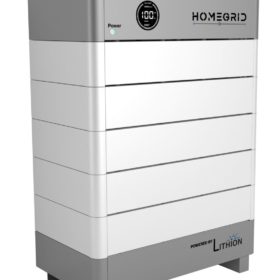
Stackable home battery with 9.6 kWh to 38.4 kWh of capacity
Lithion’s Stack’d Series LFP batteries are modular and can be scaled in 4.8 kWh increments, from 9.6 kWh to 38.4 kWh.

Self-healing perovskites can withstand fierce cosmic radiation
The development of a set of testing protocols for perovskite solar cells intended for use outside Earth’s atmosphere could lead to the devices being installed permanently, and even manufactured, on the moon.
