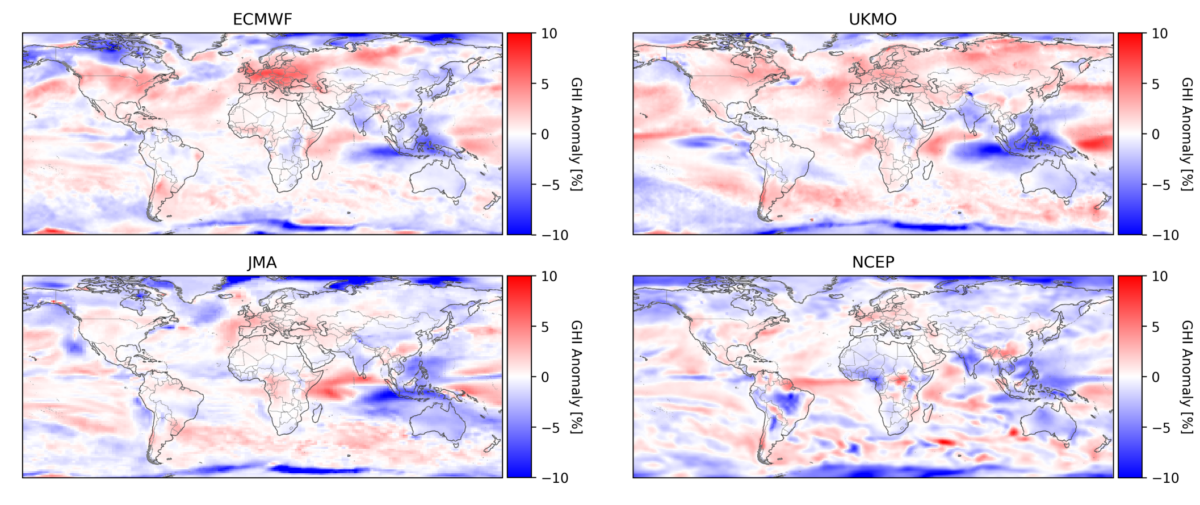





After a good start to 2025 for many regions, seasonal forecasts show a more mixed outlook heading into the second half of the year. North America and Europe are expected to benefit from relatively strong solar conditions, while other major markets face more uncertainty or unfavourable trends. These insights are drawn from multiple seasonal models and regional forecasts, according to analysis using the Solcast API.
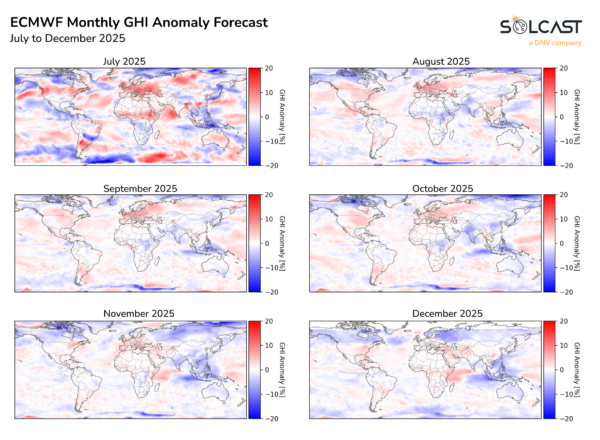
Europe looks set to continue its strong year for solar irradiance into the second half of 2025. Forecast models suggest Q3 and Q4 will bring persistent sunny conditions, building on a strong performance in the first half of the year.
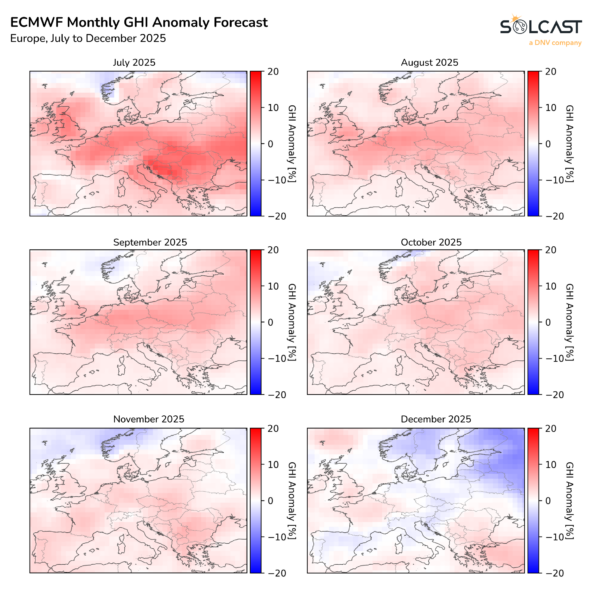
The UK and Benelux countries are expected to break records for irradiance, with a strong start to the year and forecasts predicting consistently clear months rather than isolated irradiance spikes.
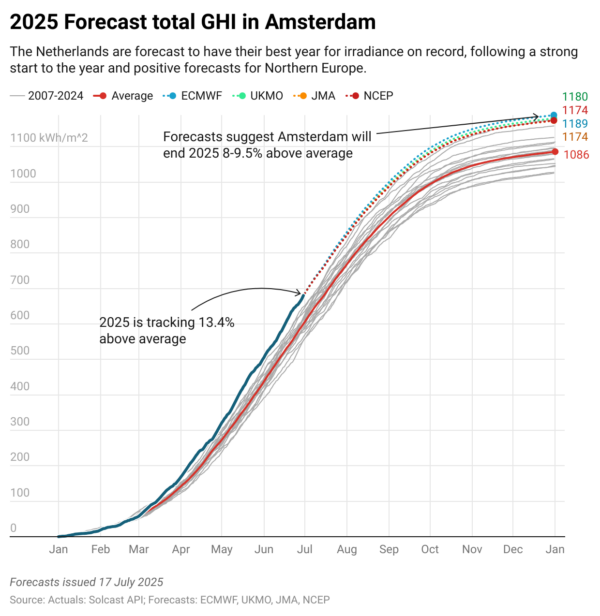
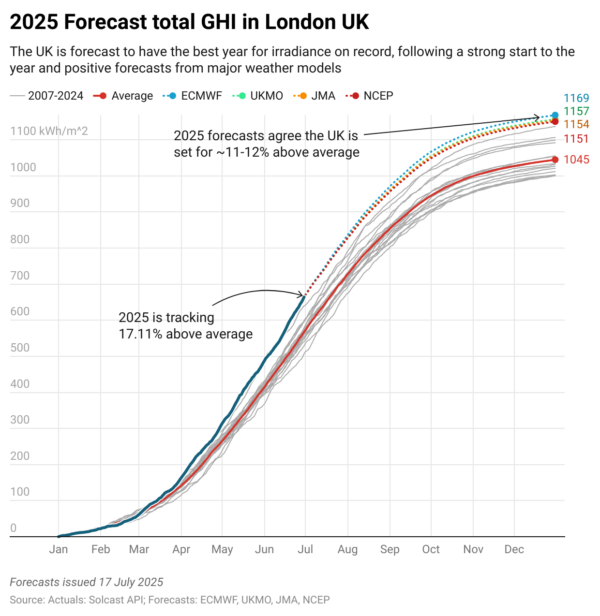
For the Scandinavian and Iberian Peninsulas, forecasts are less aligned. While some models indicate a sunnier second half for Spain and Portugal following from their cloudier start, others remain inconclusive. Northern Europe, and in particular the Nordic region, is mostly expected to stay cloudier than usual, but not all forecasts agree.
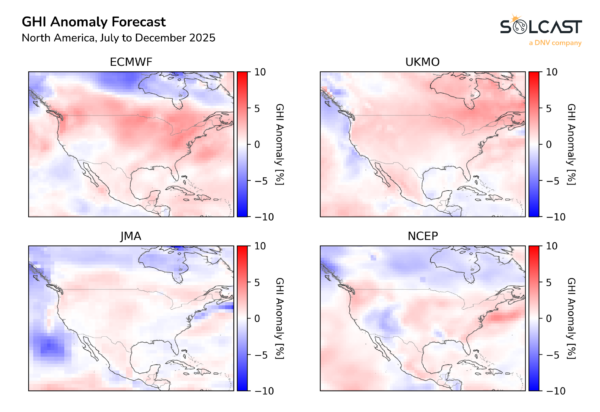
In North America, solar conditions are also looking positive. The Western United States, Rockies and Mexico are likely to build on strong early-year performance to deliver a standout 2025. That said, some model disagreement exists for the Western US, with a few forecasts indicating periods of below-average irradiance.

In contrast, northern Canada is not expected to fare as well, with persistent cloudiness forecasted. These conditions are expected to extend southwards late in the year, potentially affecting solar output near the US-Canada border.
Beyond Europe and North America, the global outlook is less optimistic. Conditions in Australia are forecast to revert toward more typical mid-year weather patterns, with an increase in cloud cover likely to impact solar generation.
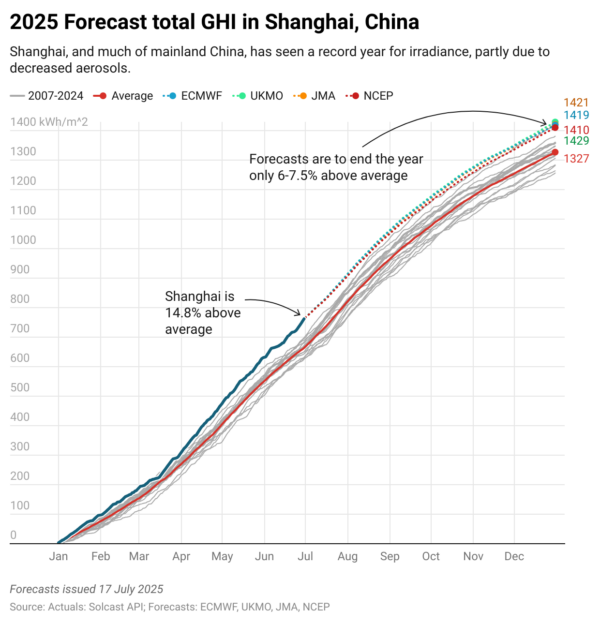
In China, where early 2025 brought unusually strong irradiance, most regions outside of parts of the eastern provinces are forecasted to see a return to cloudier skies.
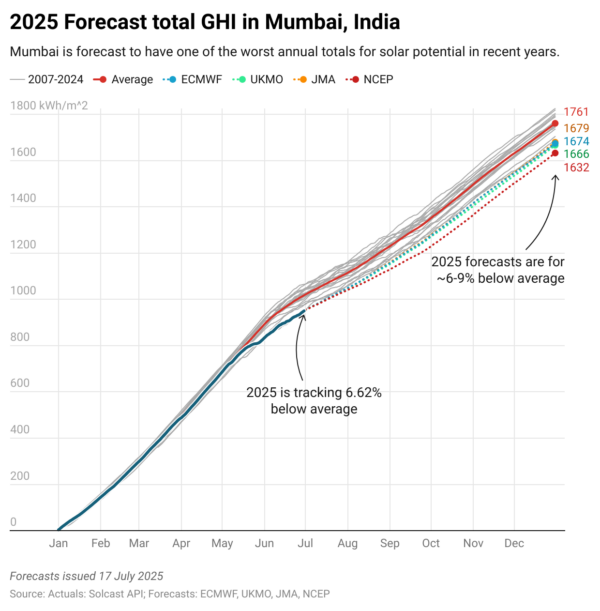
India and much of Southeast Asia, which have already experienced a gloomy start to the year, are now facing predictions for one of the worst solar years on record.
In South America, the forecast consensus is weak. While no single trend dominates, all models point toward variable, region-specific outcomes for the remainder of the year.
Adding to the forecast uncertainty is the current neutral status of both the El Niño Southern Oscillation (ENSO) and Indian Ocean Dipole (IOD). Without a strong positive or negative phase from either system, the ability to link large-scale climate patterns to solar irradiance outcomes is diminished, limiting predictability in some regions.
Solcast produces these figures by tracking clouds and aerosols at 1-2km resolution globally, using satellite data and proprietary AI/ML algorithms. This data is used to drive irradiance models, enabling Solcast to calculate irradiance at high resolution, with typical bias of less than 2%, and also cloud-tracking forecasts. This data is used by more than 350 companies managing over 300 GW of solar assets globally.
The views and opinions expressed in this article are the author’s own, and do not necessarily reflect those held by pv magazine.
This content is protected by copyright and may not be reused. If you want to cooperate with us and would like to reuse some of our content, please contact: editors@pv-magazine.com.

By submitting this form you agree to pv magazine using your data for the purposes of publishing your comment.
Your personal data will only be disclosed or otherwise transmitted to third parties for the purposes of spam filtering or if this is necessary for technical maintenance of the website. Any other transfer to third parties will not take place unless this is justified on the basis of applicable data protection regulations or if pv magazine is legally obliged to do so.
You may revoke this consent at any time with effect for the future, in which case your personal data will be deleted immediately. Otherwise, your data will be deleted if pv magazine has processed your request or the purpose of data storage is fulfilled.
Further information on data privacy can be found in our Data Protection Policy.