




Minister of Climate and Green Growth of the Netherlands, Sophie Hermans, has confirmed an ongoing floating solar pilot project in the Dutch North Sea does not receive any government subsidies.
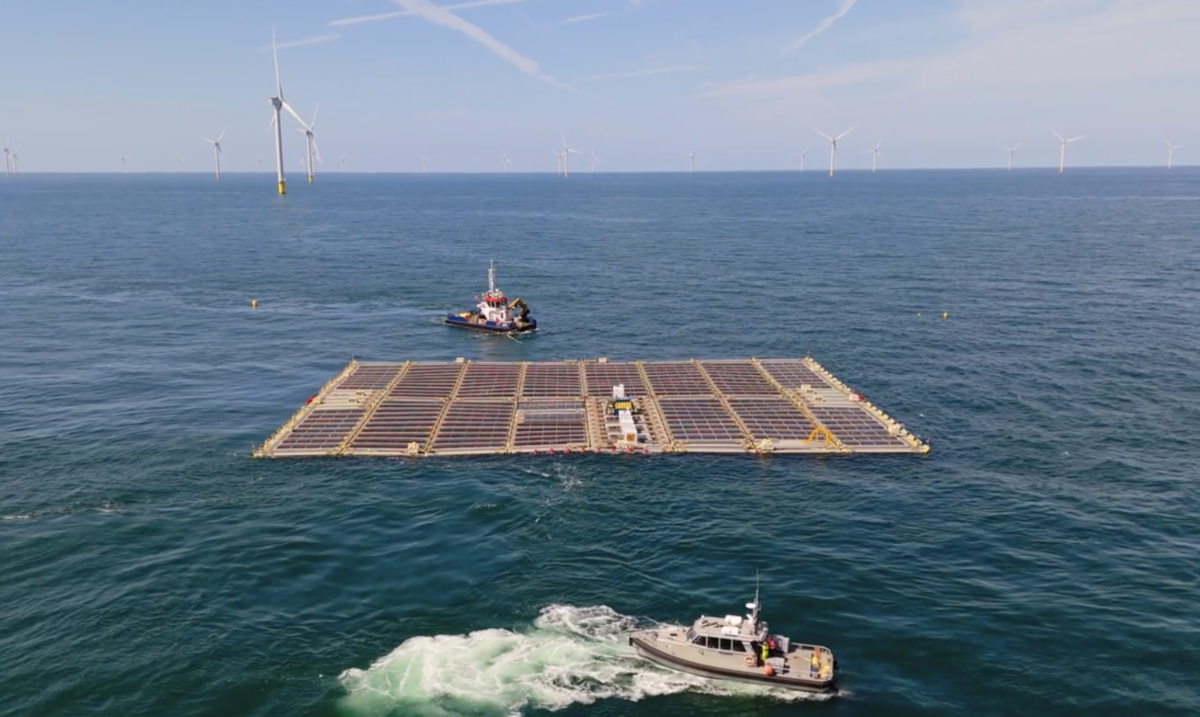
The Nymphaea Aurora project is a 0.5 MW floating solar array integrated within the 759 MW Hollandse Kust Noord offshore wind farm, located 18.5 km from the coast. It was installed in mid-August and is set to operate for a year.
The project is the world’s first offshore solar system within an offshore wind farm and is a collaboration between Dutch floating solar specialists Oceans of Energy and CrossWind, a joint venture company between Shell and Eneco that developed and operates the wind farm.
During a line of parliamentary questioning, Minister Hermans confirmed the government has not entered into any financial obligations for the realization and operation of the project.
“The project is financed by the initiator CrossWind, which, as the permit holder, is also responsible for the development and operation. This involves collaboration with the subcontractor and technology developer Oceans of Energy,” Hermans explained.
In a separate question, Hermans emphasized the permit holder bears the full costs for the project but added that around €520,000 ($611,166) of unspent subsidy budget from another offshore solar innovation project is being used for ecological monitoring of this project. “The government is actively using these funds so that realistic data is collected on this project about the ecological effects of this technology, thereby reducing existing knowledge gaps,” the minister said.
Hermans added that the demonstration project is exploring the potential and feasibility of offshore solar. Among its objectives is to better estimate yield losses, with monitoring to calculate what percentage of yield is lost to soiling factors such as salt deposits and algae growth.
In a decision note submitted alongside the parliamentary questions, Hermans added that the pilot installation experienced problems in recent weeks, including damage caused by a storm and several fire incidents which were extinguished by the coast guard.
In a LinkedIn post, Oceans of Energy confirmed a small fire and significant smoke developed on September 5, leading to the plant being electrically isolated as a precaution. A follow up post from mid-September said some of the floaters were affected by heating events due to a specific electrical connector issue, resulting in partly melting of plastics.
“It affected around 15 of the 200 floaters in the southernmost row. These had no PV panels but they have lost part of their synthetic materials,” the post explained. “We have worked hard on containment and are preparing for repair. The learnings in the past two months have been invaluable to get to product maturity”.
Oceans of Energy deployed the world’s first offshore solar farm, a 50 kW modular PV system, in the Dutch North Sea in 2019. In February 2024 it announced a project, in collaboration with 15 European partners, aiming to scale up offshore solar technology to standard formats of 150 MW.
This content is protected by copyright and may not be reused. If you want to cooperate with us and would like to reuse some of our content, please contact: editors@pv-magazine.com.



By submitting this form you agree to pv magazine using your data for the purposes of publishing your comment.
Your personal data will only be disclosed or otherwise transmitted to third parties for the purposes of spam filtering or if this is necessary for technical maintenance of the website. Any other transfer to third parties will not take place unless this is justified on the basis of applicable data protection regulations or if pv magazine is legally obliged to do so.
You may revoke this consent at any time with effect for the future, in which case your personal data will be deleted immediately. Otherwise, your data will be deleted if pv magazine has processed your request or the purpose of data storage is fulfilled.
Further information on data privacy can be found in our Data Protection Policy.