Deployable tracker-based rooftop PV system for stadiums

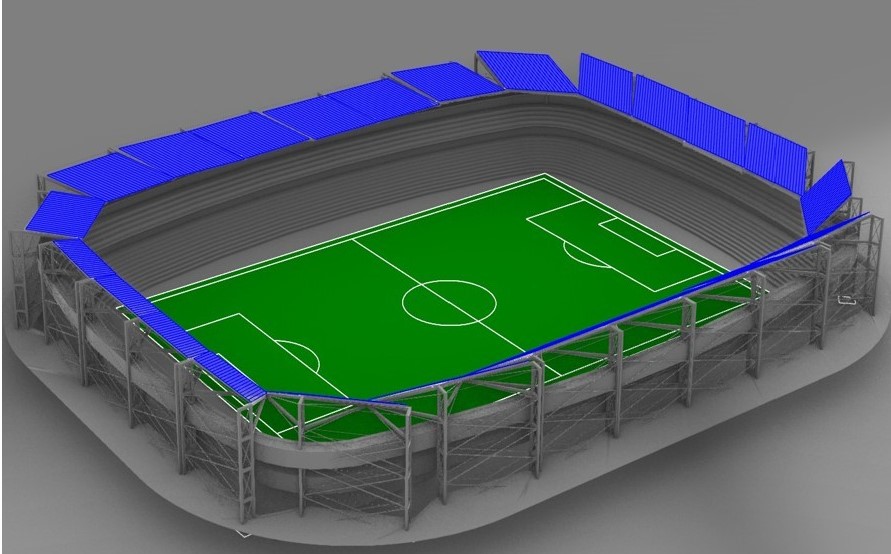
A group of researchers led by the University of Salerno in Italy has developed a deployable tensegrity roof structure for tracker-based photovoltaic applications.
“In our new research, we presented a novel solar roof module for sports stadiums featuring sun-tracking capabilities, which can be used both for the design of new solar stadiums and for the retrofitting of existing ones,” the research’s corresponding author, Fernando Fraternali, told pv magazine, noting that the PV system design builds upon previous research work published in March, where the scientists proposed a sun-tracking PV system design for stadium covers that was said to offer both strong structural response and high energy yield compared to systems based on fixed structures.
“While previous work examined the mechanical behavior of a tensegrity structure for a solar stadium roof in its undeployed configuration, the present study investigates its performance in the deployed state, with particular attention to its response to wind-induced forces and vibration modes,” they explained. “The sun-tracking mechanism enables the adjustment of individual tilting angles for the various roof modules composing the stadium roof, which is an advancement over the concept introduced in the previous research.”
Thanks to a deployable tensegrity architecture that relies on folding and unfolding activation struts mounted on sliding supports, the proposed roof module can be easily integrated into various roof configurations. It utilizes a special mounting structure consisting of four struts located beneath the panels, with the upper ends being hinged at four fixed points and interconnected by a longitudinal beam. Furthermore, the lower ends are connected to horizontal sliders mounted on a second longitudinal beam and are driven by a looped bus cable.
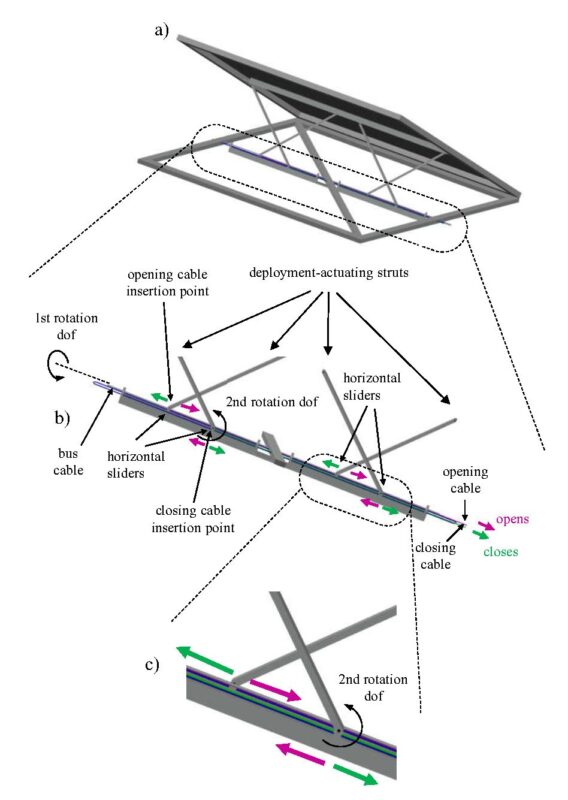
Image: University of Salerno
Moreover, the bus cable is linked to both an opening and a closing cable, each wound around an external winch. This setup allows the bus cable to move continuously along the guiding track when the winch is activated.
“This articulated arrangement provides a technically robust solution for accommodating large rotations at the strut ends,” the research group emphasized. “The upper longitudinal beam is connected to a linear cylindrical hinge that transfers the loads applied to the roof panel directly to the beam.”
The proposed system design is said to require minimal energy for deployment is minimal, owing to the tensegrity-based design, which eliminates the need for pneumatic actuators. Instead, deployment is achieved through simple winch-driven adjustments of the rest lengths of activation cables.
The researchers conducted a series of simulations to compare the performance of the system with that of the 1 MW PV array deployed on the Bentegodi Stadium in Verona, with the analysis showing that the tracker-driven system could achieve the same annual power production with just 740 kW.
“Overall, we conclude that the deployable roof system analyzed in the present study shows strong potential both for the design of novel sports stadiums equipped with efficient sun-tracking strategies and for the retrofit of existing stadiums aimed at enhancing their energy performance,” the scientists stressed.
The novel PV system design was introduced in “Deployability, mechanical response, and energy harvesting capacity of a novel solar roof for sports stadiums,” published in Developments in the Built Environment.
The team included academics from the Universitat Politècnica de Catalunya in Spain, as well as from the University of Bologna and the University of Naples in Italy.
This content is protected by copyright and may not be reused. If you want to cooperate with us and would like to reuse some of our content, please contact: [email protected].

Please login to comment