Storm systems suppress Northern Europe’s October solar output

Autumn storm systems have dominated large swathes of Europe in October, driving a clear split between northern regions where solar output declined and southern areas that enjoyed relatively favourable conditions. According to analysis using the Solcast API, irradiance levels were well below average across the UK, Benelux region, Germany and the Balkans due to persistent cloud cover and rain from a series of storms, while the southwest of the continent benefited from ridging high pressure and clearer skies. This analysis was completed overnight on October 30, using actuals for October 1-30, and forecasts for October 31. Using a single day of forecasts is unlikely to have any significant impact on the results.

Across the British Isles, Germany, Belgium, and the Netherlands, solar production took a hit as cloud-laden storm systems swept across the region. Storm Amy, which passed through in the first half of the month, and Storm Benjamin, which arrived in the final week were key contributors to the reduced irradiance.
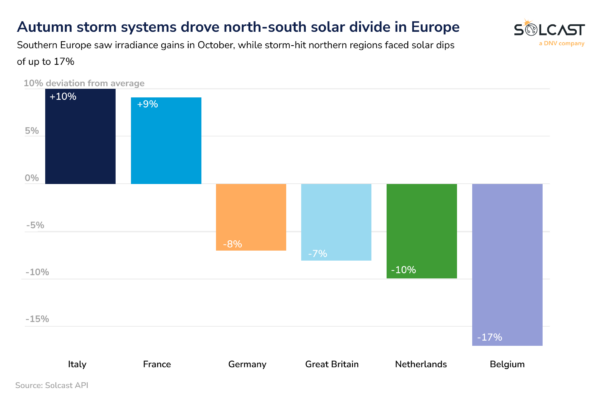
As a result, solar generation fell to around 8% below normal in the British Isles and Germany, dropped by 10% in the Netherlands, and declined by as much as 17% in Belgium. Eastern Europe also saw subdued solar output, particularly in central Ukraine, where stormy weather and frequent frontal passages brought irradiance down by as much as 30% below the October average. This pattern was influenced in part by Storm Barbara, which originated over Italy on October 5 and tracked eastward, bringing heavy rainfall to much of the region.
While PV generation suffered, wind production surged during storm events. Germany, positioned on the periphery of several low-pressure systems, experienced periods during which up to 70% of electricity demand was met by wind, both onshore and offshore. However, the benefits of this boost may have been tempered by curtailment, as high levels of wind output in previous months had already strained grid capacity and likely continued to do so in October.
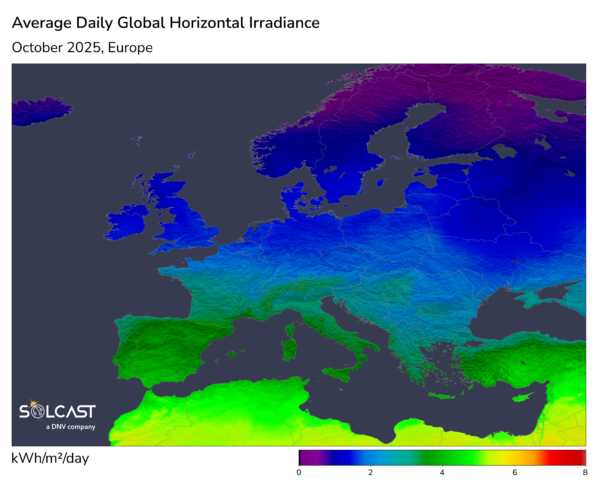
Meanwhile, in southern and southwestern Europe, irradiance patterns told a different story. The Iberian Peninsula, France, and northern Italy all experienced above-average sunshine, benefitting from more settled weather under ridging high pressure that kept storm systems at bay. Solar irradiance was about 10% above normal in France and northern Italy and 5% higher than average across Spain and Portugal. These gains were mirrored in PV power estimates, supporting better-than-average generation across the region.
In the Baltic states and southern Sweden, there were also localized improvements. Latvia and Estonia both recorded irradiance values 15% above normal. However, the absolute values remained modest—averaging around 1.5 kWh/m²/day—limiting their overall contribution to regional solar production.
Solcast produces these figures by tracking clouds and aerosols at 1-2km resolution globally, using satellite data and proprietary AI/ML algorithms. This data is used to drive irradiance models, enabling Solcast to calculate irradiance at high resolution, with typical bias of less than 2%, and also cloud-tracking forecasts. This data is used by more than 350 companies managing over 300 GW of solar assets globally.
The views and opinions expressed in this article are the author’s own, and do not necessarily reflect those held by pv magazine.
This content is protected by copyright and may not be reused. If you want to cooperate with us and would like to reuse some of our content, please contact: [email protected].
Please login to comment