Blocking pattern lifts irradiance from France to Finland while storms hit the east
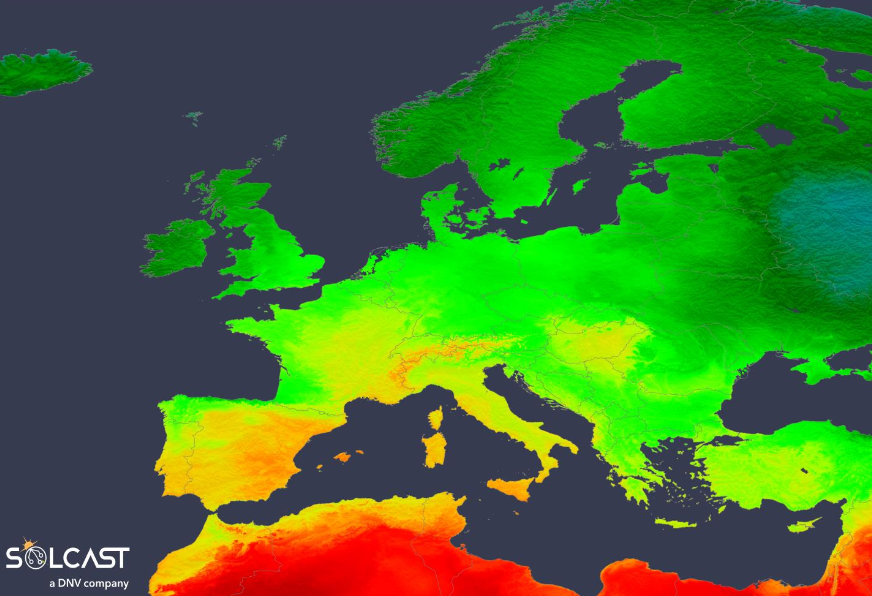
Persistent high pressure centered over the North Sea delivered one of Europe’s strongest April solar resource anomalies in recent years, according to analysis using the Solcast API. A blocking pattern suppressed cloud formation across much of western and northern Europe, lifting irradiance from Iberia to Finland. At the same time, storms diverted around the eastern flank of the block reduced irradiance across the eastern Mediterranean including Greece and Turkey, and further northeast of Ukraine.
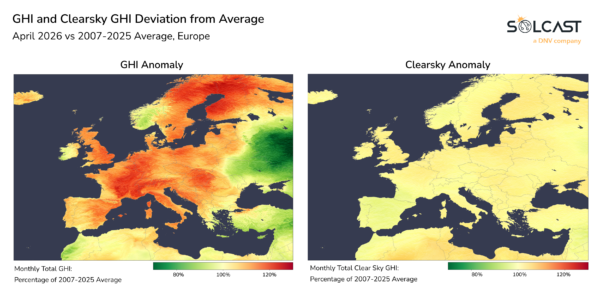
The dominant feature through April was a persistent high pressure system anchored over the North Sea, with mean sea-level pressure up to 7 hPa above climatology. This circulation pattern kept the lower atmosphere unusually dry and stable, limiting cloud development across France, Germany, and the Low Countries. As a result, GHI averaged 13% above the 2007–2025 baseline across France, 11–14% above average in Germany and Benelux, and 14–16% above in Sweden and Finland. Iberia also recorded an 8% surplus, while Italy averaged 11% above normal as the high extended south across the peninsula.
France recorded its fifth sunniest April on record, with irradiance up 30% and a rainfall deficit of 70%, while locations including Cannes, Nice, and Le Mans reported no rain days during the entire month. Italy’s surplus marked a sharp turnaround from March, when a cut-off low associated with Storm Deborah brought persistent cloud and late-season snowfall that suppressed irradiance.
April’s irradiance anomaly was notable for being almost entirely cloud-driven. Clearsky GHI anomalies averaged only +0.9% relative to the 2007-2025 baseline, indicating that aerosol loading remained close to climatology across Europe. This marked a strong contrast with March, when Saharan dust intrusions reduced clearsky irradiance independently of cloud conditions across southern Europe. In April, the atmosphere remained comparatively optically clean, allowing reductions in cloud cover to translate directly into elevated solar resource.
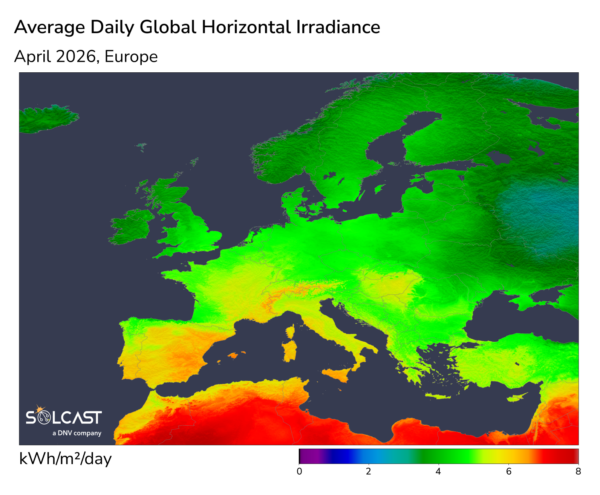
While western and northern Europe benefited from clear skies, the same blocking pattern displaced Atlantic storm tracks southeastward. Systems that would typically cross central Europe were instead funnelled into the eastern Mediterranean. Storm Erminio tracked across the Ionian Sea in early April, triggering flash flooding across Greece before bringing persistent cloud and rainfall to Turkey. Greece recorded a GHI deficit of 3%, while Turkey and Syria were around 4% below average. Poland and the Balkans remained under the influence of the high pressure system and recorded GHI firmly above average, generally between 9% and 12%. In contrast, Ukraine and Moldova caught the edge of the storm track throughout the month – capped by Storm Ylvi in the final week – and fell around 8% below average despite relatively dry conditions.
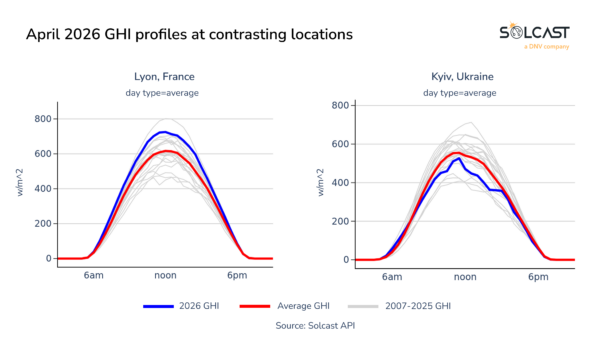
This contrast is also evident in GHI profiles on either side of the ridge, with sites under the high such as Lyon showing consistently elevated and smooth daytime curves, while locations east of the ridge, including Kyiv, display suppressed and highly variable profiles indicative of frequent cloud interruption.
Solcast produces these figures by tracking clouds and aerosols at 1-2km resolution globally, using satellite data and proprietary AI/ML algorithms. This data is used to drive irradiance models, enabling Solcast to calculate irradiance at high resolution, with typical bias of less than 2%, and also cloud-tracking forecasts. This data is used by more than 350 companies managing over 300 GW of solar assets globally.
The views and opinions expressed in this article are the author’s own, and do not necessarily reflect those held by pv magazine.
This content is protected by copyright and may not be reused. If you want to cooperate with us and would like to reuse some of our content, please contact: [email protected].
Please login to comment