Pacific ridge reversal brings Western U.S. solar conditions back to average in April

April 2026 brought a sharp shift in weather patterns across North America, ending the widespread irradiance highs seen in March. According to analysis using the Solcast API, a breakdown of the paired high-pressure systems that had dominated both Atlantic and Pacific coasts led to a more mixed irradiance outcome. Western U.S. conditions eased back toward long term averages as cloud cover increased, while the eastern states retained above average sunshine despite a weakening Atlantic high. Further north, Canada remained locked in cold, cloudy conditions linked to polar vortex disruptions, while Mexico saw its earlier heat driven sunshine boost fade to more neutral conditions.
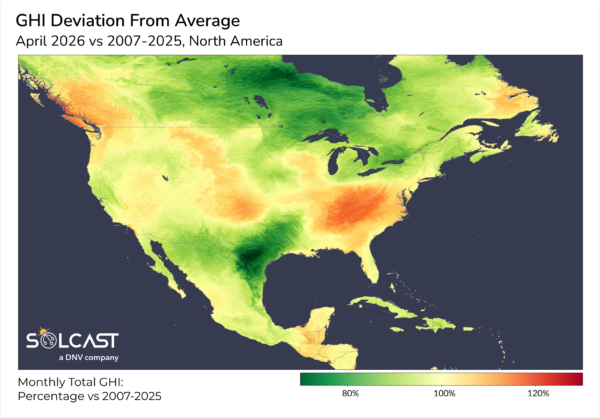
In March, high pressure systems over both the Pacific and Atlantic had supported widespread clear skies and elevated irradiance across the United States. This pattern extended into the first half of April. However, during the second half of the month, the Pacific high pressure ridge flipped to a low pressure configuration. This shift opened the door to more cloud formation and cooler conditions across the western states. As a result, the majority of the US, and particularly California and the solar-rich regions in the west and south, which saw irradiance anomalies of 10–20% above average in March moved back toward neutral conditions for April overall. The change highlights how sensitive western U.S. irradiance is to Pacific pressure patterns, particularly during seasonal transitions.
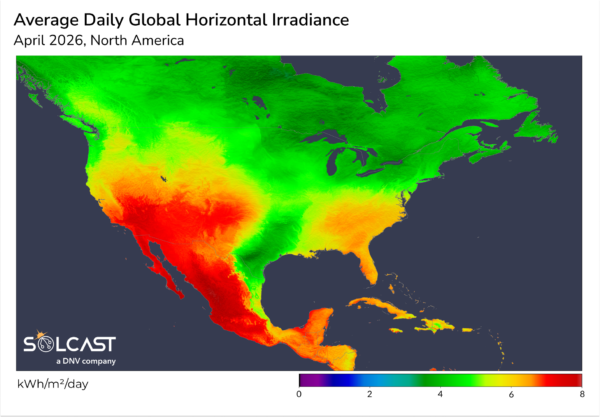
Across the eastern U.S., the Atlantic high pressure system that had driven record warmth in March weakened but did not fully dissipate. The remaining positive pressure anomaly continued to suppress cloud formation and rainfall across much of the interior east, supporting warm, dry, and sunny conditions. States such as Tennessee and Georgia recorded irradiance levels up to 15% above typical April values. Temperature anomalies were also notable, with the Ohio Valley experiencing a standout positive deviation of 5.8 F, and numerous cities recording their warmest April on record.
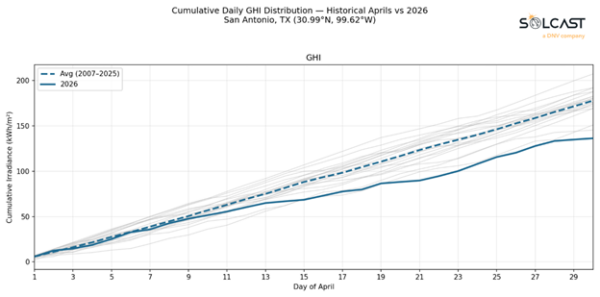
Coastal Texas was a clear exception to this broader eastern pattern. The warm and moisture laden air from the tropics promoted cloud development and intense rainfall episodes, reducing April irradiance along parts of the coast to as much as 20% below average. San Antonio Texas, and the surrounding region, saw 22.1% less irradiance than typical for April. The below data, showing cumulative total GHI for San Antonio, shows that the conditions were around average from until the 9th of April, with the gap widening through mid to late April as persistent cloud cover limited daily gain.
Further north, the cold and cloudy regime that affected Canada in March persisted through April. Disruptions to the polar vortex helped establish a long-lived trough of low pressure over the country, increasing cloud cover and sustaining frequent rain and snowfall. Much of Canada experienced irradiance levels up to 10% below average, with several locations approaching record snow seasons. To the south, as pressure systems destabilised, Mexico’s earlier heat dome weakened. The result was a quiet fade from March’s enhanced sunshine to neutral or slightly negative irradiance conditions during April.
Solcast produces these figures by tracking clouds and aerosols at 1-2km resolution globally, using satellite data and proprietary AI/ML algorithms. This data is used to drive irradiance models, enabling Solcast to calculate irradiance at high resolution, with typical bias of less than 2%, and also cloud-tracking forecasts. This data is used by more than 350 companies managing over 300 GW of solar assets globally.
The views and opinions expressed in this article are the author’s own, and do not necessarily reflect those held by pv magazine.
This content is protected by copyright and may not be reused. If you want to cooperate with us and would like to reuse some of our content, please contact: [email protected].
Please login to comment