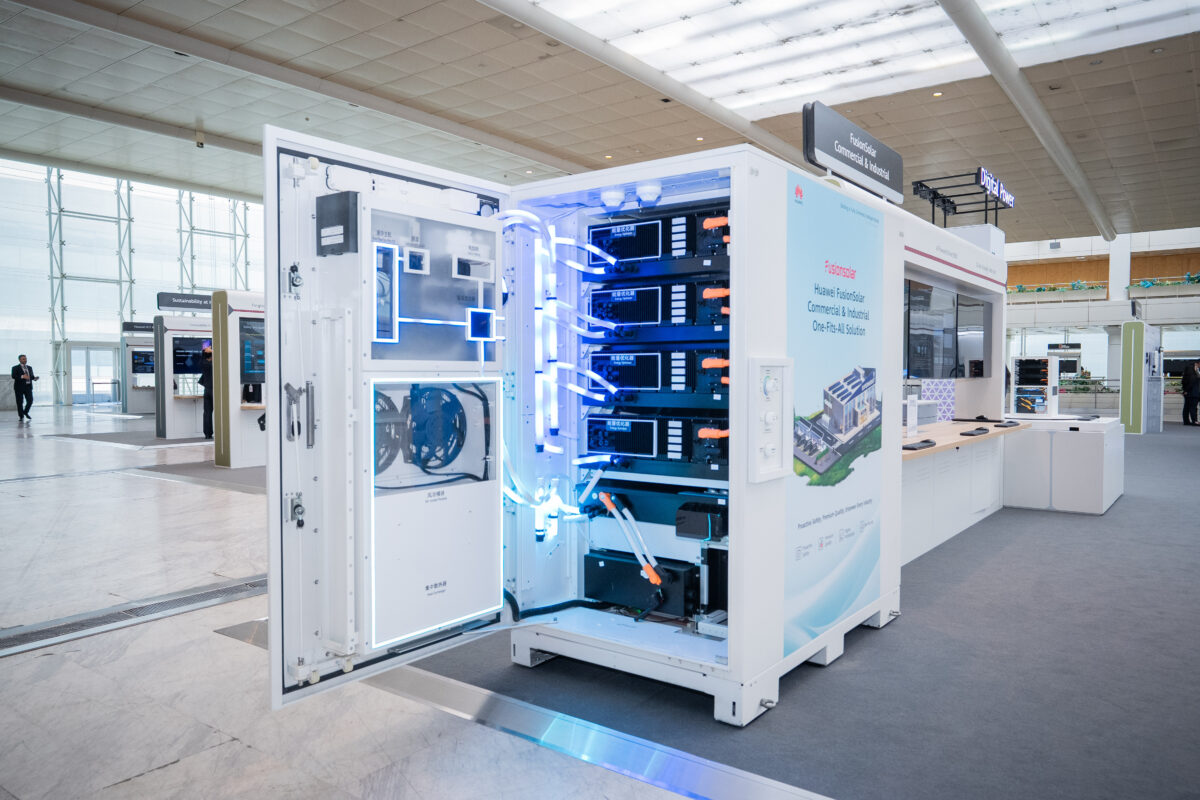





Huawei has unveiled its latest advancements in commercial and industrial (C&I) energy and electric vehicle (EV) charging infrastructure. The C&I One-Fits-All Solution offers Lite, Pro, and Max versions that cover small, medium, and large-scale applications. The manufacturer says this end-to-end solution delivers proactive safety, premium quality, higher profitability, and “one-fits-all” versatility. The new C&I solution is supported by Huawei’s recently-launched LUNA2000-215 Series, a smart hybrid cooling ESS for the C&I market.
The Huawei FusionCharge solution is a Liquid-Cooled Ultra-Fast Charging ecosystem designed to integrate seamlessly with PV and ESS to build a grid-friendly smart network. The solution consists of the FusionCharge Liquid-Cooled Power Unit and charging dispensers. The Power Unit achieves a maximum power of 720 kW, with a single connector capable of 500 A charging current. Key advantages include ultra-fast charging with a maximum of 500 A, capable of adding 200 km of range in 5 minutes.
The company says its innovative fully liquid cooling design extends service life to more than 10 years and reduces O&M costs. A power-sharing matrix saves power grid capacity and improves power utilization. The system’s reserved DC bus is available with a bidirectional AC/DC module, supporting smooth coupling with an ESS, as well as future DC ESS coupling and VPP evolution. The PV+ESS+Charger Solution is dedicated to charging. It offers three unique values: enhanced safety through end-to-end self-development, increased benefits through scheduling and maximizing power resource utilization, all at low costs and enhanced convenience thanks to its all-in-one design and reliable service warranty.
Maximizing efficiency and versatility
The LUNA2000-215 Series achieves the industry's highest system round-trip efficiency (RTE), according to Huawei, with a maximum RTE >91.3%. The company says this is due to its innovative smart hybrid cooling architecture and upgraded pack-level optimization (version 2.0). This optimization uses an efficient bidirectional balancing topology to achieve 100% depth of discharge (DOD) for each pack and a 2% higher available energy over the battery lifecycle. Furthermore, the system's smart hybrid cooling design reduces the temperature difference between cells to less than 2.2 degrees, resulting in a 2% higher lifecycle battery State of Health (SOH).
Huawei says the new solution extends value to installers through easy design, purchasing, installation (less than 2 hours per cabinet), commissioning, and O&M. The ESS cabinet's high-density integrated design and prefabricated installation significantly reduce installation time and cost.
New safety architecture
Huawei has also introduced its Cell-to-Consumption (C2C) Dual-link Safety Architecture, which provides electrical and thermal safety from the cell to the point of consumption. The architecture offers cell-level management, proprietary pack-level insulation resisting up to 1500 V, and system-level cell-to-ground short circuit protection achieving rapid shutdown within 5 ms.
In the area of thermal safety, the architecture provides cell-level cooling with a heat insulation layer and a liquid cooling plate, is pack-level heat-resistant, features IP65-rated airtight designs that eliminate fire risks, and has system-level L-shaped directional air ducts for the exhaust of easily combustible gases.
This content is protected by copyright and may not be reused. If you want to cooperate with us and would like to reuse some of our content, please contact: editors@pv-magazine.com.

By submitting this form you agree to pv magazine using your data for the purposes of publishing your comment.
Your personal data will only be disclosed or otherwise transmitted to third parties for the purposes of spam filtering or if this is necessary for technical maintenance of the website. Any other transfer to third parties will not take place unless this is justified on the basis of applicable data protection regulations or if pv magazine is legally obliged to do so.
You may revoke this consent at any time with effect for the future, in which case your personal data will be deleted immediately. Otherwise, your data will be deleted if pv magazine has processed your request or the purpose of data storage is fulfilled.
Further information on data privacy can be found in our Data Protection Policy.