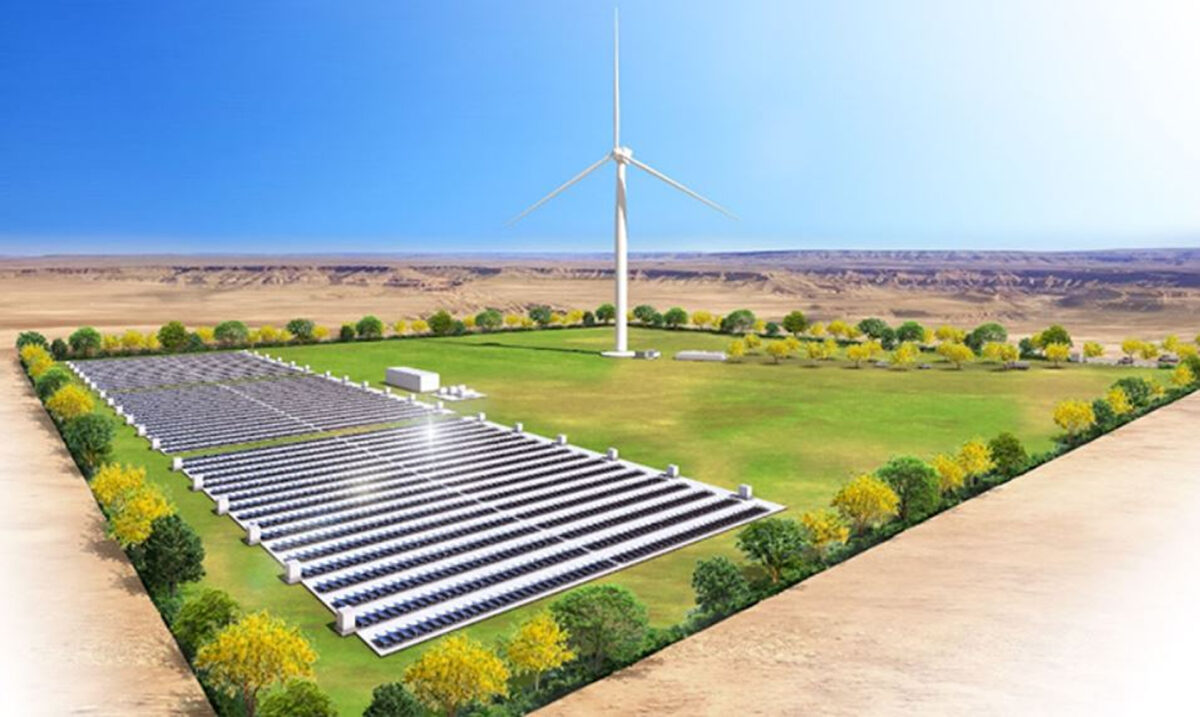





Toshiba ESS, a unit of Japanese industrial conglomerate Toshiba, has launched a pilot project to test a hybrid wind-solar power plant linked to battery storage in the Kingdom of Saudi Arabia.
The project was developed with support from Japan’s New Energy and Industrial Technology Development Organization (NEDO) and Saudi Electricity Co. (SEC) and is scheduled to run until May 2028.
“By combining wind and solar with battery storage, a stable power supply can be achieved in remote areas, even with highly fluctuating renewable energy sources,” Toshiba said, noting that unstable renewable energy supply is emerging in many remote Saudi distribution systems. “These issues can lead to power outages and voltage drops for electricity consumers.”
The project includes a small ground-mounted solar plant, a battery, and an energy management system (EMS) at a wind power plant operated by SEC on the outskirts of Riyadh.
The storage system will use two types of batteries: power-oriented batteries, which have high cycle life and smooth fluctuations in renewable output, and energy-oriented batteries, which provide large energy capacity and shift power peaks.
“In addition, to improve the economic viability of the hybrid renewable energy power generation system, we will demonstrate the optimization of battery output and capacity. Furthermore, because this demonstration project also contributes to GHG reduction, we will monitor GHG reductions during the demonstration project,” Toshiba explained.
Further technical details about the project were not disclosed.
This content is protected by copyright and may not be reused. If you want to cooperate with us and would like to reuse some of our content, please contact: editors@pv-magazine.com.



By submitting this form you agree to pv magazine using your data for the purposes of publishing your comment.
Your personal data will only be disclosed or otherwise transmitted to third parties for the purposes of spam filtering or if this is necessary for technical maintenance of the website. Any other transfer to third parties will not take place unless this is justified on the basis of applicable data protection regulations or if pv magazine is legally obliged to do so.
You may revoke this consent at any time with effect for the future, in which case your personal data will be deleted immediately. Otherwise, your data will be deleted if pv magazine has processed your request or the purpose of data storage is fulfilled.
Further information on data privacy can be found in our Data Protection Policy.