




Aging plants and components, the need to add storage to solar to make it more ‘grid-friendly’, and the threat posed by cybercriminals are some of the dilemmas today’s independent power producers (IPPs) and engineering, procurement and construction (EPC) companies face.
These end up impacting O&M at plant level, and as the solar sector’s development ambition has grown so has its deployment of technological solutions to help asset owners keep tabs on their plant’s performance.
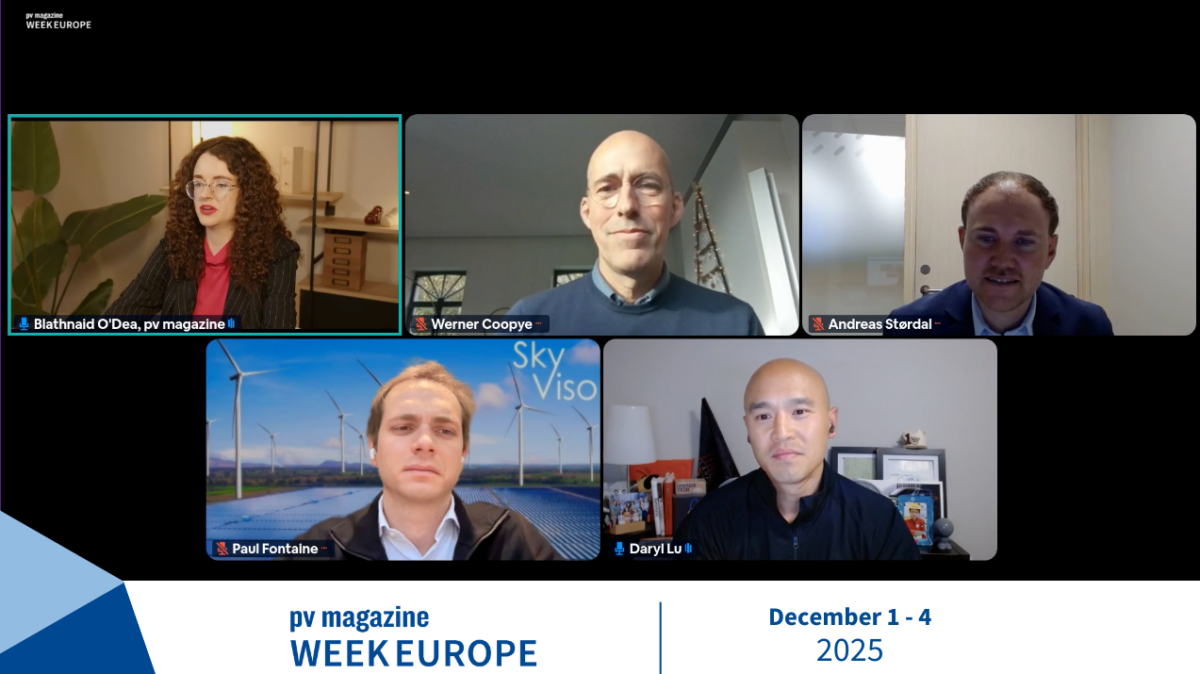
At this year’s Week Europe 2025 virtual conference event curated by pv magazine, a session dedicated to technology’s evolving role within European solar O&M featured a variety of industry speakers discussing applications such as drone monitoring, artificial intelligence, cybersecurity firewalls, data management platforms, digital twins, and more.
Hind Abdulla, researcher at Khalifa University in the United Arab Emirates, said that because PV systems have a relatively simple design compared to other renewable resources like wind, there was a misconception that they would require minimal maintenance, leading to overconfidence in component reliability.
“This is currently changing,” she said, adding that as PV capacity is expanding, there has been more investment in condition monitoring systems, UAV-based inspections, thermography, AI-based diagnostics, and operators are now realizing the cost of under maintaining PV assets, like higher degradation, performance losses or missed revenue.
“Modern PV O&M is now moving towards an integrated, data-driven maintenance ecosystem,” said Abdulla, adding that she has seen increased attention towards prescriptive maintenance, which “builds on predictive maintenance by recommending the optimal actions at the right time”, assisting operators to balance all resources, “efficiently prioritizing repairs, smart scheduling for repairs, and also allocate their resources where they yield the highest impact.”
“We are in an industry coming from a very high focus on rapid build out, which in many ways is good but also means we have, at least historically, been lagging behind on even such a basic thing as standardizing the technology,” said Andreas Stordal, VP of Production Optimization at Scatec Asa.
Coming from the IPP and EPC perspective, Stordal said that Scatec is doing a big push on automation, robotization, and drones to ensure its assets are “entering midlife gracefully” with a particular focus on monitoring module health and degradation.
He also highlighted the scalability challenge: “We’re deploying more and more plants. Many of these plants are getting bigger which means that we need to have digital tools and a digital foundation which allows us to operate these plants in an effective way.”
And he mentioned another pain point: companies moving into operating hybrid assets, including energy storage – “which means that there’s challenges coming from that side.”
Khalifa University’s Abdulla singled out digital twins and reinforcement learning algorithms as two emerging PV O&M trends.
Werner Coppye, Chief Technology Officer, at software services company 3E, explained how digital twins can give asset owners a comprehensive overview of their plants by creating a virtual replica that can be continuously updated with real data. If deployed correctly, this can offer big plant owners a competitive advantage, he said, emphasizing the importance of interoperability.
And Paul Fontaine, CEO and founder of SkyVisor, spoke about the fall in drone prices over the last few years and how the introduction of new European legislation that simplifies the deployment of drone solutions has made drone-based monitoring and inspection more popular in O&M.
Data quality is extremely important in the use of technology in plant monitoring, and all panelists had insightful points to make on this. Daryl Lu, CEO of LCOE.ai, said a lot of organizations his company deals with are “stuck with a lot of muddied, siloed data” and they are still trying to figure out their digital strategy.
Lu said focusing on how intelligent use of data can deliver value is more important than jumping on the technology bandwagon. A lot of the fuss about artificial intelligence (AI) can be overstated, he said.
Manuel Llenas, Regional Director, EU at GreenPowerMonitor, a DNV company, agreed with Lu, adding that companies need a “clear roadmap” of the outcome they are trying to get when they deploy AI solutions, and this depends on the scale and type of asset they have – whether it’s a rooftop or a few thousand ground-mounted panels.
Robust cybersecurity was one thing that all speakers agreed on as a must-have for utility-scale asset owners. Fabian Michel, Head of Cybersecurity and Operational Technology at Belectric – a sponsor of the Week Europe 2025 event – said that cybersecurity is not a topic investors should ignore.
“A hacker attack can trigger the plant to shut down and have a loss of revenue” he said, adding that such an attack can also change the behavior of a plant bringing severe consequences to the grid. Michel pointed out that investing in cybersecurity for PV plants is important on a national level and should be part of each country’s national defense spending.
He explained he recommends asset owners have next-generation firewalls with advanced threat protection in place to protect their sites at all times. Coming from the EPC perspective, Abo Energy’s Head of Solar, Wojtek Swietochowski mentioned high costs as a potential difficulty for companies investing in cybersecurity, although he said he fully agreed with Michel’s view that it is a must-have. He added that legally and contractually, such solutions are required of asset owners, and he pointed out that criminals can attack plants through components like inverters if they are compromised.
Going back to Stordal’s point about the fast development of the PV industry and the pressure to deliver at scale, Swietochowski, who is also vice chair at SolarPower Europe’s Lifecycle Quality Workstream, explained that best practices around hardware and software and their use in O&M are constantly changing. “Therefore, the industry should not only rely on standards, but sometimes on guidelines.” Asset owners should maintain open communication with manufacturers to ensure their equipment works well in the field. He also suggested that repowering some plants after a decade or so might end up being the best option for delivering return on investment for asset owners.
This content is protected by copyright and may not be reused. If you want to cooperate with us and would like to reuse some of our content, please contact: editors@pv-magazine.com.

By submitting this form you agree to pv magazine using your data for the purposes of publishing your comment.
Your personal data will only be disclosed or otherwise transmitted to third parties for the purposes of spam filtering or if this is necessary for technical maintenance of the website. Any other transfer to third parties will not take place unless this is justified on the basis of applicable data protection regulations or if pv magazine is legally obliged to do so.
You may revoke this consent at any time with effect for the future, in which case your personal data will be deleted immediately. Otherwise, your data will be deleted if pv magazine has processed your request or the purpose of data storage is fulfilled.
Further information on data privacy can be found in our Data Protection Policy.