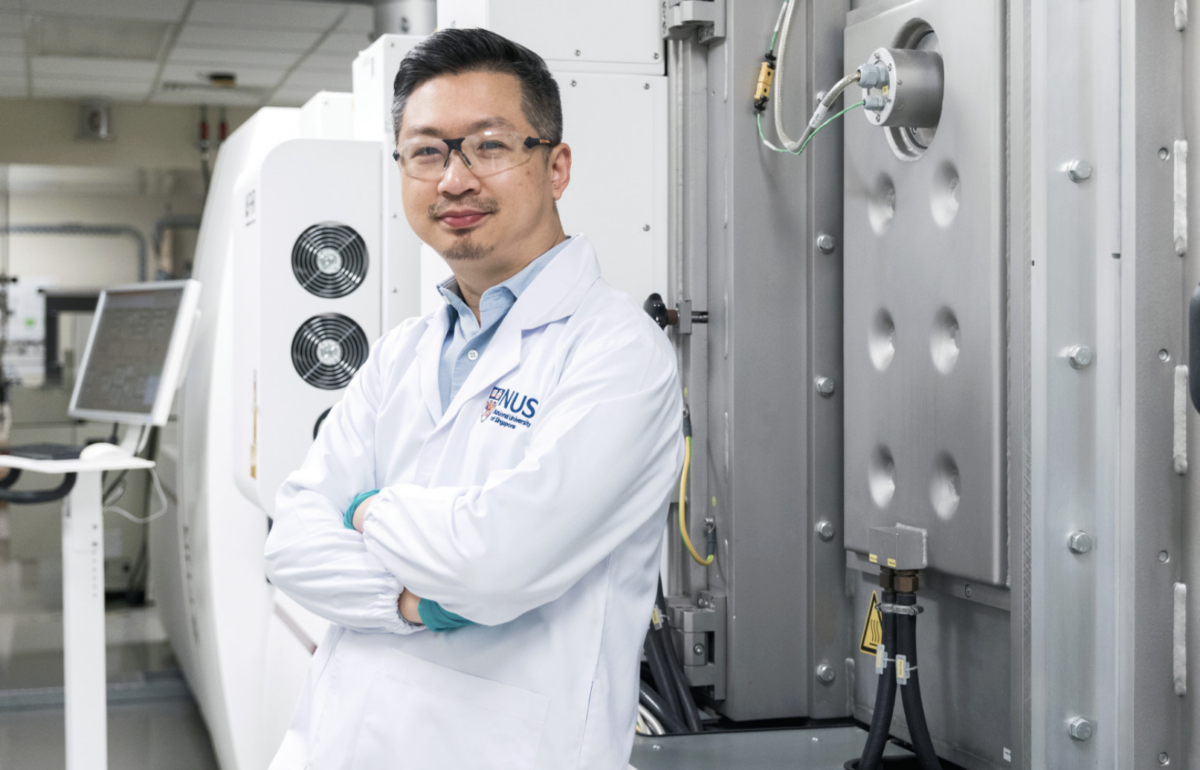





Researchers at the National University of Singapore have demonstrated a vapor-deposition process that purportedly enables perovskite-silicon tandem solar cells to operate with high efficiency and sustained durability on industrial-grade textured silicon wafers.
The team claimed power conversion efficiencies above 30% and operational stability exceeding 2,000 hours, including a T90 lifetime of more than 1,400 hours at 85 C under one-sun illumination, which is defined as 1,000 W/sqm – a standard industry stress test. The work marks the first successful application of vapor deposition on micrometer-scale textured silicon wafers, overcoming a long-standing manufacturing constraint that has limited the scalability of perovskite-silicon tandem devices.
The research was led by Hou Yi, assistant professor in the Department of Chemical and Biomolecular Engineering at NUS and head of the Perovskite-based Multijunction Solar Cells Group at the Solar Energy Research Institute of Singapore (SERIS). The team published their findings in Science earlier this month.
“The key novelty of our work is one of the first successful demonstrations of high-quality vapour-deposited perovskite layers conformally integrated onto industrial, micrometre-textured silicon wafers, the same wafer architecture used in commercial solar manufacturing,” Hou told pv magazine, adding that the process enabled devices with high efficiency and “unprecedented thermal and operational stability, bringing the technology significantly closer to real-world deployment.”
Vapor deposition is widely viewed as an industry-compatible production route, but prior attempts failed to produce stable perovskite layers on the steep pyramid textures of industrial silicon wafers. The NUS team addressed this by designing a surface-binding molecule that promotes balanced adsorption of perovskite precursor compounds during vapor deposition, enabling uniform film formation and improved thermal resilience.
The resulting tandem cells maintained stable performance under prolonged exposure to heat and continuous illumination, conditions that have historically caused rapid degradation in perovskite-based devices. The durability demonstrated places the cells among the most stable perovskite-silicon tandems reported to date and supports their suitability for rooftop, utility-scale and industrial solar applications.
The researchers said the next phase of work will focus on scaling the process from laboratory-scale devices to large-area modules and integrating the vapor-deposition method into pilot manufacturing lines, a step required before commercial deployment.
“In parallel, we are developing next-generation perovskite compositions and interface designs tailored for manufacturability, with the aim of enabling reliable, high-volume production of perovskite-silicon tandem solar cells,” said Hou.
In June, SERIS researchers reported a world-record certified power conversion efficiency of 26.4% for a perovskite-organic tandem solar cell, achieving 26.7% on larger test devices and marking the highest performance for this technology to date.
This content is protected by copyright and may not be reused. If you want to cooperate with us and would like to reuse some of our content, please contact: editors@pv-magazine.com.

By submitting this form you agree to pv magazine using your data for the purposes of publishing your comment.
Your personal data will only be disclosed or otherwise transmitted to third parties for the purposes of spam filtering or if this is necessary for technical maintenance of the website. Any other transfer to third parties will not take place unless this is justified on the basis of applicable data protection regulations or if pv magazine is legally obliged to do so.
You may revoke this consent at any time with effect for the future, in which case your personal data will be deleted immediately. Otherwise, your data will be deleted if pv magazine has processed your request or the purpose of data storage is fulfilled.
Further information on data privacy can be found in our Data Protection Policy.