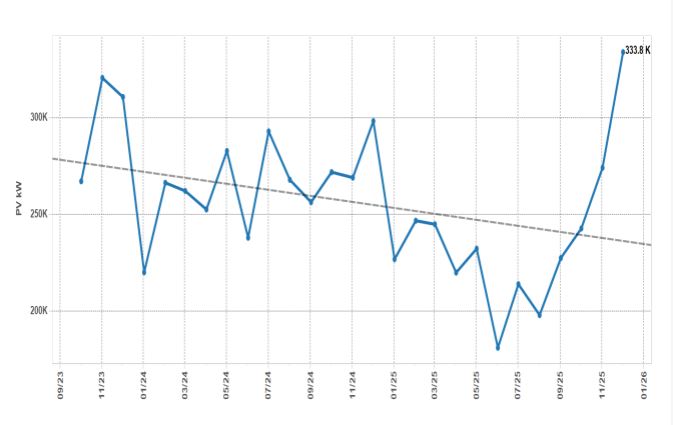





The latest monthly update from solar and storage market analyst SunWiz shows 334 MW of new rooftop solar systems (0 kW to 100 kW) was installed across Australia in December 2025, up from the 279 MW deployed in the previous month.
The figure represents a 22% increase in national market volumes compared to November 2025 with SunWiz Managing Director Warwick Johnston saying the PV industry had finished the year on a high.
“This is the first time there’s been a four-month increase in volumes recorded since November 2023,” he said, noting that the growth delivered the best December monthly volume in two years.
Despite the strong end to the year, Johnston said a “slow first half” to 2025 meant the annual volume lags 11% behind the volume reached in 2024, when about 3.19 GW of small-scale solar was installed.
Johnston said the federal government’s recently overhauled AUD 7.2 billion ($4.81 billion) home battery subsidy program had a major influence of the December results with the 10 kW to 15 kW and 15 kW to 20 kW segments enjoying strong growth as the national average system size increased to 11.57 kW, up 0.76 kW on the previous month.
“The key driver of this end-of-year surge is clearly that the solar industry is riding the coattails of the battery boom,” he said. “While there was a late surge in commercial PV installation volumes, as is often the case at this time of year, the real growth engine has been large residential systems, which are clearly associated with battery installations.”
The Australian government’s Cheaper Home Batteries program, which has been in place for six months, provides discounts of up to 30% on the upfront cost of installing small-scale battery systems alongside new or existing rooftop solar. More than 184,600 home batteries with a combined storage capacity of 4.27 GWh have already been installed under the initiative.
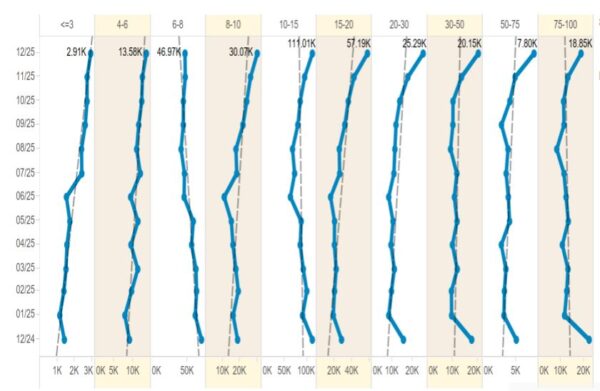
Sunwiz said all small-scale solar segments recorded increases in the past month, with the 10-15 kW segment growing by 15% and the 15 kW to 20 kW sector climbing by 34%.
The 50 kW to 70 kW segment reported the strongest growth of 58%, followed by the 30 kW to 50 kW and 75 kW to 100 kW segments, the latter two with 49% and 44% growth. Residential systems with less than15 kW grew the least, with 12% of increase.
At the state level, the data shows strong growth across the nation with the Northern Territory charting an “unbelievable” 91% month-on-month growth rate. The Australian Capital Territory grew by 47% while even the state with the least growth, Western Australia, saw an increase of 15%. New South Wales still leads the country on total volume.
This content is protected by copyright and may not be reused. If you want to cooperate with us and would like to reuse some of our content, please contact: editors@pv-magazine.com.


By submitting this form you agree to pv magazine using your data for the purposes of publishing your comment.
Your personal data will only be disclosed or otherwise transmitted to third parties for the purposes of spam filtering or if this is necessary for technical maintenance of the website. Any other transfer to third parties will not take place unless this is justified on the basis of applicable data protection regulations or if pv magazine is legally obliged to do so.
You may revoke this consent at any time with effect for the future, in which case your personal data will be deleted immediately. Otherwise, your data will be deleted if pv magazine has processed your request or the purpose of data storage is fulfilled.
Further information on data privacy can be found in our Data Protection Policy.