




From pv magazine Spain
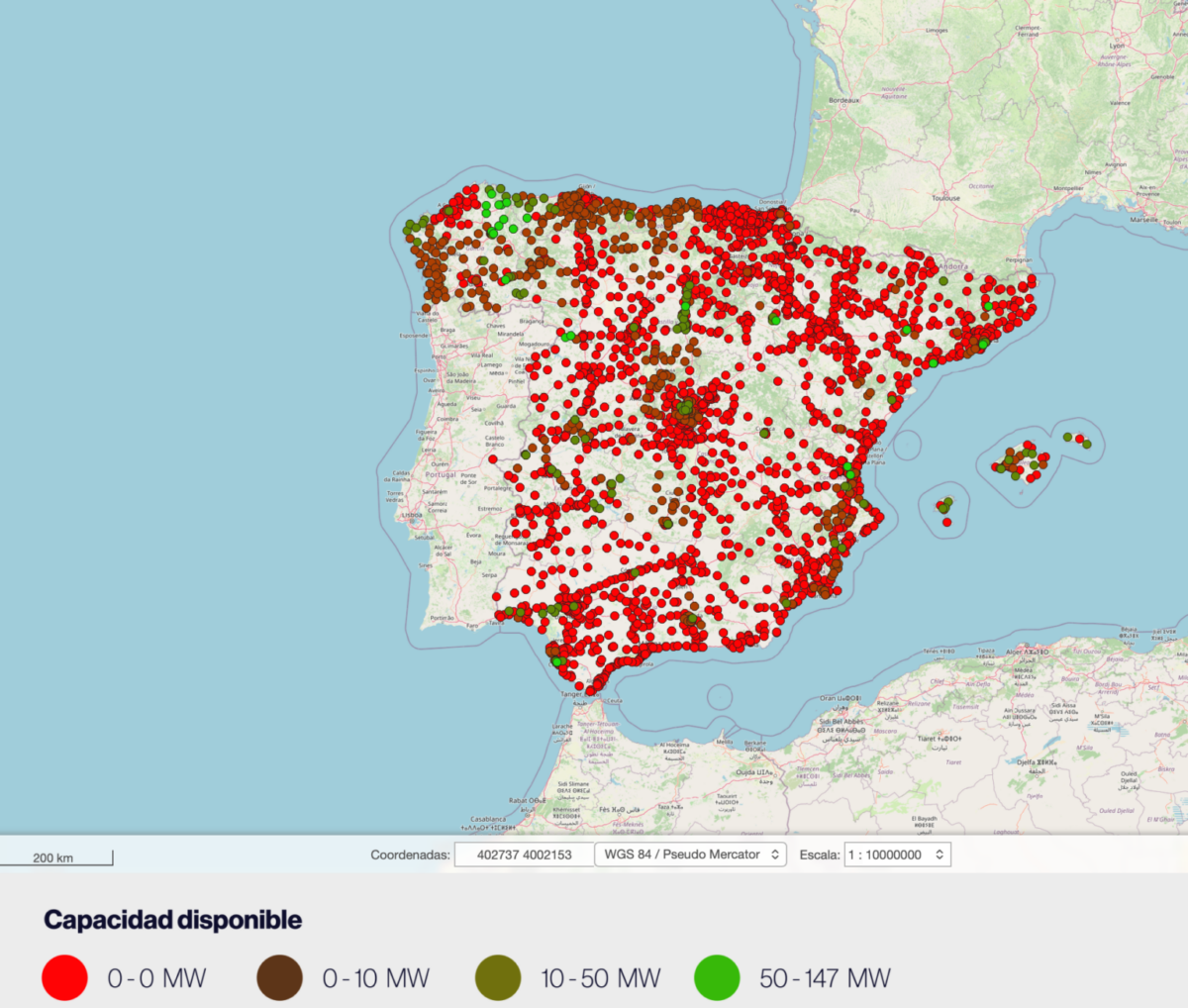
Spain’s electricity grid is under growing strain after losing almost 2.8 GW of available capacity in just two months, pushing overall saturation to 85.7%, according to the latest update of a study by the Industry and Energy Forum and consultancy firm Opina 360.
The study, based on data as of Dec. 1, 2025, reviewed 6,108 substations operated by Spain’s 29 main electricity distributors, covering about 97% of national supply points. It found that the share of substations with no available capacity rose from 82.4% in October to 85.7%, leaving 5,235 facilities fully saturated.
In capacity terms, available power fell from just over 10 GW to 7,363 MW, indicating that rising electricity demand from electrification and new industrial projects is outpacing grid reinforcement.
Northern and central regions are experiencing the most acute structural saturation. The Basque Country recorded the highest level at 99.8%, followed by Navarre and La Rioja at 99.2%. At the provincial level, eight provinces are fully saturated: Almería, Málaga, Zaragoza, Albacete, Guadalajara, Salamanca, Álava and Biscay, effectively blocking new grid connections for technical reasons.
Only six provinces retain more than 50% of available substation capacity: the Balearic Islands, Ourense, Pontevedra, Las Palmas, Asturias and Lugo. The report cautions, however, that part of this apparent surplus is constrained by technical limits or dependent on pending transmission upgrades.
In absolute terms, Galicia has the largest volume of available capacity at 1,720.8 MW, followed by Catalonia with 1,024 MW and Andalusia with 870.5 MW. The analysis highlights mismatches between capacity availability and industrial demand, particularly in Barcelona, where much of the remaining capacity is located in older urban areas poorly suited to current industrial requirements.
Overall, the study points to rapid depletion of grid capacity across the country. Regions including Asturias, the Balearic Islands, the Canary Islands and Castilla-La Mancha recorded sharp increases in saturation over the two-month period, while almost all regions saw a net loss of available substation capacity.
This content is protected by copyright and may not be reused. If you want to cooperate with us and would like to reuse some of our content, please contact: editors@pv-magazine.com.

There appear to be conflicting points in this article. The “blame” is put on industrialization and electrification, which would add power draw. The article starts with “available power fell from just over 10 GW to 7,363 MW” showing that supply instead went down, having little to do with long term electrification.
Planning is crucial now to avoid problems related to capacity. Whole new stand alone systems need to be incorporated now. In addition, all rooftops, that can generate solar, needs to be filled with panels and tied into the grid. Solar is surprisingly easy for this due to generation proximity, that will use existing distribution.
Accurate kwh pricing should naturally push consumption (ev charging, forklifts, trucks etc) into times that will use power derived from solar being generated and not the storage.
Nuclear has decreased while solar and wind are surging! Yet we hear of the SMR’s while none have been built, only money for development, while the study by Yale shows 30 times more high level waste, 35 times more low-level waste per kilowatt! Why the silence on geothermal, is that so the big players can scarf it up? Or are they truly satanic and wish to nuke us all to death? Peace.