




From pv magazine India.
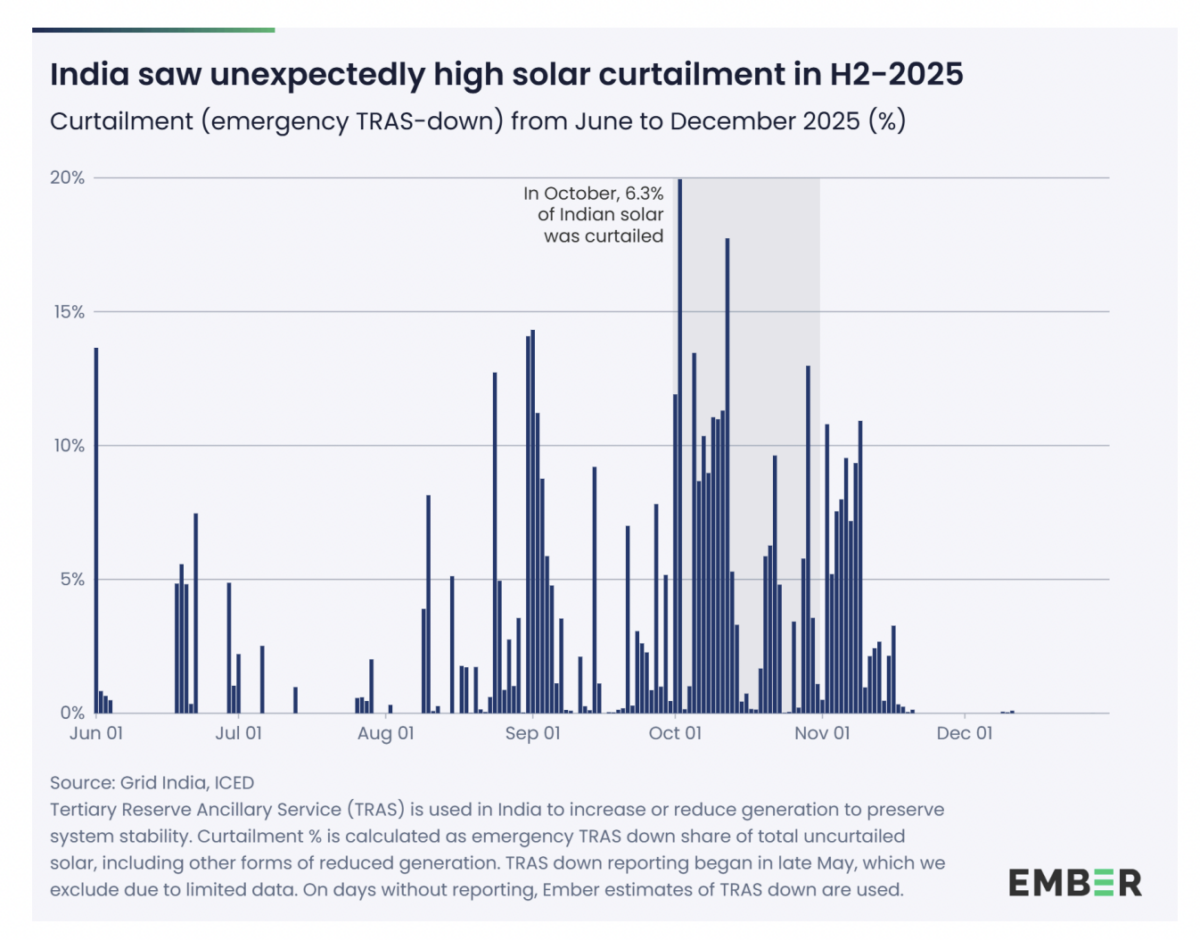
India had to curtail 2.3 TWh of solar generation between late May and December 2025, including 0.9 TWh in October alone, according to a new report from energy think tank Ember.
The report states that a combination of forecast error, low daytime demand due to unusually mild temperatures, and rising solar generation led to periods of daytime oversupply in 2025.
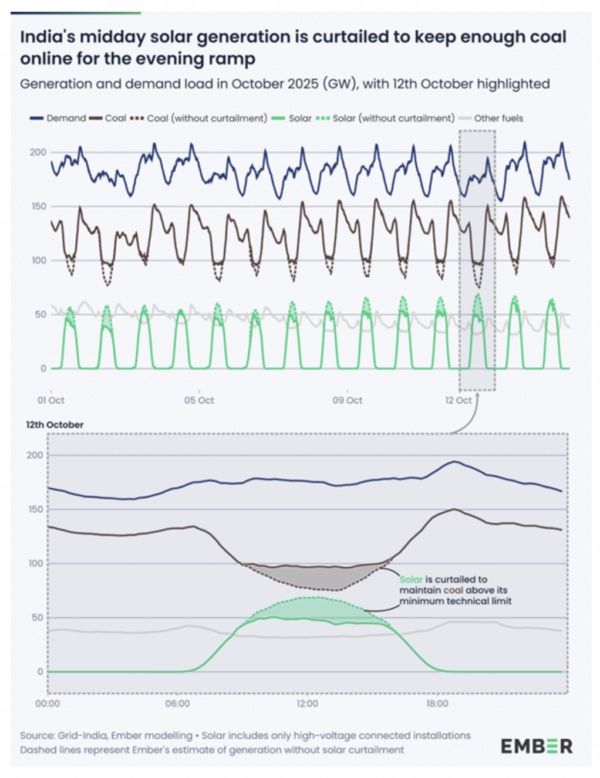
It adds that the inability to flex the coal fleet beyond technical limits restricted the system’s ability to provide sufficient headroom, making solar curtailment necessary to maintain grid security.
“Weaker-than-forecast daytime demand coincided with continued solar expansion, resulting in periods where cumulative supply was higher than demand,” the report explains. “This was because enough coal capacity had to remain online to meet the evening demand, with the mismatch leading to grid security concerns.”
Ember says that the extent of avoided curtailment in the future will depend on how accurately demand is forecasted, how decisively India resolves transmission bottlenecks and how rapidly it scales flexibility resources.
“A massive 38 GW of solar capacity was added in 2025. Yet, curtailment of renewable energy emerged as a key theme of the year, driven by transmission constraints and grid security concerns through emergency measures. In many ways, such curtailment defeats the very purpose of building this capacity,” says the report’s author Ruchita Shah, Energy Analyst at Ember.
“While grid security-related curtailment in 2025 may not be a major concern in isolation, as it was largely triggered by lower-than-expected demand, it served as a real-world stress test for a high-solar future. It highlighted a fundamental reality: clean energy cannot scale efficiently without flexibility,” she added.
Ember's report adds that transmission constraints are the largest cause of solar curtailment nationally, and represent the largest risk to new projects as they are not guaranteed to be compensated financially.
The think tank estimates that affected solar generators received an estimated INR 5,750 million – INR 6,900 million ($63 million – $76 million) in compensation through emergency Tertiary Reserve Ancillary Service (TRAS) mechanisms.
There is also an environmental price to pay, the report highlights, as the curtailed solar could have avoided around 2.1 million tonnes of CO2 emissions had it displaced coal generation, roughly equivalent to annual emissions by 0.4 million households in India.
This content is protected by copyright and may not be reused. If you want to cooperate with us and would like to reuse some of our content, please contact: editors@pv-magazine.com.



By submitting this form you agree to pv magazine using your data for the purposes of publishing your comment.
Your personal data will only be disclosed or otherwise transmitted to third parties for the purposes of spam filtering or if this is necessary for technical maintenance of the website. Any other transfer to third parties will not take place unless this is justified on the basis of applicable data protection regulations or if pv magazine is legally obliged to do so.
You may revoke this consent at any time with effect for the future, in which case your personal data will be deleted immediately. Otherwise, your data will be deleted if pv magazine has processed your request or the purpose of data storage is fulfilled.
Further information on data privacy can be found in our Data Protection Policy.