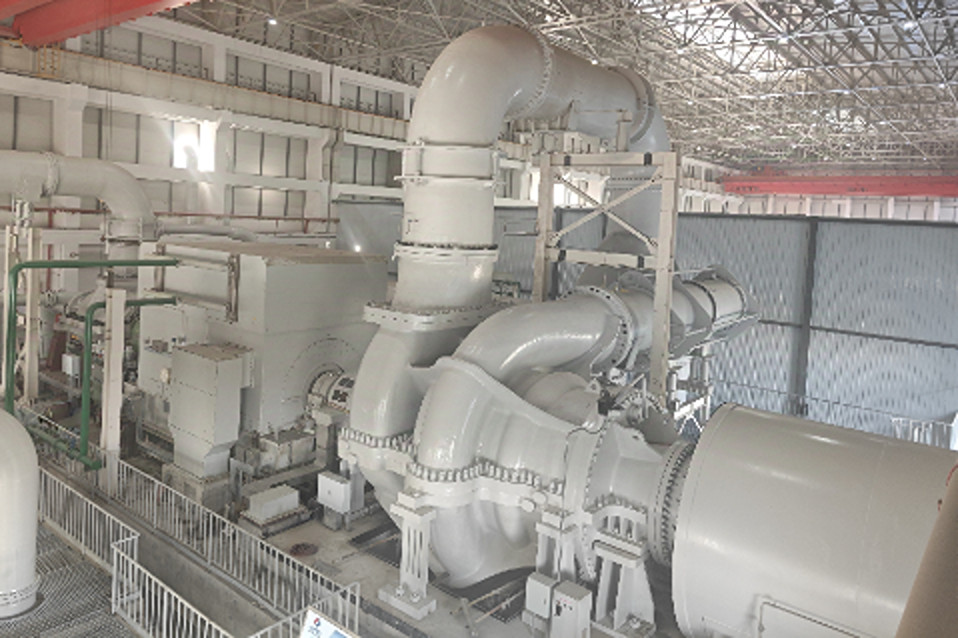





The Institute of Engineering Thermophysics of the Chinese Academy of Sciences (CAS) has unveiled a new type of compressor for applications in compressed air energy storage (CAES).
Described as the world’s most powerful single-unit CAES compressor, the system can reportedly reach a maximum discharge pressure of 10.1 MPa and a rated power of 101 MW. It operates across a load range of 38.7% to 118.4% and achieves an efficiency of 88.1% at maximum discharge pressure.
“We successfully developed the world's first compressed air energy storage compressor with a single-unit power exceeding 100 MW, possessing complete independent intellectual property rights,” the CAS said in a statement. “Compared to existing compressed air energy storage compressors, its single-unit power is increased by more than 100%, and its unit cost is significantly reduced, while also offering advantages such as high efficiency, high pressure, and a wide operating range.”
According to CAS, the compressor more than doubles the single-unit power of existing CAES compressors while significantly reducing unit costs. It also cited high efficiency, high pressure capability and a wide operating range among the system’s key advantages.
CAS added that the system has passed third-party testing conducted by a company accredited by the China National Accreditation Service for Conformity Assessment (CNAS). Test results reportedly show that the compressor meets international standards, with no further technical details about the compressor being disclosed.
China is currently leading global deployment of large-scale CAES projects.
In May 2024, Zhongchu Guoneng Technology Co., Ltd. (ZCGN) switched on the world’s largest compressed air energy storage project in in Feicheng, China's Shandong province. The $207.8 million energy storage power station has a capacity of 300 MW/1,800 MWh and uses an underground salt cave.
Moreover, a state-led consortium announced in February 2025 a 300 MW/1200 MWh CAES project in Xinyang, Henan province, featuring an entirely artificial underground cavern—China’s first of its kind. The CNY 2.15 billion ($310 million) project, backed by local state-owned enterprise Xinyang Construction Investment Group, CAES technology specialist China Energy Storage National Engineering Research Center (China Energy Storage), and two other state investment firms, is set for completion by the end of 2026.
The CAS itself switched on a 100 MW CAES plant in Zhangjiakou, in China's Hebei province, in October 2022. A few months earlier, Chinese state-owned energy group Huaneng, Tsinghua University, and China National Salt Industry Group commissioned the Jiangsu Jintan Salt Cavern Compressed Air Energy Storage Project in Changzhou, Jiangsu province. It has a storage capacity of 300 MWh and a power generating capacity of 60 MW.
This content is protected by copyright and may not be reused. If you want to cooperate with us and would like to reuse some of our content, please contact: editors@pv-magazine.com.


By submitting this form you agree to pv magazine using your data for the purposes of publishing your comment.
Your personal data will only be disclosed or otherwise transmitted to third parties for the purposes of spam filtering or if this is necessary for technical maintenance of the website. Any other transfer to third parties will not take place unless this is justified on the basis of applicable data protection regulations or if pv magazine is legally obliged to do so.
You may revoke this consent at any time with effect for the future, in which case your personal data will be deleted immediately. Otherwise, your data will be deleted if pv magazine has processed your request or the purpose of data storage is fulfilled.
Further information on data privacy can be found in our Data Protection Policy.