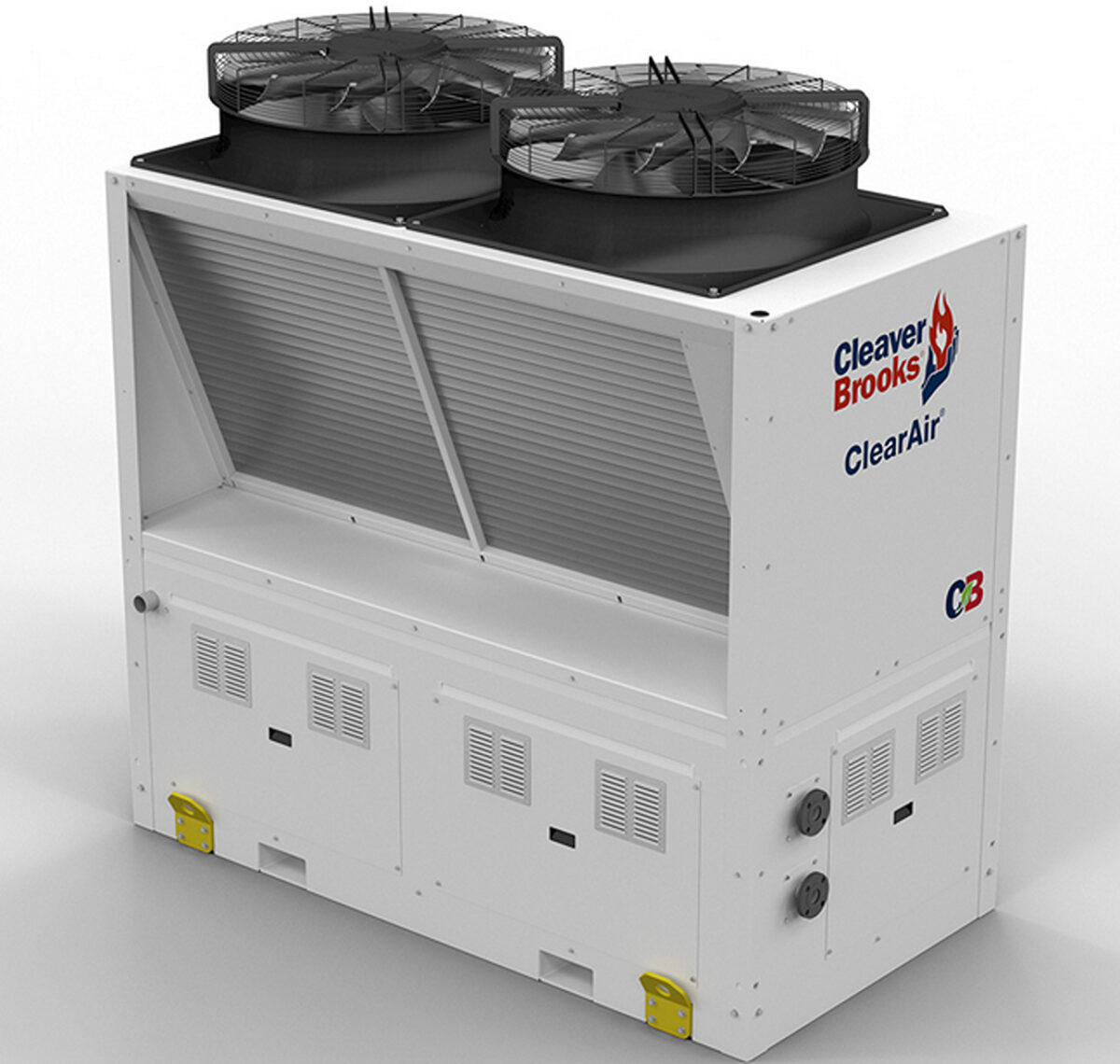





US-based industrial heating company Cleaver-Brooks has launched a new air-to-water heat pump for hydronic heating applications.
Hydronic systems circulate hot water through pipes to radiators, baseboards, or underfloor tubing, warming spaces efficiently. The water, heated by a boiler or heat pump, flows in a closed loop, delivering energy-efficient heat. These systems are widely used in residential, commercial, and industrial buildings.
“The ClearAir heat pump is engineered for versatility across a wide range of building types,” the company said. “From schools and universities to offices, hospitals, and multi-family housing, it delivers consistent performance at every scale. Whether serving a single facility or a large campus, the system adapts to the heating demands of each application.”
The system can reportedly generate hot water up to 80 C, a threshold that the manufacturer describes as compatible with high-temperature coils, radiators, and other hydronic terminal units without requiring distribution upgrades.
The ClearAir unit measures 2,488 mm × 1,316 mm × 2,421 mm and weighs 1,677 kg. It delivers 103 kW of thermal output with a coefficient of performance (COP) of 2.7 under standard conditions. The system features a monobloc design and uses R-513A refrigerant.
Connectivity and control are handled through an integrated, factory-installed controller supporting BACnet and Modbus protocols, enabling seamless integration with building management systems.
Cleaver-Brooks notes the potential for hybrid plant designs, combining ClearAir with existing boilers for backup heating during extreme conditions or peak demand.
“Well suited for both new construction and retrofit projects, the ClearAir heat pump integrates seamlessly into existing hydronic systems or new designs,” the company added. “Its compact, modular, and scalable design ensures owners, contractors, and engineers can rely on a single platform to meet diverse project needs.”
In single heat pump setups, one system serves the entire heating load. In multiple-unit designs, two or more heat pumps share the load. In a hybrid configuration, one or more heat pumps are paired with one or more boilers, making it the preferred design for most applications. This setup addresses capacity, redundancy, and low outdoor temperature limitations common to single or multiple heat pump systems.
This content is protected by copyright and may not be reused. If you want to cooperate with us and would like to reuse some of our content, please contact: editors@pv-magazine.com.



By submitting this form you agree to pv magazine using your data for the purposes of publishing your comment.
Your personal data will only be disclosed or otherwise transmitted to third parties for the purposes of spam filtering or if this is necessary for technical maintenance of the website. Any other transfer to third parties will not take place unless this is justified on the basis of applicable data protection regulations or if pv magazine is legally obliged to do so.
You may revoke this consent at any time with effect for the future, in which case your personal data will be deleted immediately. Otherwise, your data will be deleted if pv magazine has processed your request or the purpose of data storage is fulfilled.
Further information on data privacy can be found in our Data Protection Policy.