Thermoacoustic heat pumps on the verge of commercial breakthrough

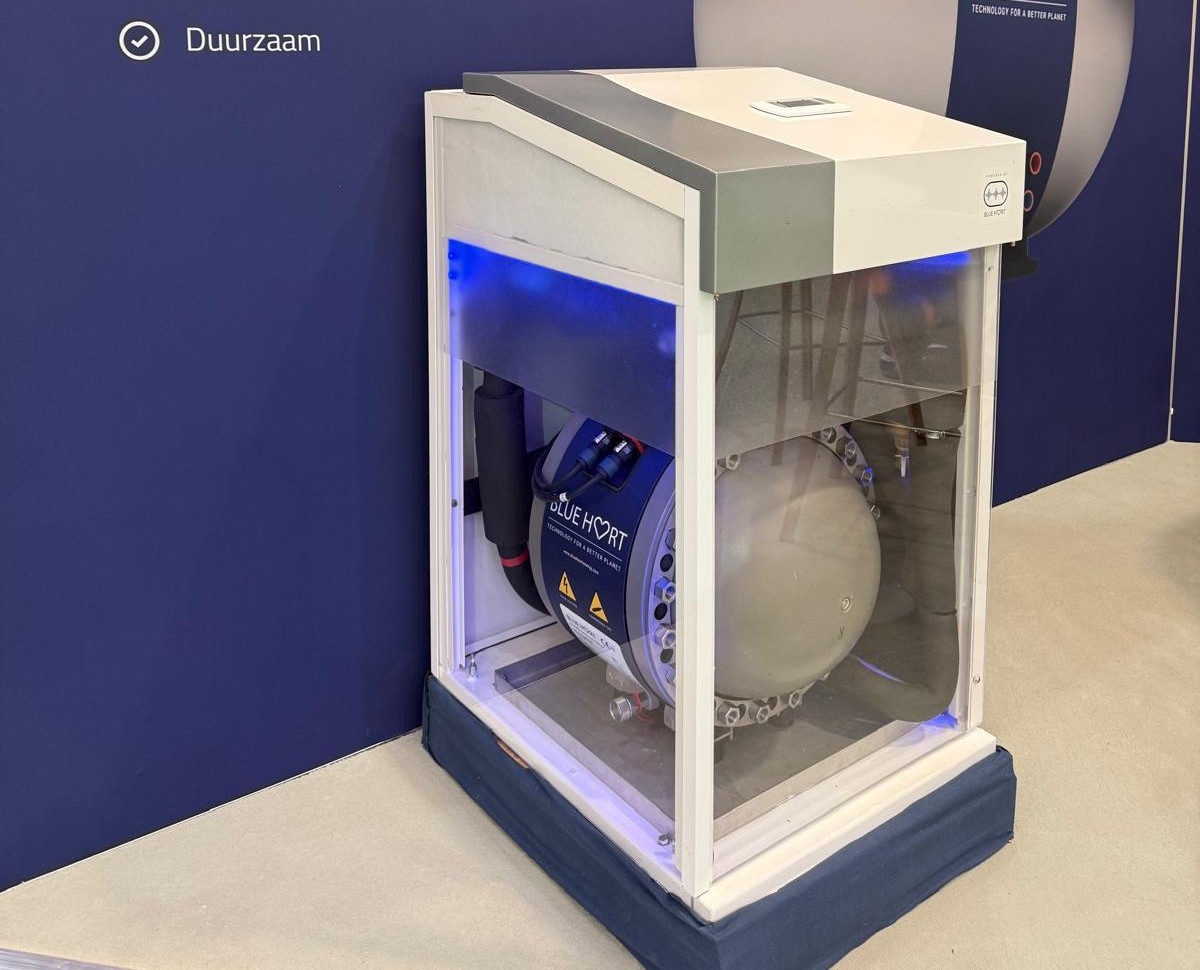
Dutch thermoacoustic heat pump developer BlueHeart Energy has announced that its thermoacoustic heat pump engine technology is currently being tested in residential settings and is expected to enter the European market in spring 2027.
“This initial launch will be deliberately modest,” CEO Michiel Hartman told pv magazine. “Early units will be delivered in limited volumes, allowing partners to validate performance in real-world conditions while production capacity ramps up. A broader rollout will follow gradually, with scaling expected to take at least another year. In other words, while some customers may be able to purchase systems within the next 12 months, widespread availability will come later.”
The timeline coincides with a broader shift in Europe’s residential energy landscape. Households are increasingly facing surplus solar generation, particularly as net metering schemes are phased out in markets such as the Netherlands.
At launch, systems incorporating the new engine are expected to be priced similarly to existing heat pumps. The initial value proposition will therefore focus on other advantages: lower noise, greater flexibility, compatibility with existing buildings, and improved integration with renewable energy systems.
Over time, the economic benefits are expected to become clearer not necessarily through lower equipment costs, but through reduced installation expenses and lower energy bills. The ability to avoid major building modifications and to capitalize on flexible energy pricing could make a significant difference in total cost of ownership.
System design
A thermoacoustic heat pump operates without the conventional processes of compression, condensation, and evaporation. Instead of a refrigerant cycle, it uses high-intensity sound waves to transfer heat. These waves generate pressure oscillations in a gas, creating temperature differences that can be harnessed to move heat. The approach reduces mechanical complexity and may improve durability due to fewer moving parts.
“One of the defining characteristics of thermoacoustic heat pumps is flexibility,” Hartman said. “Conventional systems perform best within a narrow temperature range. When paired with sources such as photovoltaic-thermal (PVT) panels, they may require additional components to regulate temperature, adding cost and complexity. Thermoacoustic systems can operate efficiently across a much wider range of input temperatures, without pre-conditioning. This makes them well suited for integration with variable renewable sources.”
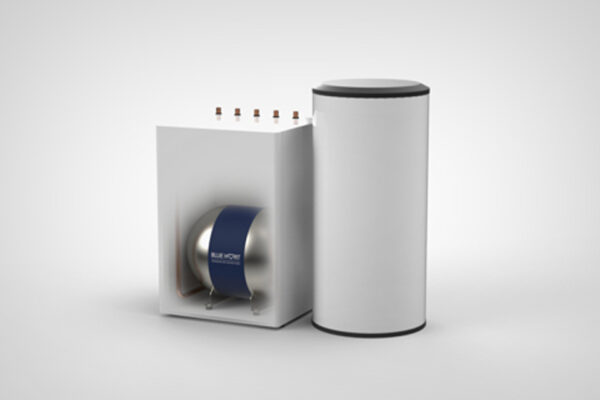
Image: Copeland
Heat pumps incorporating the engine can be used for space heating, domestic hot water (DHW), and cooling in both residential and industrial applications.
First presented in 2022, the engine uses helium gas and sound waves instead of a conventional compression cycle. Two pistons generate a 60 Hz acoustic wave, causing the gas to alternately compress and expand, while heat exchangers capture the resulting temperature differences.
The system is compact and modular, with individual units delivering 1 kW to 6 kW of heating capacity. Output can be scaled up to 600 kW by combining multiple units. It operates across a wide temperature range, with source temperatures from approximately -25 C to 40 C and output temperatures up to 80 C, making it suitable for both new buildings and retrofits with existing radiators.
“It is compact and very quiet, as its constant frequency enables effective noise cancellation,” Hartman said. “Compared to conventional systems, it responds faster to demand and experiences minimal wear due to smooth operation and a limited number of moving parts.”
The engine measures approximately 55 cm x 55 cm and weighs around 60 kg. Noise levels are reported to be below 40 dB(A), enabled by vibration-canceling pistons and constant-frequency operation. “Its simple architecture ensures low maintenance and a design lifetime of around 20 years,” Hartman added.
Inside the engine, two linear drivers, similar to loudspeakers, generate pressure oscillations that propagate as sound waves through a sealed helium circuit. These oscillations cause the gas to compress and expand at specific locations, enabling heat transfer. A regenerator, together with heat exchangers, converts this oscillating motion into a continuous heat flow.
Electrical energy drives the pressure waves, the helium undergoes cyclic compression and expansion, and heat is absorbed at one end and released at the other. The result is a temperature lift, effectively concentrating heat through sound waves in a sealed, pressurized system.
The regenerator is a key component, consisting of a porous structure designed for efficient heat exchange with the oscillating helium. It acts as a thermal storage medium, enabling heat transfer between the gas and solid material. As the gas moves back and forth, temperature gradients and phase shifts between pressure and velocity create a net directional heat flow.
BlueHeart Energy does not manufacture complete heat pump systems. Instead, it supplies the core engine, which is integrated into finished products by partner companies. As a result, market entry depends not only on the company but also on its partners.
The company is currently working with an undisclosed Spanish heat pump manufacturer to launch a system using the thermoacoustic engine by the end of the first quarter of next year. Demonstrations at recent trade fairs have included both the standalone engine and integrated systems.
Performance
Performance comparisons with conventional heat pumps are nuanced. “Vapor compression systems can achieve very high efficiency at specific operating points,” Hartman said. “Thermoacoustic systems offer more consistent performance across a broader range of conditions.”
Rather than peaking at a single optimal point, the system maintains a relatively stable efficiency profile, particularly at higher temperature lifts, such as raising water from 10 C to 55 C or more. This makes it well suited to existing buildings, where higher operating temperatures are often required.
“In practical terms, this makes the technology particularly suitable for retrofits,” Hartman said. “Older buildings, which represent the majority of Europe’s housing stock, often cannot accommodate low-temperature heating without costly upgrades. Thermoacoustic systems can work with existing radiators and piping, reducing the need for extensive renovation.”
As production ramps up and partnerships expand, the coming year will be critical in determining how quickly thermoacoustic technology gains market traction. Its success will depend not only on technical performance but also on its ability to address practical challenges for homeowners, installers, and industry stakeholders.
“What is clear,” Hartman said, “is that the technology arrives at a moment of significant change. As energy systems become more decentralized, dynamic, and renewable-based, flexible solutions like thermoacoustic heat pumps could play an increasingly important role.”
Blueheart Energy is a spinoff of The Netherlands Organization for Applied Scientific Research (TNO) and is based in Heemskerk, in the North Holland province, where it operates a small factory and a testing facility.
In April 2025, US-based heating specialist Copeland invested an undisclosed sum in Blueheart Energy.
This content is protected by copyright and may not be reused. If you want to cooperate with us and would like to reuse some of our content, please contact: [email protected].

Please login to comment

Interesting. I’m surprised there was no mention of this being used for home refrigerators or freezers. Obviously a much smaller unit would be needed, but this would allow more experience with these units before larger home heating/cooling options are made available.
I would guess that the system could be set up with a hot tank and a cold tank enabling a restaurant for example to run a cold room and produce hot water simultaneously from one system with no additional electricity demand than to provide heat only.