





Night-time from the point of view of solar PV is effectively 16 hours on average, longer in winter and shorter in summer. How can we cover night-time electricity demand in a renewable energy system?
By far the most important storage technologies are pumped hydro energy storage and batteries in terms of both power (GW) and energy (GWh).
Wind is great because it often blows at night. In some places, wind and solar are counter correlated. Shifting loads from night-time to daytime is also useful. Dispatchable hydro, geothermal, bio and nuclear generation help, although these are small or non-existent in most countries.
The rise and rise of rooftop solar, solar farms and wind farms forces large changes in the operation of electricity grids. Typically, coal and gas generation is squeezed by low or negative prices during daytime and learns to operate flexibly. Curtailment of solar and wind is frequent.
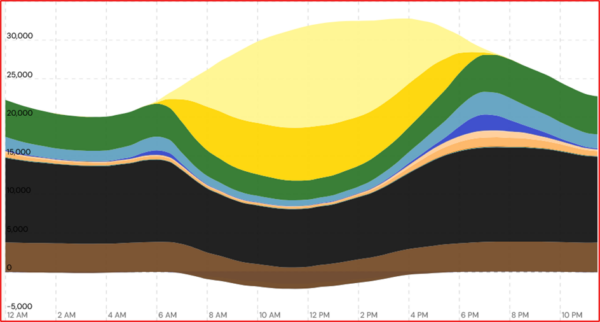
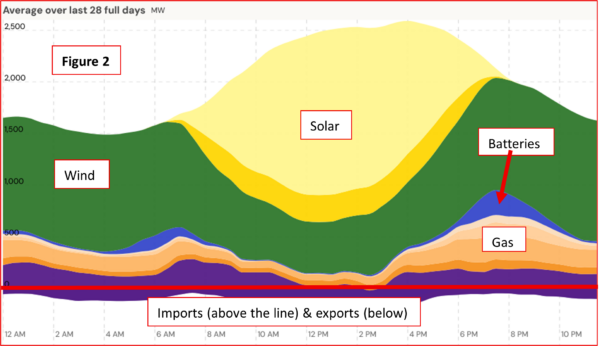
Figures 1 and 2 shows midnight to midnight generation averaged over 28 days in February (late summer) in Australian’s National Electricity Market (NEM) and in the state of South Australia.
In the NEM, average coal generation varied from 16 GW during the evening peak down to 10 GW around noon. Most coal will retire as the NEM tracks towards 82% renewables in 2030.
In South Australia (Figure 2), coal has already retired. Solar and wind are tracking towards 100% of demand on average in 2027. Balancing is provided by gas, batteries, electricity trading with eastern states, and overbuilding of solar and wind coupled with frequent curtailment.
In most renewable electricity systems, a large amount of storage is required to ride through night-time, and wet and windless days and weeks.
Batteries are rapidly rising in importance due to deployment of many large utility batteries (typically 2-4 hours) and a large home battery support program. Sufficient battery power and energy capacity to cover most evening and morning peak periods will soon be available, which will greatly moderate prices. The balancing emphasis then shifts to high-priced night-time, and wet and windless weather.
Roughly speaking, storage of 16 hours is required on average to cover night-time between two sunny days. Coverage for one cloudy day requires 40 hours of storage, while a cloudy week requires 160 hours of storage. Storage of this duration is far beyond the realm of current batteries, but well within the scope of pumped storage.
Figure 3 shows recent capital cost estimates by GenCost for storage as a function of duration. These estimates are widely used in Australia. Comparing utility batteries in the year 2055 with pumped hydro, the cross-over point is about 30 hours duration.
However, the technical lifetime of pumped hydro is 150 years compared with batteries at 20 years, which shifts the cross-over point to much shorter duration, depending mostly on assumed discount rate. Pumped hydro storage is projected to remain highly competitive for overnight and longer storage.
Also shown is Snowy 2.0 pumped hydro which stores 350 GWh of energy (13 kWh per Australian) with duration of 160 hours, and will be completed in 2028 at a cost around $10 billion ($29/kWh). Snowy 2.0 can generate at 2.2 GW for 10 hours most nights and can then be recharged when sunny and windy. Over one year this yields 8000 GWh. Importantly, Snowy 2.0 can generate flat-out for 160 hours during an occasional high-priced wet and windless week. Over its 150-year lifetime, the capital cost of Snowy 2.0 amounts to less than one cent per Australian per day.
Most countries and regions have many sites that match the quality of Snowy 2.0 and can provide very low cost and long lifetime storage.

Authors: Prof. Ricardo Rüther (UFSC), Prof. Andrew Blakers /ANU
ISES, the International Solar Energy Society is a UN-accredited membership NGO founded in 1954 working towards a world with 100% renewable energy for all, used efficiently and wisely.
The views and opinions expressed in this article are the author’s own, and do not necessarily reflect those held by pv magazine.
This content is protected by copyright and may not be reused. If you want to cooperate with us and would like to reuse some of our content, please contact: editors@pv-magazine.com.


By submitting this form you agree to pv magazine using your data for the purposes of publishing your comment.
Your personal data will only be disclosed or otherwise transmitted to third parties for the purposes of spam filtering or if this is necessary for technical maintenance of the website. Any other transfer to third parties will not take place unless this is justified on the basis of applicable data protection regulations or if pv magazine is legally obliged to do so.
You may revoke this consent at any time with effect for the future, in which case your personal data will be deleted immediately. Otherwise, your data will be deleted if pv magazine has processed your request or the purpose of data storage is fulfilled.
Further information on data privacy can be found in our Data Protection Policy.