





Russia installed around 100 MW of solar in 2025, according to analysis published by GlobalData. The UK-based consultancy estimates the country’s cumulative solar capacity increased from 3 GW in 2024 to 3.1 GW in 2025.
GlobalData is expecting annual solar additions of around 200 MW through to 2035, which would see Russia reach 3.3 GW of solar by the end of this year, hit 4 GW of solar in 2029, surpass 5 GW before the end of 2034 and reach 5.3 GW by the end of 2035.
Mohammed Ziauddin, Power Analyst at GlobalData, says increases in solar capacity are set to be driven primarily by utility-scale installations across the country’s southern and eastern regions, in areas with higher solar irradiation levels.
He explained that renewables are being implemented under Russia’s capacity supply agreement framework, which provides selected solar and wind projects with fixed capacity payments for up to 15 years within the wholesale electricity and capacity market.
Ziauddin told pv magazine that Russia has also implemented policies to promote small-scale, distributed solar, with households and businesses permitted to install solar systems up to 15 kW and sell surplus electricity under a net metering framework at approximately RUB 1.70 ($0.021)/kWh to RUB 2.00/kWh.
He added that solar is increasingly being deployed in hybrid solar-diesel systems in remote regions of the country where off grid solar deployments are most suitable.
“In remote and off grid regions where solar-plus-storage systems replace diesel generation, the levelized cost of electricity of recently commissioned off grid solar-plus-storage projects ranges from approximately $0.19 to $0.29 per kWh, which is significantly more economically viable compared to net diesel generation costs,” Ziauddin explained. “Hybrid energy complexes in regions such as Yakutia have demonstrated significant cost savings. Across twelve complexes commissioned between 2021 and 2024, more than 3,596 tons of diesel fuel were saved collectively.”
Another key driver of Russia’s solar market is the government’s emphasis on industrial localization and technological sovereignty, Ziadduin added. He explained renewable energy auctions require projects to incorporate between 50% to 70% of locally-manufactured components, a requirement he says is expected to increase over time.
The policy has supported the growth of a domestic solar manufacturing sector in Russia. Ziadduin named Moscow-headquartered Hevel Group as one of the market leaders, operating one of Russia’s largest solar cell production facilities that has commissioned more than 100 projects with a total capacity exceeding 1.6 GW.
“The company specializes in heterojunction (HJT) technology and has significantly advanced its cell efficiency since first introducing HJT production in 2017. By 2023 the commercial industry average for HJT cells had reached 25.0%, a benchmark Hevel's ongoing research and development program is designed to match and surpass,” Ziadduin told pv magazine. “Other manufacturers are also developing thin film CIGS modules, flexible solar panels and building integrated photovoltaics for urban applications.”
Additional analysis from GlobalData anticipates Russia’s total renewables capacity to increase from 9.8 GW in 2025 to 18.4 GW in 2035, registering a compound annual growth rate of approximately 6.5% over the study period.
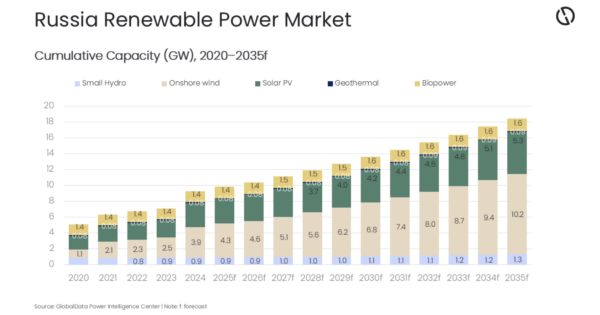
Image: GlobalData
Onshore wind is expected to strengthen its position as Russia’s leading form of renewables, increasing from 4.3 GW last year to 10.2 GW in 2035, with solar the second largest renewable source.
Russia’s power mix is dominated by thermal generation, particularly natural gas. GlobalData expects gas-fire capacity to expand from 143.5 GW in 2025 to 151.2 GW by 2035. Coal capacity is projected to gradually decline over the forecast period, while oil-fired capacity is expected to stay relatively unchanged.
Earlier this month, a 102.3 MW solar project was commissioned in Dagestan, southern Russia.
The project was built by Russian developer New Energy Management Company LLC and is the largest solar energy project in the region. According to a Telegram post published by the Ministry of Energy of Dagestan, it has begun to supply electricity to the southern Russian grid and has a planned production equivalent to approximately 3% of the total volume of electricity generated by all of Dagestan's power plants.
This content is protected by copyright and may not be reused. If you want to cooperate with us and would like to reuse some of our content, please contact: editors@pv-magazine.com.


By submitting this form you agree to pv magazine using your data for the purposes of publishing your comment.
Your personal data will only be disclosed or otherwise transmitted to third parties for the purposes of spam filtering or if this is necessary for technical maintenance of the website. Any other transfer to third parties will not take place unless this is justified on the basis of applicable data protection regulations or if pv magazine is legally obliged to do so.
You may revoke this consent at any time with effect for the future, in which case your personal data will be deleted immediately. Otherwise, your data will be deleted if pv magazine has processed your request or the purpose of data storage is fulfilled.
Further information on data privacy can be found in our Data Protection Policy.