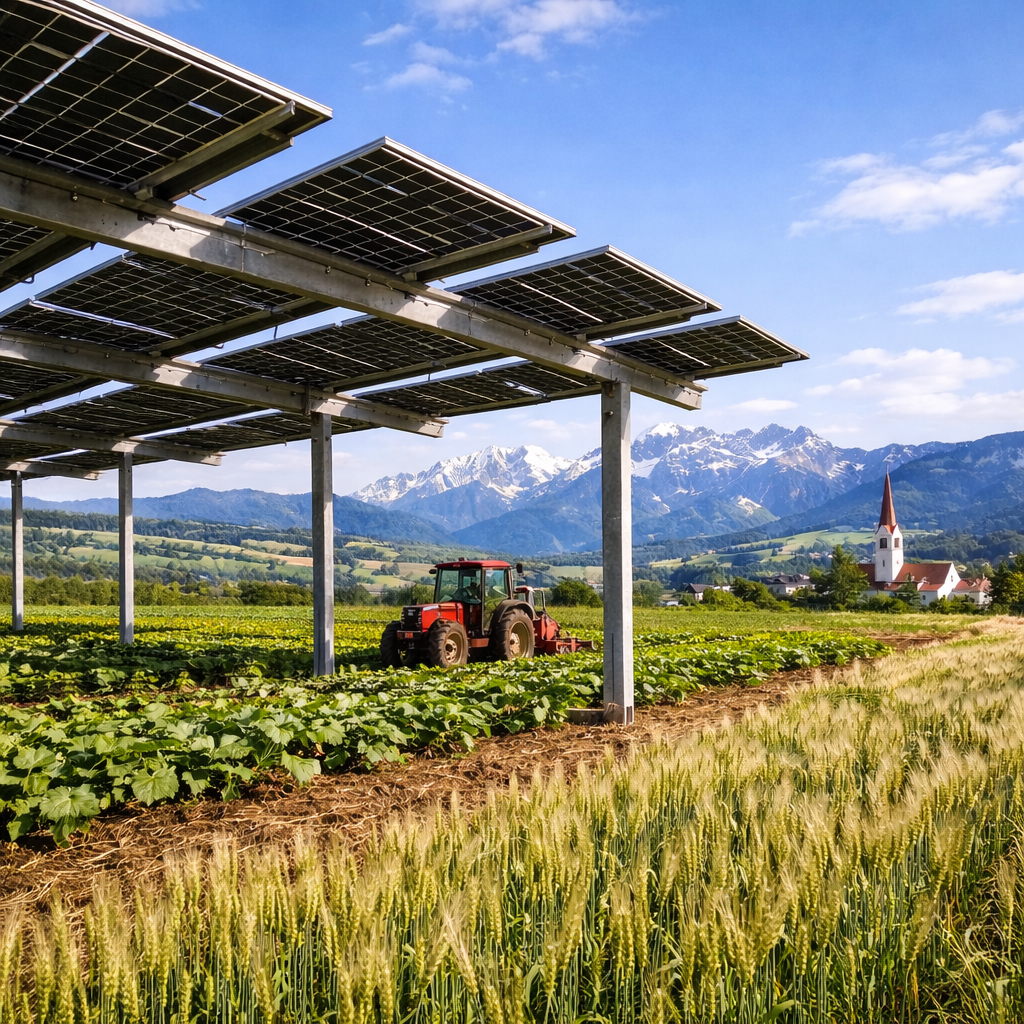





A research group led by Austria’s University of Natural Resources and Life Sciences, Vienna conducted a techno-economic analysis of the potential of the country’s agrivoltaic installations, combining profitability assessments for both solar PV generation and agricultural production.
“Our paper presents, to our knowledge, the first integrated framework combining the simulation of both PV electricity generation and agricultural output for agrivoltaic systems on the level of a whole country, including climate change impacts,” corresponding author Isabelle Grabner told pv magazine. “In our research, we investigated reductions in crop production for Austria due to solar PV expansion on agricultural land.
“We compared aggressive deployment of agrivoltaics and typical ground-mounted PV installations necessary for reaching climate neutrality targets,” Grabner added. “Furthermore, we showed limited climate change adaptation effects under agrivoltaics, but the latter results are highly dependent on the chosen crops as well as country-specific.”
To conduct the analysis, the team used a modular simulation framework, employing established software where available and developing new solutions as needed. The framework is available online under the GPL license. Using EU data from the policy-integrated climate model (EPIC), the researchers first classified areas suitable for agrivoltaic use, applying filters such as a minimum connected cropland area of 1 ha, a maximum average slope of 20°, and a maximum altitude of 1,950 m above sea level.
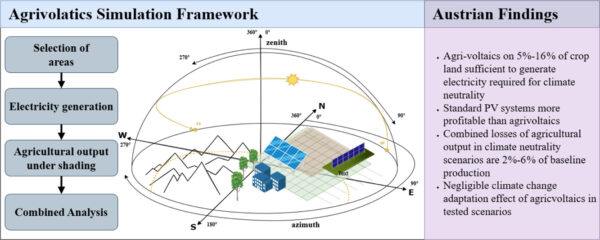
Image:
BOKU University, Renewable Energy, CC BY 4.0
Electricity generation was simulated with PVlib, using global horizontal irradiation (GHI) data from a climate simulation on a 1 km grid. EPIC was used to model key environmental processes and plant growth at the plot level, with daily time steps and a spatial resolution of 1 km × 1 km. The scenarios incorporated interactions between environmental conditions and management practices, including crop rotations, for crops such as peas, soybeans, potatoes, alfalfa, summer barley, and oats.
Climate data were based on observations from 1981–2020 and projections from 2031–2070. Two baseline scenarios were tested: agricultural production without a PV system and ground-mounted PV without agriculture. Agrivoltaic scenarios included overhead stilted systems, south-facing with an installation height of approximately 10 m, and vertical bifacial systems with a row distance of 10 m and two bifacial panels stacked vertically. Each system was evaluated under low, medium, and high cost scenarios.
The analysis showed that in Austria, ground-mounted PV systems generate 1,173 MWh/ha, stilted agrivoltaic systems 684 MWh/ha, and vertical agrivoltaic systems 373 MWh/ha of electricity. Profit ratios relative to agricultural production alone ranged from 10:1 to 50:1 for vertical systems, up to 60:1 for stilted systems, and up to 100:1 for ground-mounted PV.
“For attaining 90 TWh/y of electricity generation from solar PV on cropland, an upper bound in all climate neutrality scenarios, an amount of 5%–16% of total crop area is required,” the team concluded. “The required areas and the simulated reduction in the yield imply that the loss in Austrian crop production would reach 2%–6%. Only agrivoltaic systems can achieve production losses at the lower end of the observed range. Climate change adaptation effects of agrivoltaic systems are minor.”
The research's findings are available in “The techno-economic potentials of agrivoltaic installations in Austria,” published in Renewable Energy. Researchers from Austria’s BOKU University and the Federal Institute of Agricultural Economics have participated in the study.
This content is protected by copyright and may not be reused. If you want to cooperate with us and would like to reuse some of our content, please contact: editors@pv-magazine.com.

By submitting this form you agree to pv magazine using your data for the purposes of publishing your comment.
Your personal data will only be disclosed or otherwise transmitted to third parties for the purposes of spam filtering or if this is necessary for technical maintenance of the website. Any other transfer to third parties will not take place unless this is justified on the basis of applicable data protection regulations or if pv magazine is legally obliged to do so.
You may revoke this consent at any time with effect for the future, in which case your personal data will be deleted immediately. Otherwise, your data will be deleted if pv magazine has processed your request or the purpose of data storage is fulfilled.
Further information on data privacy can be found in our Data Protection Policy.