




A French research team has analyzed the impact of solar parks on soil mesofauna, respiration and plant traits gathering samples from 20 different parks in southern France.
“This research has several novel aspects,” corresponding author Arnaud Lec'hvien told pv magazine. “Firstly, the research was conducted across two regions with different climatic conditions, with a large number of sites surveyed in each region. Secondly, we compared two management methods: mowing and grazing. Thirdly, many new variables were studied, notably the functional traits of plants and the soil food web.”
Lec'hvien added that the results show a decline in biodiversity beneath the solar panels. “However,” he added, “the most surprising finding is that the soil food web is significantly more impacted by mown sites than grazed ones. Conversely, for pollinators, the opposite was observed.”
The study focused on functional traits, soil physicochemical characteristics, small soil animal communities, and soil respiration.
It was conducted in two southern French regions—the Atlantic and the Mediterranean—which differ in climate, soil types, and vegetation. In each region, ten solar parks were selected: five managed by mowing and five by grazing. Within each park, three positions were studied: under solar panels, between panel rows, and an unshaded area. Each treatment was repeated in four blocks per park.
Measurements in the Mediterranean were carried out in May 2023 and in the Atlantic in June 2023. Some analyses were performed on-site, while other samples were transported to the laboratory. Each sample consisted of a composite soil sample, 6 cm deep, from the same position type within a park. The team measured plant traits; soil properties including temperature, moisture, and nutrient content; soil fauna such as mites and springtails; and soil respiration as an indicator of biological activity.
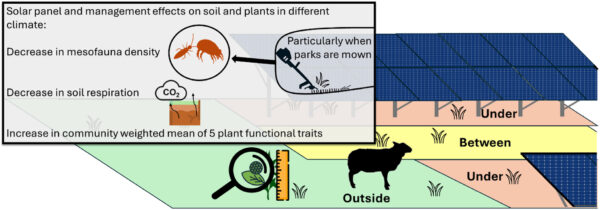
Results showed species richness was 37.5% lower under panels compared with unshaded areas, while chlorophyll content increased by about 12%. In grazed parks, plant height under panels increased by up to 72%, and specific leaf area was up to 46% higher. Soil temperature was 2–4.5 °C lower under panels, and soil moisture was reduced by up to 42% in the Mediterranean region.
Soil fauna were strongly affected by solar panels. Springtail abundance declined by 74–76% under panels, and overall mesofauna dropped by about 38%. Non-predatory mites decreased by approximately 45–65% at Atlantic sites, while predatory mites showed no significant change.
Meanwhile, soil respiration, a measure of biological activity, was found to fall by around 62% overall, with reductions exceeding 50% in the Mediterranean and 55–58% in mown Atlantic parks. Grazed Atlantic sites showed no significant effect.
“Future research will examine how the climatic gradient in each region affects the impact of solar panels by comparing it with open grassland,” Lec’hvien said. “This work will investigate interactions between plants and soil, as well as trophic interactions among soil fauna, including macro- and mesofauna.”
The research work is described in “Effects of solar panels and management on soil mesofauna, respiration and plant traits in solar parks of two southern French regions,” published in the Journal of Environmental Management. Scientists from France’s Aix Marseille University, Avignon University, University of Montpellier, University of Tours and French energy company Engie have participated in the study.
This content is protected by copyright and may not be reused. If you want to cooperate with us and would like to reuse some of our content, please contact: editors@pv-magazine.com.

By submitting this form you agree to pv magazine using your data for the purposes of publishing your comment.
Your personal data will only be disclosed or otherwise transmitted to third parties for the purposes of spam filtering or if this is necessary for technical maintenance of the website. Any other transfer to third parties will not take place unless this is justified on the basis of applicable data protection regulations or if pv magazine is legally obliged to do so.
You may revoke this consent at any time with effect for the future, in which case your personal data will be deleted immediately. Otherwise, your data will be deleted if pv magazine has processed your request or the purpose of data storage is fulfilled.
Further information on data privacy can be found in our Data Protection Policy.