HY Solar unveils 670 W TOPCon modules with 24.8% efficiency

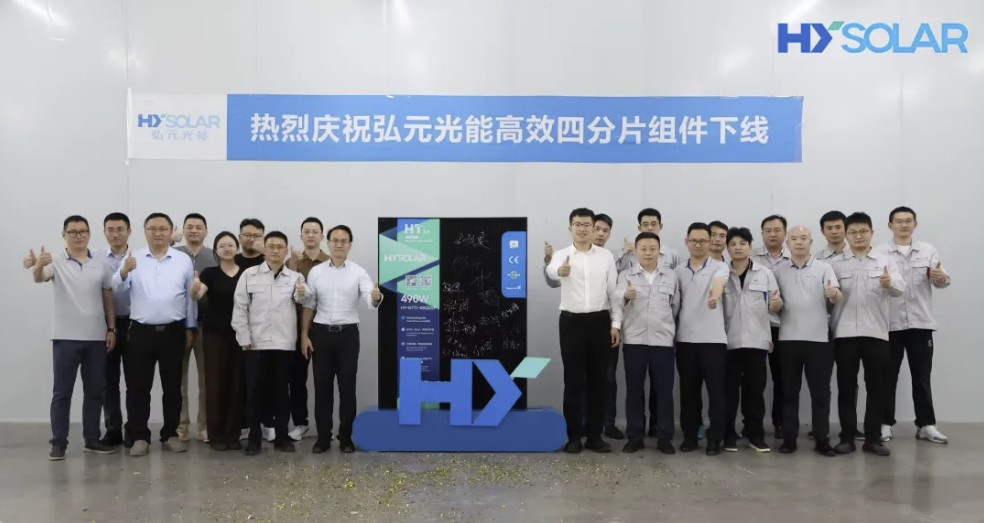
Formerly known as Wuxi Shangji Automation, Chinese manufacturer HY Solar has rolled out the first unit of its HT3.0 high-efficiency quad-cut module at its Jiangyin manufacturing base, marking an upgrade to the Chinese manufacturer’s n-type module portfolio.
The module is based on the company’s self-developed n-type TOPCon 3.0 cell technology. According to HY Solar, the cell platform uses a poly-finger laser-patterning process designed to retain a thicker poly layer in metal contact areas while thinning or removing it in non-contact regions. The approach is intended to improve current transport, reduce optical shading and lower parasitic absorption.
The TOPCon 3.0 cells reach conversion efficiencies of up to 27.5%. The HT3.0 module is built on 210R rectangular wafers and a 66-cell quad-cut layout. It combines high-density, negative-gap encapsulation with a compact cell configuration, enabling module efficiency of up to 24.8% and output exceeding 670 W, according to the company.
HY Solar said the quad-cut architecture uses a parallel-series-parallel (PSP) topology designed to reduce hot-spot risk and improve output stability under partial shading and high-temperature conditions. The smaller cell format is also intended to distribute mechanical stress more evenly, reducing microcrack risk and limiting the impact of single-cell anomalies on overall output.
The module features a bifaciality of up to 90%, a temperature coefficient of -0.26%/C, first-year degradation of up to 1%, and annual degradation of around 0.35%, according to the company. It is backed by a 25-year product warranty and a 30-year linear power warranty.
HY Solar added the module is designed for harsh environments, including coastal, plateau and desert conditions, with resistance to salt mist, sand, UV exposure and mechanical loads. It received IEC 61215 and IEC 61730 certification from TÜV Rheinland.
Production will mainly take place at HY Solar’s Jiangyin intelligent module base, which features digitalized and traceable manufacturing processes to support ramp-up of the new product. As of May 2026, the company reported 21 GW of module capacity and 30 GW of n-type TOPCon cell capacity, with cell capacity expected to rise to 50 GW during the year.

Please login to comment