




Chinese solar manufacturer JA Solar has published a TÜV Nord-certified white paper demonstrating its DesertBlue module series.
The white paper highlights the power generation capability, weather resistance and performance of JA Solar’s DesertBlue modules in deserts, Gobi areas and wastelands under testing conditions and simulations.
Desert-Gobi-Wasteland environments cover nearly 27% of China’s territory and approximately a quarter of global land area, according to the white paper, featuring abundant but underutilized land resources for solar deployment. While such climates offer plentiful solar irradiance and land resources, solar projects face challenges including dust impact, strong winds, high-intensity UV radiation and large temperature variations.
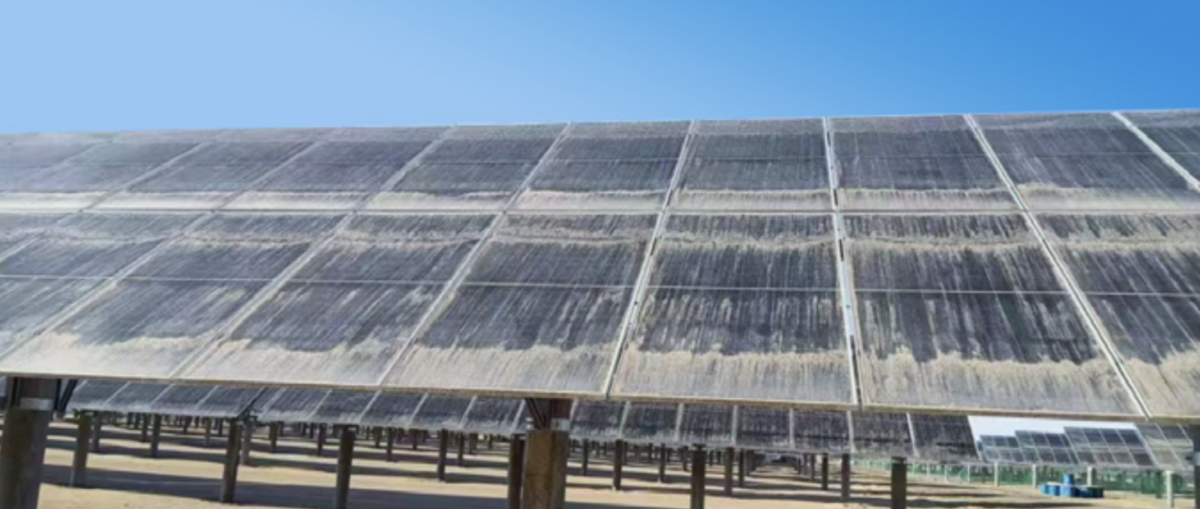
JA Solar says its DesertBlue modules, first unveiled to the market in August, offer excellent self-cleaning performance due to a nano-scale self-cleaning coating that reduces dust adhesion. The company says this results in a more than 32% reduction in light transmittance degradation when compared to conventional PV module glass, helping to extend life service by up to five years.
The modules are available in outputs up to 650 W, have an efficiency of 24% and can withstand 6,000 Pa front loading and 4,000 Pa back loading, JA Solar says, representing an over 60% improvement in load capacity when compared to conventional PV modules.
The white paper also highlights compliance with IEC requirements. The operating temperature range of the modules has been elevated from the 55-15 C specified in IEC 61215-2 to 80-5 C, while their cumulative irradiance has been increased from 15 kWh/m2 as required by the IEC 61215-2 standard to 220 kWh/m2.
JA Solar also says its DesertBlue modules can operate at a temperature nearly 5 C lower in dusty environments compared to conventional PV modules, equating to additional power generation capacity. Test results in the white paper highlight that at JA Solar’s manufacturing base in the Fengxian district of Shanghai, the DesertBlue modules achieved a 7.09% power generation gain compared to conventional modules during a 10-day study period in July, which simulated heavy dusty conditions.
Across an almost 4-month study period, DesertBlue modules demonstrated a 4.98% power generation increase compared to conventional modules during an empirical test in the Ulan Buh Desert of Inner Mongolia, northern China, where JA Solar adopted 2P mounting.
JA Solar has also established an empirical test platform in the Tengger Desert within Inner Mongolia, in collaboration with TÜV Nord, and a demonstration project in the Xinjiang region of northwest China, with power generation data currently under monitoring.
The white paper adds that the DesertBlue modules reduce initial investment costs of projects in deserts, Gobi areas and wastelands, achieving CNY 0.003 ($0.00042)/W savings in grounding costs, along with CNY 0.04/W and CNY 0.025/W savings in cleaning robot costs for China and the Middle East markets.
In its conclusion, the white paper says the DesertBlue modules series transcends industry benchmarks, setting a new performance standard and delivering an optimized levelized cost of electricity.
“Their exceptional temperature coefficient and bifacial energy generation capability ensure stable and efficient power output under harsh conditions, including extreme heat, desert environments, and high-albedo surfaces,” it says. “The product has successfully passed more stringent testing per IEC standards, guaranteeing over 25 years of reliable performance for solar power plants.”
This content is protected by copyright and may not be reused. If you want to cooperate with us and would like to reuse some of our content, please contact: editors@pv-magazine.com.



By submitting this form you agree to pv magazine using your data for the purposes of publishing your comment.
Your personal data will only be disclosed or otherwise transmitted to third parties for the purposes of spam filtering or if this is necessary for technical maintenance of the website. Any other transfer to third parties will not take place unless this is justified on the basis of applicable data protection regulations or if pv magazine is legally obliged to do so.
You may revoke this consent at any time with effect for the future, in which case your personal data will be deleted immediately. Otherwise, your data will be deleted if pv magazine has processed your request or the purpose of data storage is fulfilled.
Further information on data privacy can be found in our Data Protection Policy.