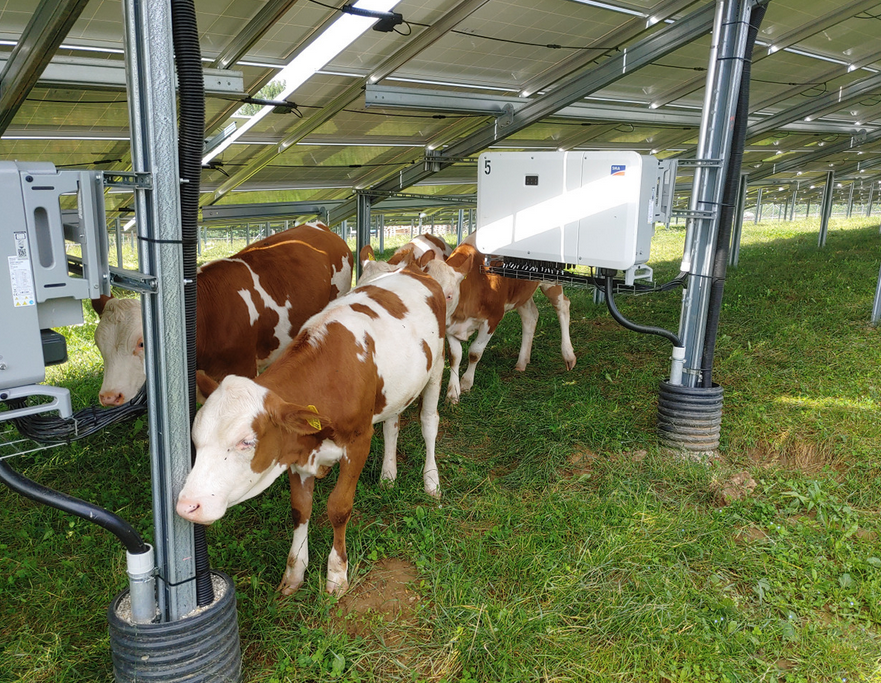





Researchers from Technische Universität Ilmenau have assessed lightning-related hazards in livestock-integrated agrivoltaic systems and proposed a range of mitigation strategies and protection measures to reduce risks to animals.
“Project developers are generally aware that lightning can pose risks to livestock, particularly since protective measures against lightning are already implemented in agricultural facilities such as stables,” the research's corresponding author, Kamila Costa, told pv magazine. “However, in agrivoltaic systems the situation is more specific. While PV installations are not expected to increase the probability of lightning strikes compared to open fields, their conductive mounting structures can modify ground potential distribution during a strike. As a result, dangerous step and touch voltages may occur at locations that would otherwise remain unaffected in an open-field scenario.”
Costa explained that assessing lightning safety for livestock remains complex, as there is limited scientific data on animals’ tolerance to impulse currents and lightning-related step and touch voltages, and no standardized values are currently available. “In our work, we propose benchmark values for livestock under lightning conditions; however, these limits are not standardized, which makes systematic design approaches more challenging,” she added.
Join us on March 5 for the Dual harvest, double trouble: Tackling EPC barriers in agrivoltaics design pv magazine session in English language at KEY – The Energy Transition Expo in Rimini. Experts will share insights on current agrivoltaic technologies, key design choices and the main barriers to standardized, scalable dual‑use projects in Europe and Italy, including region‑specific EPC issues. She also said that, to date, no lightning-related incidents involving livestock at agrivoltaic plants have been reported. “Agrivoltaics is still an emerging concept in many countries, and large-scale livestock-integrated projects are relatively recent,” she went on to say. “Our intention is preventive: to identify and quantify potential risks before accidents occur. A severe lightning event affecting grouped livestock could result in significant economic losses for farmers and potentially undermine public acceptance of agrivoltaic concepts. Early consideration of lightning safety helps strengthen reliability and long-term viability.” The cost impact of the additional measures intended to reduce lightning risks for animal would depend on the project-specific risk assessment and the initial design. “Tailored lightning protection measures, such as optimized earth-termination systems or selective use of insulating or local surface-layer measures in critical areas, may increase the cost of the lightning protection system itself,” Costa stated. “However, with optimized and site-specific design, the impact on overall leveliezed cost of energy (LCOE) is expected to be limited. One objective of our research is precisely to support technically effective and economically proportionate solutions, ensuring safety without imposing unnecessary costs.” In the study “Lightning protection in agrivoltaic systems: Assessment of step and touch voltages tailored to livestock,” published in Electric Power System Research, Costa and her colleagues identified the main lightning injury mechanisms affecting livestock, established safe step and touch voltage limits under representative lightning conditions, and evaluated earth-termination system (ETS) designs to reduce hazardous voltages in agrivoltaic installations. The researchers noted that during thunderstorms, human access to PV plants is restricted, but livestock remain in agrivoltaic systems and require dedicated safety measures. While PV arrays do not increase the likelihood of lightning strikes, their conductive structures can redistribute ground potentials, creating hazardous step and touch voltages even at locations distant from the strike point. Livestock are especially vulnerable due to their body size, stance, and tendency to cluster near metallic supports. Key injury mechanisms include step voltage, touch voltage, side flashes, direct strikes, upward streamers, and nearby strike effects. Assessing lightning safety for livestock is challenging because data on animals’ tolerance to impulse step and touch voltages are limited. To address this, the team derived benchmark values from IEC and IEEE standards. They evaluated three representative lightning waveforms, estimated tolerable currents based on experimental data for calves, and applied conservative body impedance values. From these calculations, they determined permissible effective step and touch voltages for different current pathways. Prospective voltage limits were then derived by factoring in hoof earthing resistance, showing that higher soil resistivity significantly increases allowable source voltages. The group also tested whether a conventional PV ETS can protect livestock in an agrivoltaic installation with grazing cattle. A real site was modeled to assess step and touch voltages and explore potential safety improvements. Simulations used XGSLab with frequency- and time-domain modules based on the PEEC method to calculate ground potential rise and transient responses. PV mounting structures, the ETS grid, and fences were modeled with defined geometries, bonding configurations, and LPL III lightning waveforms. Two homogeneous soil conditions—wet and dry—were considered, including frequency-dependent behavior, to evaluate their impact on voltage distribution. Combining XGSLab results with a Python-based algorithm, the team also calculated prospective step and touch voltages, accounting for animal height, step distance, and contactable structures. Frequency- and time-domain analyses showed that lightning strikes near the edges of agrivoltaic systems produce the highest ground potential rise and largest hazardous areas. Touch voltages posed greater risks than step voltages, especially under dry soil and near conductive elements such as mounting structures and fences. The study also highlighted that soil resistivity and fence earthing significantly affect voltage distribution. Low-resistivity soils reduce voltages, while bonding fences can increase touch hazards. Time-domain results closely matched frequency-domain patterns, but frequency-domain simulations proved conservative, faster, and effective for identifying hazardous zones and guiding mitigation strategies. “Overall, conventional ETS designs optimized for human safety may not adequately protect livestock in agrivoltaic environments,” the scientists concluded. “Our findings highlight the need for animal-specific lightning safety standards and integrated earthing design practices tailored to agrivoltaic systems.” This content is protected by copyright and may not be reused. If you want to cooperate with us and would like to reuse some of our content, please contact: editors@pv-magazine.com.



By submitting this form you agree to pv magazine using your data for the purposes of publishing your comment.
Your personal data will only be disclosed or otherwise transmitted to third parties for the purposes of spam filtering or if this is necessary for technical maintenance of the website. Any other transfer to third parties will not take place unless this is justified on the basis of applicable data protection regulations or if pv magazine is legally obliged to do so.
You may revoke this consent at any time with effect for the future, in which case your personal data will be deleted immediately. Otherwise, your data will be deleted if pv magazine has processed your request or the purpose of data storage is fulfilled.
Further information on data privacy can be found in our Data Protection Policy.