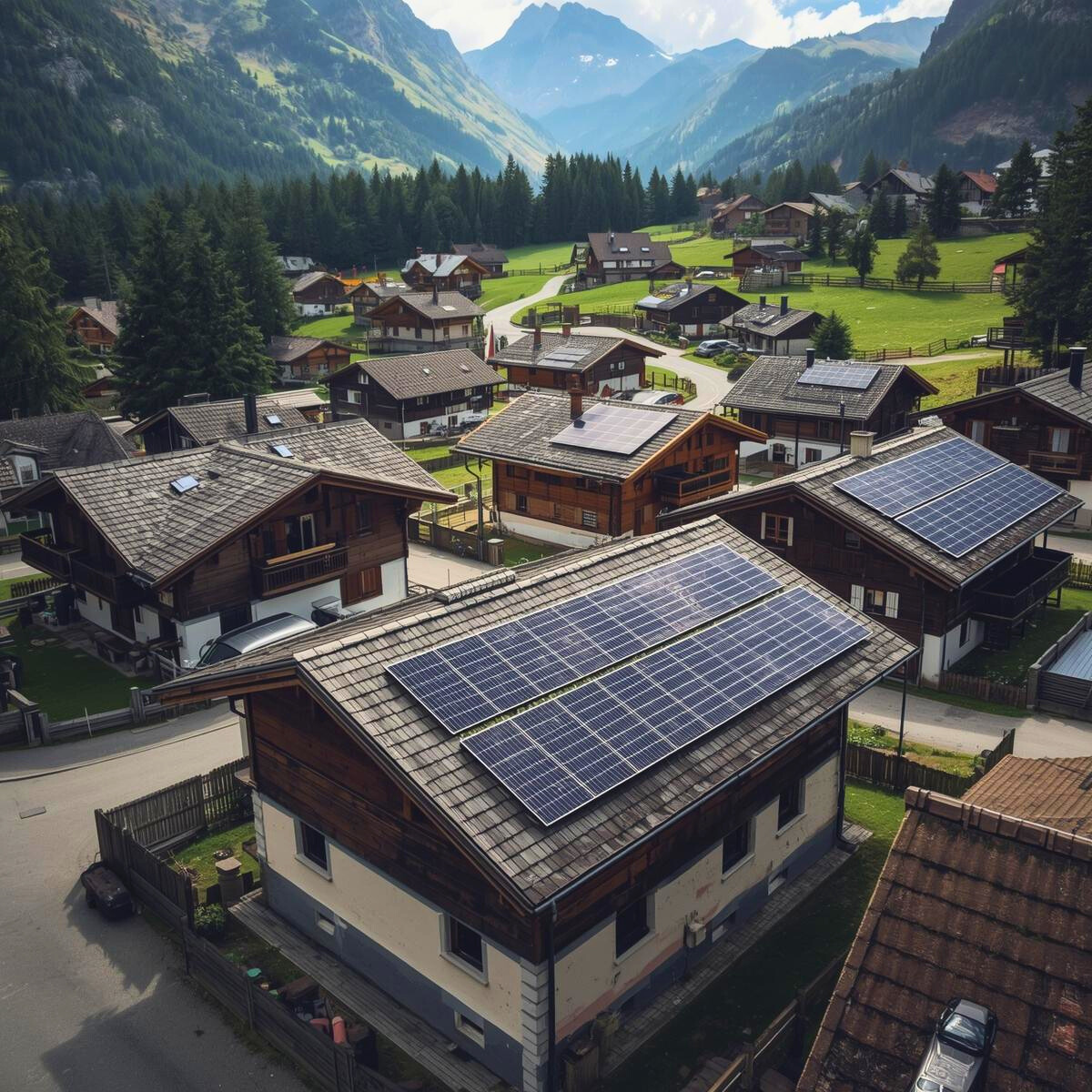





The market shares of back-contact (BC) solar module producers have increased significantly from 2023 to 2025 in Switzerland, according to the a new report from the Bern University of Applied Sciences and Swiss software company Eturnity.
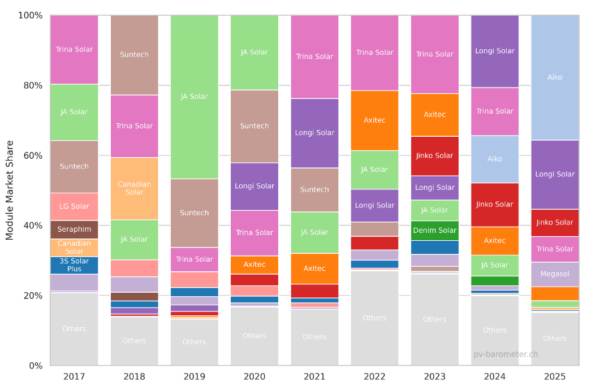
The Photovoltaik Barometer 2026 report reveals that last year, Chinese BC solar panel makers Aiko Solar and Longi secured a combined market share of over 50%, with Aiko holding a slightly larger share. Close followers included pure TOPCon manufacturers such as JinkoSolar, Trina Solar, and Switzerland-based Megasol.
In 2024, Longi and Aiko Solar held market shares similar to those of Trina Solar and JinkoSolar, and together, these manufacturers accounted for nearly 70% of the Swiss market. In 2023, Aiko had not yet entered the Swiss market, while Longi was still supplying TOPCon products.
“The Swiss market is almost entirely a rooftop market,” one of the report's author, Christof Bucher, told pv magazine. “As PV module costs account these days sometimes for less than 10% of the project costs, module efficiency becomes a very important aspects when choosing the module technology. If the influence of the module price on the levelized cost of energy (LCOE) goes down, the influence of efficiency goes up.”
According to Bucher, Switzerland is not necessarily showing an increasing preference towards BC technologies as such, rather in modules with high efficiency. This distinction may seem subtle, because in practice, high efficiency currently coincides with back-contact technology, but the broader trend reflects a focus on maximizing performance rather than simply adopting a specific module type, he went on to say.
AC/DC ratio
The report also reveals that the nominal power ratio of PV systems in Switzerland has decreased from 95% in 2017 to around 90% in 2023. This reduction lowers the impact of peak power on the grid, making new PV systems increasingly grid-friendly.
“We were somewhat surprised that the AC/DC ratio has decreased only slightly in recent years. However, inverters are relatively inexpensive, so the direct savings from maintaining a lower AC/DC ratio may not be immediately obvious. This could change as grid access restrictions become more significant,” said Bucher.
He also noted that as east–west orientations become more common and north-facing roofs gain attractiveness, lower AC/DC ratios become more relevant. “If I had to guess, it’s the less attractive—or less south-oriented—rooftops, which have become more viable due to low module prices, that are primarily driving the decrease in the AC/DC ratio,” he added.
The report further highlights that DC power per MPPT averages between 5 and 7 kW and has increased slightly over the years. Systems with two MPPTs have clearly become the standard, while models with three or four MPPTs are increasingly used in more complex installations.
Huawei has notably increased its inverter market share in Switzerland to around 50%, while other suppliers, such as Kostal, have steadily lost market share, with some manufacturers achieving only short-term gains.
Another clear trend is the growing integration of battery storage. According to Statistik Sonnenenergie 2024 by Swissolar, the number of installed storage systems rose from 45,000 in 2023 to 65,000 in 2024. This means that already one in three newly installed PV systems was equipped with a storage system.
Data from Eturnity show that since 2021, the share of PV systems offered with storage has nearly doubled. In 2025, over 70% of PV systems were offered with a storage option. Nevertheless, a significant portion of end customers still chooses PV systems without additional storage.
This content is protected by copyright and may not be reused. If you want to cooperate with us and would like to reuse some of our content, please contact: editors@pv-magazine.com.


By submitting this form you agree to pv magazine using your data for the purposes of publishing your comment.
Your personal data will only be disclosed or otherwise transmitted to third parties for the purposes of spam filtering or if this is necessary for technical maintenance of the website. Any other transfer to third parties will not take place unless this is justified on the basis of applicable data protection regulations or if pv magazine is legally obliged to do so.
You may revoke this consent at any time with effect for the future, in which case your personal data will be deleted immediately. Otherwise, your data will be deleted if pv magazine has processed your request or the purpose of data storage is fulfilled.
Further information on data privacy can be found in our Data Protection Policy.