Emiliano Bellini

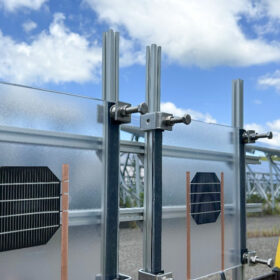
Perovskite solar testing field commissioned in Japan
Kanazawa University has begun long-term outdoor testing of tandem perovskite solar cells in collaboration with Toshiba. The research project aligns with Japan’s broader push to scale perovskite PV technologies toward large deployment by 2040.

Japan’s 26th solar auction concludes with average final price of $0.046/kWh
Japan has allocated 75.3 MW of PV capacity in its latest procurement exercise. The lowest price in the auction was JPY 4.97 ($0.032) /kWh.
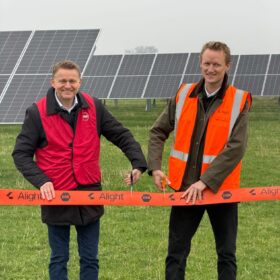
Denmark’s second largest PV plant goes online
Swedish independent power producer Alight has completed a 215 MW solar project in Lolland, southern Denmark. The construction of Lidsø solar park started in the summer of 2024.
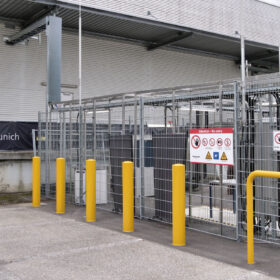
Panasonic testing PV-driven hydrogen platform in Germany
The Japanese conglomerate has deployed its Panasonic HX hydrogen solution at its facility in Munich. The system uses an AI-based energy management system that reportedly makes battery storage unnecessary.

Chinese researchers build 31.71%-efficient perovskite-silicon tandem solar cell based on new interfacial engineering
The two-terminal perovskite–silicon tandem solar cell was fabricated through a chemical polishing method that selectively removes residual lead(II)iodide from the perorvskite film in the top cell. This targeted interfacial engineering improved uniformity and stability, enabling a certified 31.71% efficiency and enhanced long-term performance.

Fraunhofer ISE achieves 30.6% efficiency for perovskite-silicon tandem based on industry-standard bottom TOPCon cell
Researchers at Fraunhofer ISE have developed a perovskite-silicon tandem solar cell using a TOPCon bottom cell with standard textured front surfaces. Their results show that TOPCon bottom cells can perform comparably to heterojunction cells in tandem devices in terms of shunt resistivity, supporting scalable, cost-effective industrial production.

Vertical PV system at Japanese parking lot operating under PPA
AirWater and Suichoku Solar K. K. have launched a 178 kW vertical PV system at a Tottori parking lot, operating under an on-site PPA. The Verpa-based system, a first for the San’in region, maximizes space, avoids snow damage, and reportedly delivers power equivalent to rooftop solar installations.
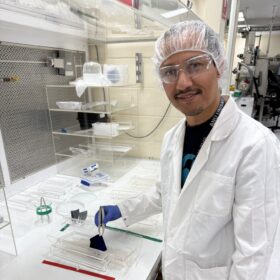
Antimony vs. phosphorous doping in solar wafer manufacturing
An international research team comprising scientists from Chinese module manufacturer Longi has investigated the resistivity distribution of antimony- and phosphorous-doped wafers used in solar cell manufacturing and have found that they offer comparable mechanical strenght. However, their work also showed that antimony-doped wafers have a more uniform resistivity, with a slight increase near the tail end.

ABB finalizes acquisition of Gamesa Electric
The Swiss group acquired Gamesa Electric’s power electronics business in Spain from Siemens Gamesa. The financial terms of the deal were not revealed.

New ultra-reflective color steel promises big efficiency gains for bifacial rooftop PV
Dongkuk CM has introduced an ultra-high-reflectivity color steel sheet designed to boost the performance of bifacial rooftop PV systems, increasing solar reflectance to 80–85. The new material also offers enhanced corrosion resistance, long-term durability, and added cooling benefits thanks to its advanced plating and dual-layer design, according to the manufacturer.
