Emiliano Bellini

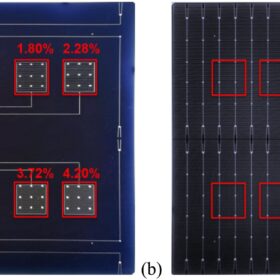
Jolywood’s laser-assisted firing process increases TOPCon solar cell efficiency by 0.6%, says UNSW research
New research from the University of New South Wales have found that the Special Injected Metallization (JSIM) technique developed by Chinese manufacturer Jolywood can considerably increase TOPCon solar cell efficiency. The scientists described precisely how laser-assisted firing enhances cell performance, reportedly filling critical gaps in industrial TOPCon cell optimization.

Credence Solar unveils 600 W TOPCon PV panel
India’s Credence Solar has unveiled the Hyper Nova N TOPCon module series available in power outputs from 580 W to 600 W with front-side power conversion efficiency of 22.45% to 23.25%, respectively.

Is solar really the root cause of Spain’s massive power outage?
Some media outlets have speculated that Spain’s April 28 blackout may have been caused by a disconnected solar plant, but DNV grid analyst Andrea Mansoldo tells pv magazine that it was likely due to a combination of grid weakness and low-frequency oscillations.

Takamiya launches vertical mounting solution for agrivoltaics, areas with little space
The Japanese company said its new vertical mounting system is ideal for farmland, regions with heavy snowfall, along factory fences, and in parking areas.

Spain’s nationwide blackout leaves millions in the dark, cause still unclear
Spanish energy expert Antonio Delgado Rigal tells pv magazine that while the exact cause of yesterday’s nationwide blackout in Spain remains unclear, preliminary signs point to grid instability triggered by system failure.
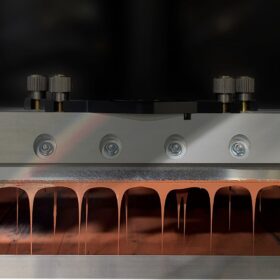
U.S. startup offers new solar cell copper metallization paste
Bert Thin Films has developed a copper paste for solar cell manufacturing that keeps the copper from oxidizing during the air-firing process while at the same time avoiding it to make direct contact with the silicon. The new product can be used in existing production lines and with different cell configurations.

Top cell transparency remains critical challenge for tandem solar cells
New research from Germany has shown how improving top-cell transparency and performance remains key to the commercialization of tandem perovskite-silicon solar cells, as well as for all other types of tandem devices. The analysis demonstrated, in particular, that the top cell must achieve higher single-cell efficiency to compensate for reduced transparency.

Viessmann launches new residential air-to-water heat pumps
The Germany manufacturer said its new heat pump systems use propane (R290) as the refrigerant and are able to provide a maximum flow temperature of 70 C. Their coefficient of performance ranges from 4.7 to 5.1.
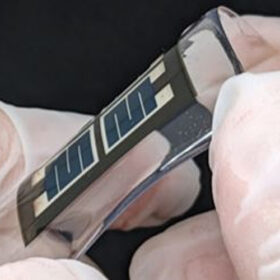
Japanese scientists build bendable perovskite-silicon tandem solar cell with 26.5% efficiency
The tandem device is based on a bottom thin-film heterojunction cell that can bend and a top perovskite cell that can be manufactured with a low-temperature process to prevent damage. It achieved the highest efficiency ever recorded to date for a flexible perovskite-silicon tandem solar cell.

Home batteries have same probability of catching fire as other appliances
New research from Germany shows that home batteries have much lower chances of being hit by fire than electric vehicles and most home appliances. The researchers warned, however, that fires in residential storage systems can be more dangerous than those of burning tumble dryers.
