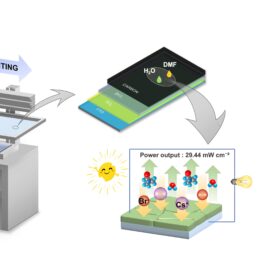
Chinese scientists improve carbon perovskite solar cell performance via dual-solvent process
A team of researchers in China has demonstrated a novel dual-solvent process in 4-terminal carbon CsPbBr3 perovskite solar cells that achieve 10.18% power conversion efficiency. They have also built a large area 17.88 cm2 device achieving an 8.72% efficiency while retaining 93.2% of the initial performance after 1,000 hours of operation at 150 C.
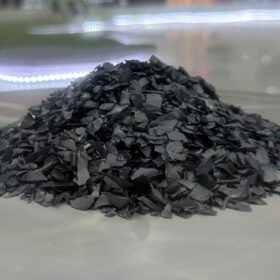
Chinese PV Industry Brief: GCL completes switch to FBR polysilicon production
GCL Technology has posted CNY 15.1 billion ($16.7 billion) in revenue and a CNY 4.75 billion net loss for 2024. The Chinese polysilicon and solar module manufacturer says its current annual capacity is 480,000 metric tons (MT).

Multi-constraint modeling for agrivoltaics
Researchers at Cornell University in the U.S. have developed a novel optimization model for agrivoltaic site design and benefits, which was demonstrated using irrigation-optimization relative to economic and environmental goals.

MCPV secures €10 million grant for 2.5 GW solar module factory in Spain
Netherlands-based MCPV, a silicon heterojunction PV manufacturer, is planning to build a GW-sized PV panel factory in Tudela, Navarra, Spain.
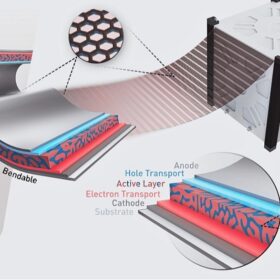
Turkish startup developing perovskite-organic tandem solar cell tech
Spacelis is developing lightweight, rollable space-grade perovskite-organic tandem solar PV technology targeting space and terrestrial portable energy applications.

Chinese PV Industry Brief: Tongwei secures $1.38 billion for polysilicon business
Tongwei says it will bring in strategic investors for its polysilicon subsidiary, Sichuan Yongxiang Co., raising CNY 10 billion ($1.38 billion) at a CNY 27 billion valuation, with investors acquiring a stake up to 27.03%.
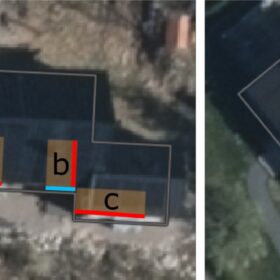
Using LiDAR data to improve modeling of PV system tilt, azimuth
Researchers in Sweden have developed a method to use LiDAR data to enable more precise tilt and azimuth modeling of solar PV and solar thermal capacity at a regional or substation level. The model could enable aggregators and grid operators to improve grid planning.
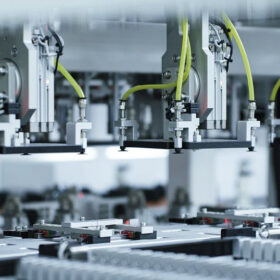
Chinese PV Industry Brief: JinkoSolar posts 19% spike in PV shipments in 2024
JinkoSolar says its global PV shipments grew 19.2% year on year to 99.6 GW in 2024, but revenue fell 22% to CNY 92.2 billion ($12.64 billion) due to a decline in module prices.
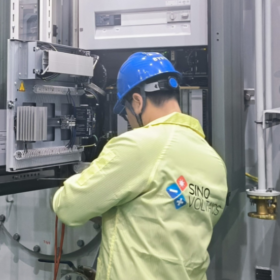
Sinovoltaics report maps 128 transformer factories in China
The technical compliance and quality assurance services firm has published a report describing the location and contact details of 128 transformer factories in China. The free publication is intended to help project developers identify manufacturers in the face of concerns about delivery delays.
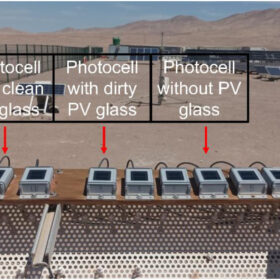
The effects of coal dust on solar PV plants
An international research team studied the solar PV impact of emissions from a coal-fired power plant in the Atacama Desert, finding that after five months of exposure, the deposited dust on co-located PV panels reached a maximum of 1.63 mg/cm2 with a 23 % reduction in photocurrent. The accumulation at the co-located plant was 3 times greater than nearby PV sites with similar coastal climate conditions.
