
To achieve net zero energy status, solar-powered buildings should not exceed 10 floors
Researchers in Canada have found that nearly zero-energy buildings (NZEBs) with on-site solar energy generation should not exceed an energy use intensity (EUI) of 50 kWh/m2a, which they said corresponds to a maximum of 10 floors. They also ascertained that the maximum permitted EUI by net-zero energy status is 17–28 kWh/m2a.
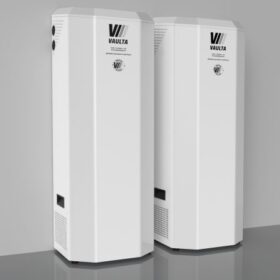
Australian manufacturer unveils 5.12 kWh battery for residential applications
Vaulta, an Australian battery tech company, has developed its first dedicated residential battery. The small-scale energy storage system can purportedly operate for 4,000 cycles, with an 80% depth of discharge.
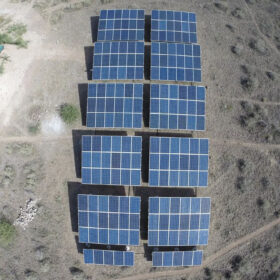
Building to last in the Global South
PV initiatives should be designed to last, as several well-meaning off-grid solar projects for the developing world have floundered over the years.
Phase-change thermoacoustic heat pump for residential, industrial applications
The novel heat pump, developed by a research group in Israel, consists of a loudspeaker, a resonator, and a thermoacoustic core placed inside the resonator. The core includes a cold heat exchanger, a stack, and an ambient heat exchanger.
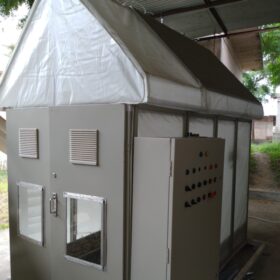
PV-driven controlled farming tech for non-electrified areas
Scientists from India conceived a new system for crop growth in remote areas with no connection to the power grid. It consists of a PV panel, add-on module hardware (AOMH), a battery, step-down DC-DC converters, system power devices, automation, and sensor elements. For climate control, it also comprises a water pump, a ventilation fan for CO2 assimilation, sprinkler foggers, and drop irrigation solenoids.
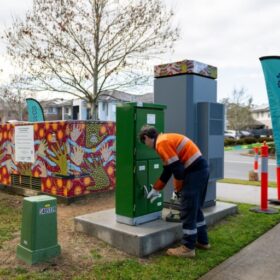
Australian grid operator testing community battery tech
A grid-connected community battery has gone live in Sydney, Australia, with New South Wales electricity distributor Endeavour Energy testing the tech to maximize the benefits of rooftop solar.
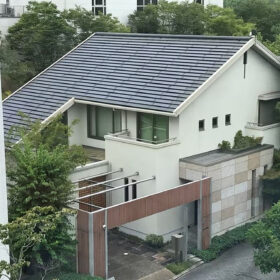
Japanese real estate firm starts residential solar hydrogen project
Sekisui House-W is testing a pilot project consisting of a residential PV system, a small-sized electrolyzer, hydrogen-absorbing alloy tanks, and a fuel cell. The company said the hydrogen storage alloys used in the project have higher energy density than battery storage.
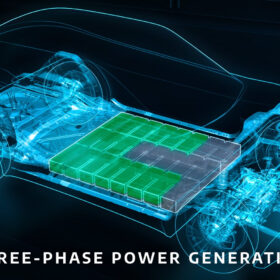
Stellantis, Saft unveil battery with integrated inverter, charger functions
After four years of development, French-Italian carmaker Stellantis, French battery company Saft, and the French National Center for Scientific Research (CNRS) have unveiled the Intelligent Battery Integrated System (IBIS), which integrates the electric charger and inverter functions. It can be used in automotive and stationary storage applications.
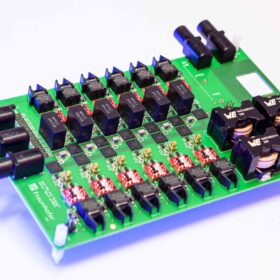
German research institute unveils 99.74% efficient power electronics for solid-fuel heat pumps
Germany’s Fraunhofer Institute for Applied Solid State Physics (IAF) has developed an ultra-efficient circuit topology for voltage converters with an electrical efficiency of 99.74%. The tech could considerably raise the coefficient of performance for electrocaloric heat pumps and the scientists are now considering components based on semiconductor gallium nitride (GaN) for higher power density and efficiency.
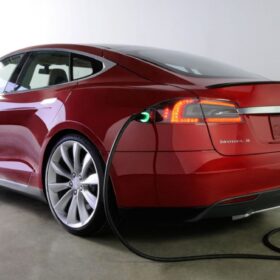
Tesla adds ‘Charge on Solar’ feature to Powerwall batteries
Tesla owners can select a feature in an app to set their Powerwall batteries to solely charge their vehicles on excess stored PV capacity.
