
The weekend read: Europe ramps up policy support for storage
Policy support for battery energy storage is gaining momentum across Europe as national governments remove regulatory barriers and the EU pledges financial support for this emerging technology. In several countries, revised capacity markets now allow energy storage operators to compete for subsidy contracts on a more equal footing with power generators. Support from the European Battery Alliance and €1 billion in loans from the European Investment Bank in 2020 alone should help shore up investor confidence. Battery storage will be a key component to support the growth of solar PV – but the rollout of projects will have to accelerate faster to fulfill this potential.

Tesla may become power provider in Germany
The high-profile electric car maker is conducting a survey of German customers to gauge their interest in a Tesla electricity tariff.

Covid-19 weekly round-up: Updates shed light on tough second quarter for solar industry firms
But Israeli inverter company Solaredge and Indian engineering, procurement and construction services provider Sterling and Wilson have both offered hope of a recovery in Europe as Chinese glass producer Xinyi said it kept the furnaces going throughout the worst of the pandemic.
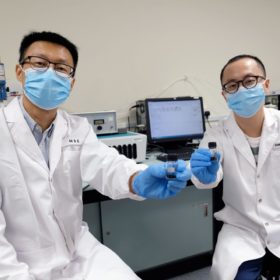
Low-cost catalysts for hydrogen production
Researchers in Singapore have taken a deep dive into spinel oxides – a class of materials known to act as a catalyst in the production of hydrogen through water electrolysis. Better understanding of how the materials work enabled the scientists to develop a machine learning model to predict their efficiency.

SolarEdge up 12% after hours on second-quarter revenue and solid earnings – despite Covid-19
The inverter and energy storage company was able to maintain its streak of profitable quarters in what was expected to be a hard period for solar and the Israeli business said it sees “signs of recovery in the U.S.”

Amorphous lithium discovery could lead to new high-performance batteries
Researchers have set out to study the kinetics of lithium deposition during cycling in a battery. By changing different parameters, they’ve found that it’s fairly easy to put lithium into amorphous form, which is superior on an electromechanical level.

A residential vanadium flow battery
Flow battery manufacturers typically pursue utility scale storage projects but German start-up VoltStorage is targeting the household market.

Perovskite structure also benefits batteries
Scientists at Germany’s Karlsruher Institute of Technology are leading an investigation into a new lithium-ion battery anode. The innovation has a perovskite crystalline structure and, according to the researchers, could provide strong all-round performance from simpler, cheaper production methods than those used for other anode materials.

Northvolt secures $1.6bn backing for twin battery gigafactories
In a little over ten years, Northvolt aims to pour 150 GWh of batteries onto the European market, annually. The company is also working to source end-of-life batteries for half its raw materials.
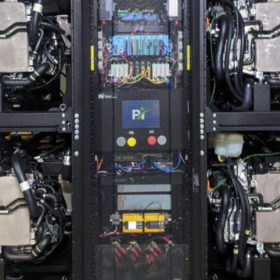
Microsoft trials hydrogen-powered data centers
The software giant has begun testing hydrogen fuel cells as a back-up power source at one of its U.S. data centers. A 250 kW pilot system successfully powered part of the facility for 48 hours and the company is now eyeing 3 MW systems to replace back-up diesel generators.
