
Spain’s Genera event dominated by PV as it draws the crowds
Spain’s most important renewable energy fair is becoming increasingly about solar. After a decade of slim pickings, last year’s event promised better times and, if this year’s show didn’t completely deliver, that’s because elections loom large.
India goes into overdrive with 6 GW tender plans announced in five days
SECI, the organization responsible for coordinating India’s push for 100 GW of new solar capacity by 2022, has had a busy week. But, as last year illustrated, tenders alone are not always a guarantee of new generation assets.
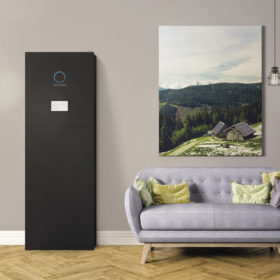
The weekend read: Just look who is closing ranks!
Owners of residential PV systems increasingly want more features. Virtual power plants, smart EV charging and self-consumption measured by ever higher percentages of self-sufficiency have been buzzwords in the industry. The result has been a new breed of smart bidirectional inverters, sometimes dubbed hybrid inverters. And with utilities having found business models that also work out in their favor, could a new dawn of residential installations rise over the world of suburbia?
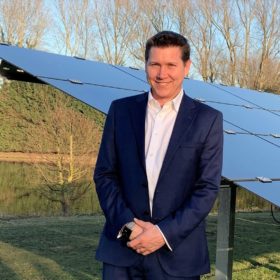
Gridserve to deploy 60 MW of bifacial-plus-tracking projects in the UK
Two sites with capacities of 34.7 MW and 25.7 MW will supply unsubsidized power to Warrington Borough Council. The smaller project will provide the local authority’s energy needs and reduce its electricity bill while the larger one will sell renewable energy on the open market, further bolstering council income.
Siemens wants to take over Kaco
After announcing its entry into residential storage a week ago, the Munich-based multinational has now unveiled a plan to acquire inverter manufacturer Kaco. Siemens has not provided details about the value of the transaction.

Dubai’s DEWA seeks proposals for phase V of 5 GW Mohammed bin Rashid Al Maktoum Solar Park
The utility has issued a request for qualification for a further 900 MW of PV at the huge solar park, which is set to reach a total capacity of 5 GW.

Medium and small power-to-gas conversion already viable
An international team of economists says power-to-gas may already generate hydrogen at costs competitive with fossil fuel power plants in Germany and Texas, provided certain production output levels are not exceeded. If medium and small power-to-gas is competitive, large-scale should be viable by 2030.

Brazil’s WEG acquires storage business of US-based NPS
The two companies entered a technological partnership in 2013 and three years ago the Brazilian company acquired the wind power business of its US peer.
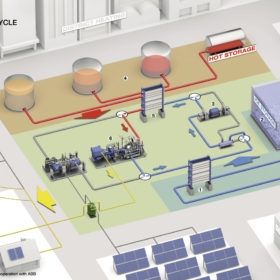
Storage Highlights Countdown #5; Thermoelectric energy storage – MAN Energy Solutions
In the run-up to the Energy Storage Europe conference pv magazine is featuring the top ten developments in the field as our Energy Storage Highlights, selected by an independent jury of experts. Last week we revealed #6, a ’70s revival of a ceramic high temperature battery.
Europe’s 100% renewables dream needs a flexible grid concept and more storage
A European energy system powered solely by renewables is economically feasible, according to a study which suggests decentralized energy systems operating within the framework of a stronger pan-European energy trade could reduce the cost of electricity from the €69/MWh price seen four years ago to around €51 in 2050.
