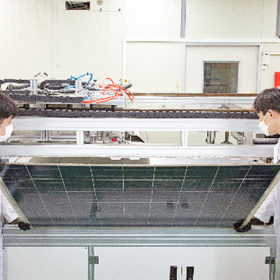
Novel PV module recycling tech from South Korea
Developed by the Korea Institute of Energy Research (KIER), the “non-destructive” technology is claimed to enable the recovery of 100% of a module’s glass and to allow the reuse of silicon for producing new solar cells with an efficiency of 20.05%.

The world’s hottest heat pump
A Norwegian consortium has built an industrial heat pump that can reach a temperature of up to 180 degrees Celsius. The machine can be used with different industrial processes that rely on steam as an energy carrier and can reduce a facility’s energy consumption by between 40% and 70%, as it enables the recovery of low-temperature waste heat.

Perovskite-silicon tandems could rapidly scale solar
Halide perovskites combined with conventional silicon could help solar break the 26% efficiency barrier – disrupting the technology without disrupting business systems.
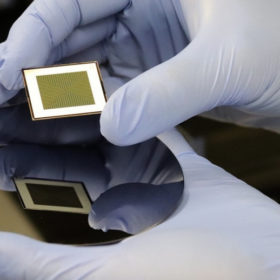
Australian researchers develop bifacial solar cell with 96.3% bifacial factor
Australian National University researchers claim to have set a world record for bifacial solar cell efficiency that they say could boost the energy output of solar farms by 30%.
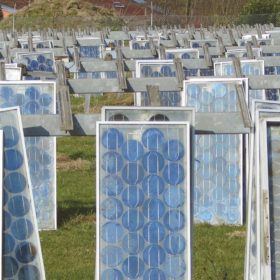
Blockchain for PV module recycling
Next Energy and Marubeni are developing a blockchain tech for PV module inspection – with the support of the Japanese government – which they claim is able to provide data on a panel’s traceability and components as well as verifying that the data were not modified or tampered with.
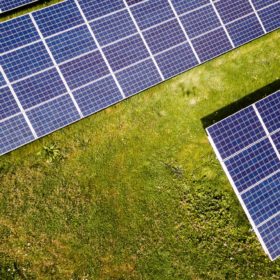
China made 14 GW of solar modules in June – and more than 80 GW in six months
The nation produced 57% more solar cells in the first half of this year than in the same period a year earlier, according to a financial update from state-controlled manufacturer Luoyang Glass.
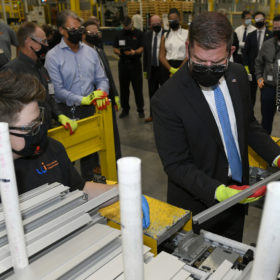
First Solar breaks ground on 3.3 GW module factory
First Solar has started building a new PV module factory in the U.S. state of Ohio. The $680 million facility is scheduled to start operations in the first half of 2023.

Solar modules are being detained by US customs agents, reports suggest
An order issued in late June instructed US customs agents to detain solar shipments containing silica-based products sourced from a Chinese firm and its subsidiaries. Three solar players may already have been impacted.

The Hydrogen Stream: big push from UK, European Union
U.K. business and energy secretary Kwasi Kwarteng has unveiled a new hydrogen strategy aiming at developing both the green and blue forms of the fuel. Furthermore, Thierry Breton, the EU commissioner for the internal market, has said Europe needs to increase its commitment to hydrogen and use nuclear to produce a decarbonized form of the gas.

Chinese PV Industry Brief: Work begins on 12 GW heterojunction module factory in Zhejiang
Furthermore, Zhonghuan Semiconductor’s parent company has reported strong results for its PV business and solar developer Shunfeng has halted trading in its shares.
