
Philippines accelerates permits for solar net-metering
The government of the Philippines has announced a series of reforms to its net-metering scheme, including faster permitting, the introduction of multi-site and aggregate net-metering, as well as allowing qualified end users to retain ownership of Renewable Energy Certificates for trade on the Renewable Energy Market.
Indonesia’s solar capacity reaches 1.49 GW
Indonesia surpassed 1 GW of cumulative solar capacity in 2025, with an estimated 546 MW of added solar last year, led by deployments in the rooftop C&I segment.

U.S.-India trade deal reduces solar tariffs
Tariff reductions under the new U.S.-India trade agreement lower import costs for solar modules and energy storage components. Reciprocal tariffs were effectively reduced from 50% to 18%.
Germany, France, Netherlands curtail 3.9 TWh of renewables in 2025
Analysis by energy advisory service Montel finds Germany, France and the Netherlands all saw record levels of renewables curtailment last year, with the build out of solar in each market contributing to midday generation peaks and consequential price cannibalization.

Finland adds 227 MW of utility-scale solar in 2025
Finland’s large-scale solar capacity more than doubled in 2025, buoyed by the commissioning of the country’s first solar projects larger than 50 MW. Another record year for ground-mounted solar is expected this year but a forthcoming Land Use Act risks threatening future projects.

Key takeaways from Solar Flex Prague
Czechia’s first international conference on solar and flexibility highlighted that the combination of solar with storage and flexibility sources is key to not just Czechia’s, but also Europe’s, secure and competitive electricity system.

Bulgaria installs 1.4 GW of solar in 2025
Bulgaria installed over 1 GW of solar for the third consecutive year in 2025 and is forecast to add over 2 GW this year thanks to a large pipeline of utility-scale projects.

Sweden deploys 652 MW of solar in 2025
Sweden deployed less solar in 2025 than the year prior despite record growth in the large-scale segment. Solar association Svensk Solenergi predicts last year was likely the bottom of Sweden’s installation curve.

Netherlands’ 2025 solar additions estimated at 2.08 GW
Provisional estimates from Dutch New Energy Research indicate the Netherlands added 0.54 GW of residential solar and 1.54 GW of C&I and large-scale solar last year, taking the country’s cumulative capacity to just shy of 30 GW.
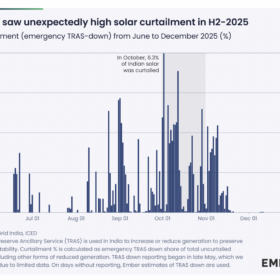
India curtails 2.3 TWh of solar between May and December 2025
A report by energy think tank Ember finds India’s system operator regularly had to curtail solar generation as an emergency measure to maintain grid security, as other resources were already flexing to their maximum capabilities.
