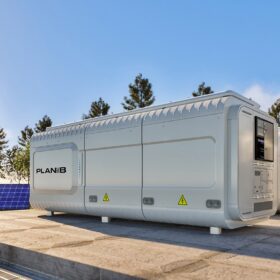
Plan-B Net Zero combines battery storage and hydrogen storage in new concept
The Swiss startup presented the battery plus hydrogen idea to a Symposium this week.

The Hydrogen Stream: Japanese researchers develop green rust catalyst
Japanese researchers have developed a green rust–based catalyst for sodium borohydride, while South Korean scientists have created a framework to assess liquid hydrogen storage tanks for unmanned aerial vehicles (UAV).

Namibia approves 3 GW of solar for hydrogen production
The Namibian government has granted an environmental approval for a 3 GW solar farm. The energy generated is set to be used for green hydrogen and green ammonia production.
Seven projects pulled from EU hydrogen fund
The projects, equivalent to 1.88 GW of electrolyzer capacity, were withdrawn after choosing not to continue with the agreement procedure or for being unable to provide a signed completion guarantee. As a result, ten hydrogen projects representing 774 MW in capacity from the reserve list have been invited to prepare grant agreements.

The Hydrogen Stream: Japanese researchers develop low-temperature hydrogen battery
Institute of Science Tokyo researchers proposed a battery with magnesium hydride (MgH2) as the anode and hydrogen (H2) gas as the cathode. Meanwhile, researchers at Chung-Ang University proposed chloride-resistant ruthenium (Ru)-based nanocatalysts for direct electrolysis and hydrogen production from seawater.

Hydrogen can mitigate curtailment in floating PV-pumped hydro energy storage systems
Scientists at Italy’s University of Cagliari explored the integration of a water electrolyzer with a floating PV-pumped hydro energy storage system. They found that under high curtailment conditions, hydrogen production helped to stabilize system efficiency and lower the levelized cost of electricity when compared to a system without the electrolyzer.
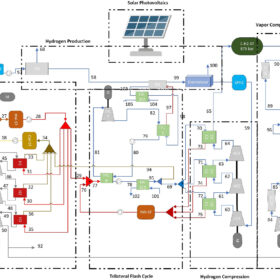
The Hydrogen Stream: Qatari team outlines solar hybrid station design
Qatari researchers tell pv magazine that they have designed the world’s first hybrid station concept combining PV, liquid air, hydrogen storage, and batteries for EV charging and hydrogen refueling.
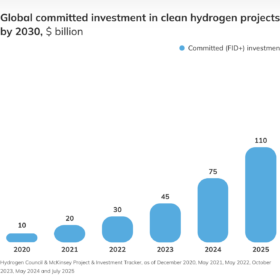
Global H2 investment tops $110 billion, says Hydrogen Council
Global hydrogen investment has topped $110 billion, up $35 billion from last year, with total committed capacity exceeding 6 million tons (metric tons) per year (mtpa), says the Hydrogen Council.

Powering ferries with floating PV, hydrogen
Scientists in Malaysia have conducted a techno-economic-environmental study of a green fueling system for a ferry that runs between islands in their home country. Using 40,000 solar panels, they were able to power two round trips round-trips per day. Annual CO₂ reduction was measured at 23.75 million kg.
The Hydrogen Stream: France, Germany back nuclear H2, Southwestern Corridor
France and Germany have pledged support for the Southwestern Hydrogen Corridor and have agreed to collaborate on nuclear-based hydrogen support and joint research.
