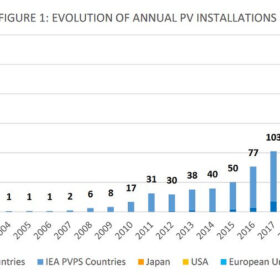
Global solar installations hit 240 GW in 2022
IEA-PVPS has used an improved methodology to determine that newly installed PV capacity in 2022 must be somewhere between the 190 GW calculated by the International Renewable Energy Agency (IRENA) and the 268 GW announced by BloombergNEF. Its new “Snapshot of Global PV Markets 2023” report was built on data from a range of sources, including grid-connected and off-grid figures.
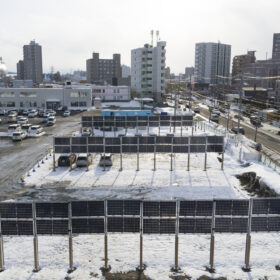
New vertical PV system for parking areas
German module maker Luxor Solar and Japan’s AirWater are selling vertical PV systems for parking areas that can reportedly provide the same energy yield as conventional PV carports, but with less space. The system features 460 W heterojunction solar panels, power optimizers, and vertical racks.
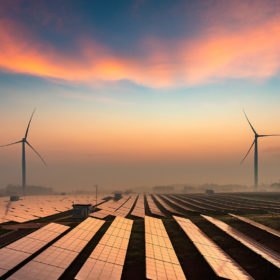
Average solar LCOE increases for first time this year
A new report by Lazard compares the levelized cost of energy (LCOE) for various generation technologies on a $/MWh basis. It shows that utility-scale solar and onshore wind LCOE increased for the first time in 2023, at $24/MWh to $96/MWh for solar and $24/MWh to $75 MWh for wind. Nevertheless, the two renewable sources are still the economic frontrunners when compared to nuclear, gas, and coal.
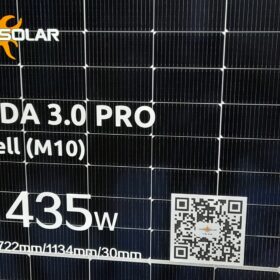
Yingli releases 435 W n-type TOPCon solar panel with 22.28% efficiency
Yingli is offering six versions of its 108-cell Panda 3.0 PRO modules, with power outputs ranging from 410 W to 435 W and efficiencies ranging from 21.0% to 22.28%.
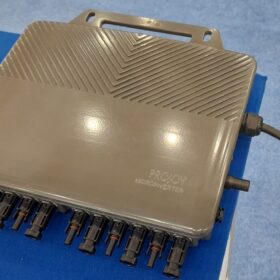
Projoy unveils microinverter to link up to 8 solar panels
Chinese manufacturer Projoy is selling a new microinverter with maximum power point tracking (MPPT) and power outputs ranging from 2.2 kW to 3 kW. The smallest version can can connect between four and eight solar panels, while the largest can link seven to eight modules.

Latest French PV tenders show clear upward price trend
The French authorities selected 16 projects (58 MW) in the third round of rooftop PV tenders, at an average final price of €104 ($114.30)/MWh, up 15% from the September 2022 tender. The authorities selected seven ground-mounted projects, or 115 MW of capacity, at an average price of €82.2/MWh, up 20% from the last tender.
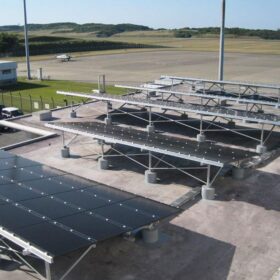
Japanese oil suppliers testing solar carports for EVs under PPA model
Idemitsu Kosan is leading a four-year demonstrator to assess the viability of solar carports for EV recharging at Tanegashima Airport in Japan. The 54.7 kW solar facility will sell power to airport buildings via a power purchase agreement (PPA) and to EV users under a pay-as-you-go billing system.

Storing renewables with aquifer thermal energy storage
US scientists have looked at how aquifer thermal energy storage (ATES) could be used to store wind and solar power, while catering to heating and cooling energy demand during extreme hot or cold periods. They modeled a distributed energy system for a neighborhood in Chicago and found that ATES could reduce consumption of petroleum products by up to 40% at a slightly higher cost than other forms of storage.
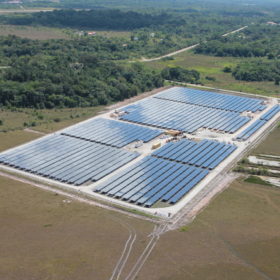
France to offer 2.3 GW of solar in tenders in June
The French government has announced the launch of a tender for 1.5 GW of ground-mounted PV and another tender for 800 MW of rooftop capacity, in order to compensate for the high failure rate of the third round of tenders for large-scale PV plants.
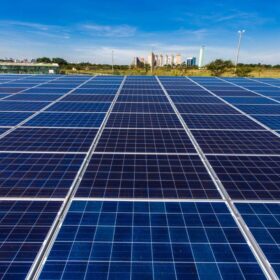
Solar exceeds 28 GW in Brazil, including 20 GW of distributed-generation PV
Brazilian developers have already installed at least 2.1 GW of distributed-generation solar and more than 1.3 GW of centralized PV this year. At this average pace of 21.1 MW per day, installers could build 7.71 GW of distributed-generation PV in 2023.
