
Photovoltaics, heat pumps to rescue failed geothermal project in Poland
The Polish government is supporting a hybrid renewable energy project based on a deep-borehole heat exchanger (DBHE) whose heat pumps are powered by photovoltaics. The heat generated by the facility will be used for district heating.
Transposition of new EU laws could increase scope of energy communities in Italy, says ENEA
Energy communities, recognized and supported in Italy’s National Recovery and Resilience Plan, could soon increase their role in the country’s energy transition, Italian research agency ENEA told pv magazine.
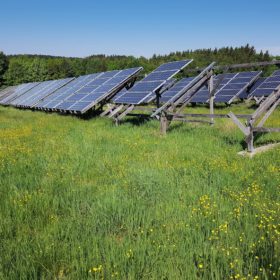
Computational model for agrivoltaics
A U.S. scientist has developed a computational framework that assesses how well a hypothetical agrivoltaic project would perform in achieving desired outcomes such as the volume of PV electricity produced, and energy-to-agriculture. The method considers the high-frequency decomposition of solar irradiance into multiple rays and analyzes how these rays are propagated forward in time, to assess multiple reflections and absorption for various system configurations. It also takes into account panel inclination, panel refractive indices, sizes, shapes, heights, and albedo.
Indian highway to host 250 MW solar plant
The Global Green Growth Institute (GGGI) has helped to secure finance for the development of a 250 MW solar plant on a highway in India. The project will support electric vehicle charging and other energy requirements along the roadway.
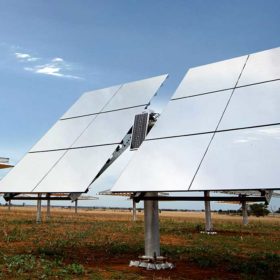
Australia to host 50 MWh ‘solar hydro’ plant with storage
RayGen Resources has secured funding to build a 3 MW/50 MWh ‘solar hydro’ power plant that could become one of the largest, lowest-cost storage projects in Australia.
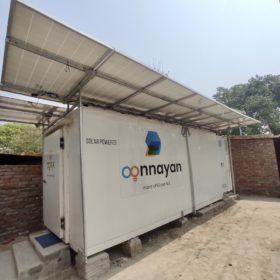
Solar-powered cold storage service
Small farmers in the Indian state of Bihar are making productive use of solar energy to reduce their losses and increase their income, thanks to an innovative pay-per-use cooling service for perishable produce.

Romania sees first green bonds
World Bank arm the International Finance Corp has now extended almost €76 million of credit into two sustainable lending facilities launched via Raiffeisen Bank.
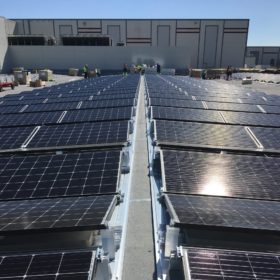
PV modules degrade less in Nordic climates
Norwegian researchers have used a year-on-year approach, considering the combined effect of temperature, humidity, and ultraviolet irradiation, to assess the degradation rate of polycrystalline modules with a temperature coefficient of -0.43%, mounted with an approximately 10-degree tilt, and located in eastern Norway. They found that these modules degrade in the range in the range of 0.1-0.19% per year, which is 0.4% less than panels operating in other climates.
Tennet begins internet-of-things grid balancing project
Household heat pumps, EV chargers and rooftop solar panels will be able to earn their owners benefits in return for helping to balance grid networks struggling to accommodate new solar and wind power generation.
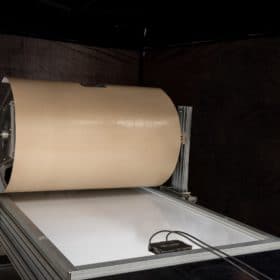
A repair tape for cracked backsheets
Backsheet failures have plagued the industry, causing hefty financial burdens to many asset owners. DuPont has launched a product it says allows for easy repair of modules.
