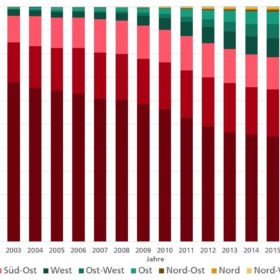
Growing interest for PV arrays with eastern and western orientation in Germany
A report from Fraunhofer ISE reveals that the share of PV systems with southern orientation has decreased from 61% in 2000 to 42% in 2019. It also highlights that solar rooftop installations with a tilted angle lower than 20 degrees have increased from just 5% in 2000 to 24% in 2019.
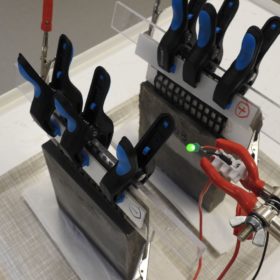
Concrete battery for applications in buildings, rooftop PV
A prototype of a cement-based battery has been developed in Sweden for potential applications in buildings. Its creators claim it could become a solution to store electricity from rooftop PV and they do not exclude that it could also be used for the storage of large-scale renewables.
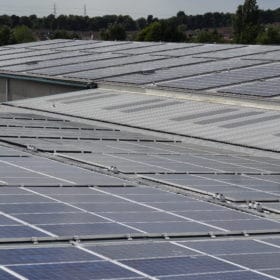
IEA calls for annual additions of solar PV to reach 630 GW by 2030
According to the International Energy Agency, most of the global reductions in CO2 emissions between now and 2030 would come from technologies available today. In a recent report, the agency sets what it described as a “cost-effective and economically productive” pathway resulting in an energy economy “dominated by renewables like solar and wind.”
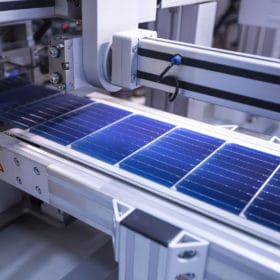
Chinese PV Industry Brief: Datang reveals results of 5 GW procurement tender
Longi is also planning to raise US$1.09 billion to support its plans to increase PV cell capacity, and Talesun has secured a solar module supply agreement from the United States.
PHV opens factory in Saudi Arabia
The new manufacturing facility will be operated by the newly created unit PV Hardware Middle East. It will produce trackers, mounting structures, and cleaning robots for the Saudi solar market.

The Hydrogen Stream: Ørsted kicks off first project, ArcelorMittal moves towards blue hydrogen
A Greek consortium is also planning to invest €8 billion in the domestic production of hydrogen and the French city of Dijon is launching a €100 million euro green hydrogen project to reduce the CO2 emissions of the territory’s public transport starting in 2023.
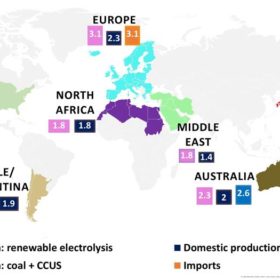
Geopolitical impact of long-distance transport of electricity and hydrogen
In an interview with pv magazine, Indra Overland, the head of the Center for Energy Research at the Norwegian Institute for International Affairs, explains how long-distance electricity and hydrogen transport differs from that of fossil fuels. He says strong Europe-North Africa connections could prove the viability of cables to connect continents, and notes that integration between countries and regions will increase.

Giant wind-solar complex to produce hydrogen in Oman
An international consortium led by Omani oil company OQ is planning a 25 GW wind-solar complex to produce green hydrogen in the central region of the Middle Eastern country. The clean fuel could be consumed on-site, used to produce green ammonia, or exported to other markets.

Green hydrogen venture aims for $1.50/kg for Los Angeles by 2030
HyDeal LA includes the Los Angeles Department of Water and Power and aims to overcome green hydrogen’s high cost by launching a commercial hydrogen cluster at scale.
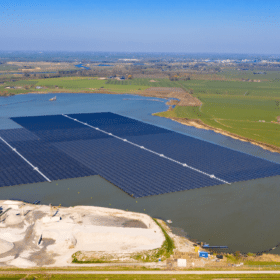
Water quality untouched by floating PV
Baywa re and Dutch researchers have evaluated the first positive effects of floating PV on the flora and fauna in water. They have also ascertained that the erosion of a lake’s banks has decreased.
