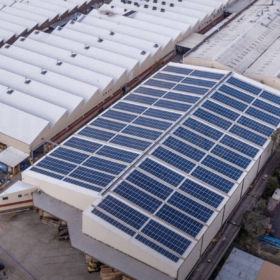
Australian manufacturer shares excess PV generation with staff
Hunter Douglas, a blinds and awnings manufacturer, will use the Enosi Powertracer platform to direct its oversupply of rooftop solar to its workforce.

Rooftop solar, storage and EVs in India
The combination of rooftop solar and storage is a big opportunity. A new report highlights Australia – a nation with the world’s highest per capita rooftop PV capacity – as a guide for Indian policymakers.
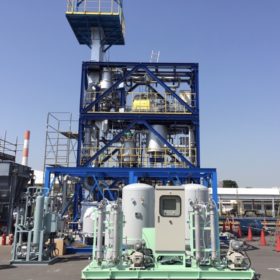
The Hydrogen Stream: Projects move forward in China, Japan, Australia and across several European countries
Sinopec wants to build 1,000 hydrogen refueling stations by 2025. Ways2H is building a facility in the Tokyo area that will convert daily 1 ton of dried sewage sludge into 40-50 kilograms of hydrogen for fuel cell mobility and power generation. Ørsted wants to deploy two renewable hydrogen production facilities for a total of 1 GW by 2030. Wacker Chemie is planning to produce green hydrogen and renewable methanol at its German site.
Xinte highlights Chinese polysilicon ‘oligopoly’
The TBEA-owned poly manufacturer has predicted further consolidation as it aims to ramp up output with another 100,000 tons of annual production capacity.
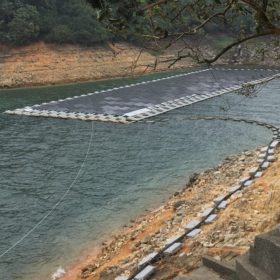
Australian utility to build floating PV plant, 200 MW battery
AGL Energy has revealed plans for a floating PV project at its Loy Yang power station in Victoria, Australia. The energy giant is already producing brown hydrogen for export to Japan, and has applied for a 200 MW battery at the Loy Yang site.
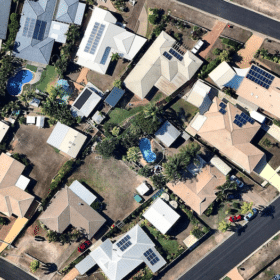
Australian researchers target rooftop solar in hunt for grid security
The University of New South Wales is leading a new research project to determine how rooftop solar PV and other distributed energy resources, including small-scale batteries, can be integrated into Australia’s power grid.

Bangladeshi garment makers advance efforts to go green
The government’s clean power department has signed a co-operation agreement with a major clothing industry trade body in a bid to drive net-metered solar rooftop installation.
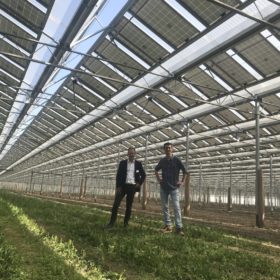
French photovoltaic greenhouse delivers 3.1 GWh and 4 tons/hectare of asparagus in one year
The solar greenhouse was built by French developer Tenergie in 2017 and last year recorded a remarkable performance in terms of both agricultural ane electricity yield.

Greece’s recovery plan to invest €10bn in clean energy
The Greek government has published its plan for a post-Covid economic recovery. The strategy aims to mobilize at least €10 billion towards the green energy sector, with the prospect of further EU loans on top.

Commercial HJT solar cells could hit 26% efficiency by 2030
Arvind Shah, a professor at École polytechnique fédérale de Lausanne, and Meyer Burger former Chief Innovation Officer Sylvère Leu recently spoke to pv magazine about the future of heterojunction PV modules. They said the tech is mature and can now compete on cost with PERC panels in projects – particularly in hot, humid environments.
