
Solar, storage-centric approaches to DC coupling
A new white paper by Alencon outlines the differences between PV-centric and battery-centric coupling.

Analysis: Initial results of Portugal’s solar+storage auction
Portugal’s recent PV auction marks a new era of battery storage for the country, says UK consultancy Everoze. It notes that the auction was so competitive that the winners had to cut their expected remuneration in the solar+storage category to negative values. It claims that the real winner is the government, as it is maximizing the value of scarce grid capacity, and argues that the auction could become a benchmark for nations with limited grid space.
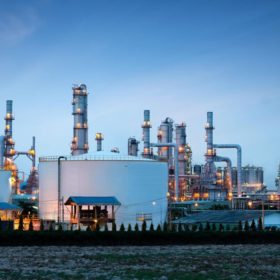
Renewables-powered 25 MW electrolyser at Dutch port
The large-scale green hydrogen facility is being developed by Dutch energy company VoltH2 at the North Sea Port. The project is planned to be expanded to 100 MW.

EBRD may finance ACWA’s 200 MW solar plant in Egypt with $54 million loan
The $155,4 million project was secured by the Saudi energy giant through a tender held in 2019. The facility will sell power at a price of $0.02752/kWh.
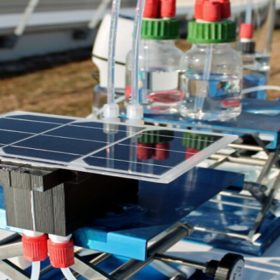
Different combinations of PV-powered electrolysers
An EU-funded research project coordinated by German research institute Helmholtz-Zentrum Berlin has tested several configurations for solar-powered hydrogen generation. First results showed which may be the most suitable PV technologies for electrolysis.
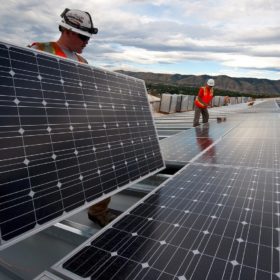
Repositioning Australian rooftop PV
A University of South Australia study has shown that solar owners selling electricity to the grid should position their panels to minimize the discrepancy between peak use and peak production.
Chinese PV Industry Brief: New EVA encapsulant factory, 1 GW PV pipeline
Cybrid, a Shanghai-listed backsheet supplier, will open a new EVA encapsulant factory in Zhejiang province. Datang, meanwhile, has revealed plans to build 1.05 GW at 10 sites across three provinces.
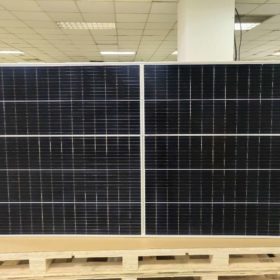
Light and shade of 500 W plus solar panels – part II
In the second article in a series, pv magazine editor Pilar Sánchez Molina and industry experts keep discussing the challenges and opportunities created by new panels with power output exceeding 500 W.
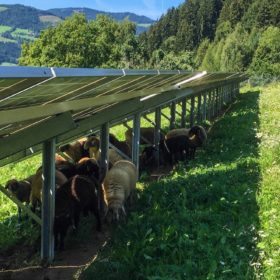
Solar projects enable biodiversity
Eco-Tec, an Austrian PV company, is cooperating with a startup, Meine Blumenwiese, to ecologically upgrade ground-mounted solar projects. The two companies aim to generate clean energy while also creating new habitats for a range of insects and animals.

Niger holds firm on plan to build solar park at diesel-fueled thermal plant
The solar plant is expected to have a capacity of up to 60 MW and will be located at the 100 MW Gorou Banda thermal power station commissioned in 2017.
